A Magnetic Pattern That Rewrites the Rules of Electricity express
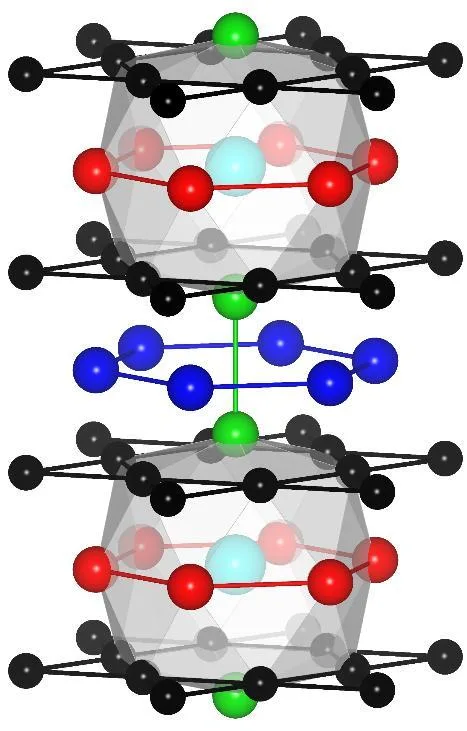
If you toss a handful of coins onto a table, they land in a jumble. But in some crystals, atoms arrange themselves into a pattern reminiscent of a woven basket — the kagome lattice. In the metal MgMn₆Sn₆, manganese atoms form such a lattice, and at room temperature they act like tiny magnetic needles. Only these needles don't point strictly in one direction; they fan out slightly within the plane of the layer. This was observed using neutrons — particles that sense magnetic order.
This "fan-like" magnetization makes electrons move not straight ahead but with a sideways drift — giving rise to the Hall effect (a transverse voltage). Its intrinsic part, related to the geometry of electron orbits, reaches 0.29 conductance quanta per kagome layer and barely changes when the magnet is rotated. Upon cooling, an additional contribution appears that depends on the field direction. It arises from how electrons scatter off magnetic inhomogeneities — regions with different magnetization.
Such a material is like a laboratory in the palm of your hand: you can study how magnetic patterns and electronic correlations together control electric current. Perhaps this is a step toward devices where information is carried not by charge but by magnetic texture — almost losslessly. And then a handful of coins scattered on a table becomes an intricate pattern through which current flows without resistance.
Original abstract
as written by the authors arXiv:2605.07904
Magnetic kagome metals provide a fertile platform for exploring unusual magnetotransport phenomena arising from the intricate interplay between electronic topology, electron correlations, and magnetic order. MgMn6Sn6 is a room-temperature kagome ferromagnet with strong in-plane magnetic anisotropy. Here, we report a combined study of single-crystal neutron diffraction (SCND) and magnetotransport properties of MgMn6Sn6, supported by first-principles calculations. Our SCND measurements reveal a non-collinear arrangement of Mn magnetic moments within the basal plane of the kagome bilayer. The Hall conductivity shows a substantial intrinsic contribution of approximately 0.29 e^2/h per kagome layer, which is nearly isotropic with respect to the field orientation. At low temperatures, the anomalous Hall conductivity develops a pronounced anisotropic extrinsic component, highlighting the directional sensitivity of scattering processes. The significantly large value of the Sommerfeld coefficient, in the absence of f-electrons, underscores enhanced electron correlation. Therefore, the non-collinear kagome ferromagnet MgMn6Sn6 is a promising candidate for studying the effects of electron correlation on magnetotransport properties.
The kagome lattice is named after a Japanese basket-weaving technique: its pattern of interlocking triangles prevents atoms from lining up in a simple row, creating a magnetic "tangle" that gives rise to unusual electrical properties.