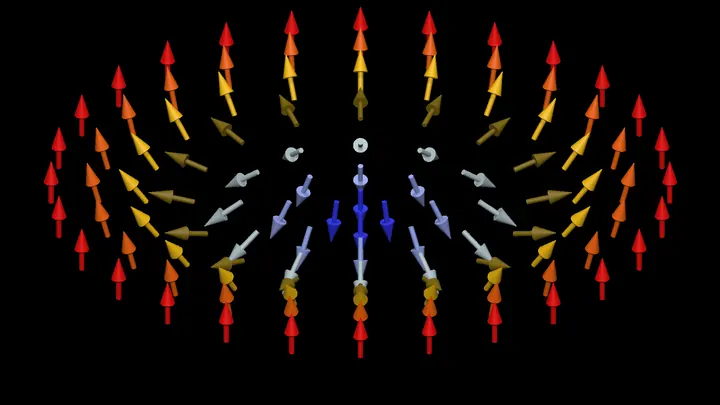
Magnetic textures are the ordered patterns of magnetic moments (spins) that emerge in magnetic materials at the atomic scale. Unlike a simple uniform magnet, where all spins point the same way, a magnetic texture can be a swirl, a spiral, a vortex, or a more complex topological structure. These patterns are governed by relativistic effects, specifically spin-orbit coupling, which ties the spin direction to the crystal lattice and leads to interactions like the Dzyaloshinskii-Moriya interaction that favor twisted spin arrangements.
History
The concept of magnetic textures as topological objects gained prominence in the 1980s–1990s, with theoretical predictions of skyrmions in magnetic materials by Bogdanov and Yablonskii (1989) and later experimental confirmations in the 2000s. The role of relativistic effects was recognized earlier through the Dzyaloshinskii-Moriya interaction, proposed by Dzyaloshinskii in 1958 and Moriya in 1960.
How it works
In a crystal, the arrangement of atoms and the relativistic interaction between electron spin and orbital motion create an energy landscape. For certain materials, the lowest energy state is not a uniform magnetization but a smoothly varying twist of spins. The specific texture that forms depends on the balance between exchange interaction (which aligns spins), anisotropy (which pins them to certain axes), and the relativistic antisymmetric exchange (which twists them). The result can be a skyrmion, a vortex, or a helical spin wave, each with a distinct topology that makes them stable against small perturbations.
In practice
Magnetic textures are used in spintronics — for example, skyrmions are considered promising bits for racetrack memory, where data is moved along a wire as a series of stable spin swirls, offering high density and low power consumption.
Fun fact
Some magnetic textures, like skyrmions, are so topologically stable that they can be moved with electric currents and are considered candidates for 'topological protection' — they cannot be easily destroyed by local perturbations.
A door lock with two different keys: one turns easily, the other demands noticeable effort. That is how two layers of hexagonal boron nitride behave when twisted relative to each other. This material consists of boron and nitrogen atoms arranged in a hexagonal lattice, and its layers can sit in different registries, like two identical grids shifted by different angles.
A vortex in a magnetic material is like a whirlpool, but instead of water, the directions of magnetization twist. An electron flying through such a vortex feels not just a magnetic field, but a curvature of space: its path bends as if it were rolling down a funnel with a narrow neck.
A piece of metal smaller than a millimeter, when cooled to minus 256 degrees Celsius, behaves like a kaleidoscope: in one corner, magnetic arrows align in neat rows, while in a neighboring corner, they twist into a screw. This was observed by directing a narrow X-ray beam at the sample and slowly sweeping it across the surface, like a flashlight along a dark wall.
Two transparent sheets with circles drawn on them. If you stack them exactly, the circles align. But give one sheet a slight twist, and a new pattern emerges: in some places the circles bunch together, in others they spread apart. That's roughly how moiré works — an unexpected pattern born from rotating two periodic structures.
A stone falls into still water, and smooth rings spread across the surface. If the stone doesn't just fall but also spins, tiny whirlpools, vortices, appear on the surface. Light can do the same, only instead of water, it's space and time themselves.
Magnetic vortices just tens of nanometers across are like tiny tornadoes frozen in metal. Called skyrmions, they are remarkably stable: hard to destroy but easy to move. That's why engineers see them as ideal 'bits' for future memory — fast, energy-efficient, and resilient.
But until now, no one knew how such a vortex is structured within the material's depth.
A spiral staircase sets the rhythm of footsteps: if a stream of people runs up it, their motion inevitably twists. Something similar happens in helical molecules — for example, in DNA or certain proteins. When an electric current is passed through such a molecule, electrons don't just fly straight.
Run a current through a spring of organic molecules, and the electrons that come out are almost all spinning the same way. This trick is called chiral spin selectivity, and it has long puzzled physicists. In light atoms, spin (the particle's intrinsic rotation) is too weakly coupled to charge motion to achieve nearly perfect sorting.
Inside a neutron star, matter is compressed so intensely that atomic nuclei fuse into long strands and flat sheets. Astrophysicists call these structures nuclear pasta. At their surface, the density of matter plummets to nearly zero, like diving out of thick jelly into thin air.
It's this sharp transition that creates the unusual effect.
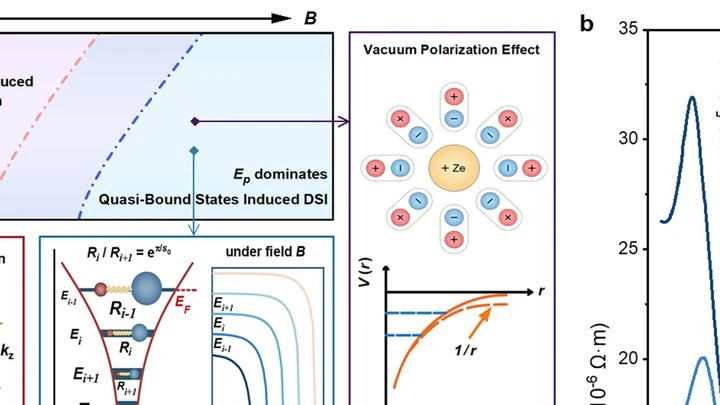
According to the Standard Model, the vacuum is not emptiness but an ocean of virtual ghost particles. An ultra-strong electromagnetic field, like a storm, yanks electron-positron pairs into reality.
In a field trap, scientists assembled a crystal — 150 ions at ultra-low temperature. Each ion behaves like a tiny magnet, capable of rotating in any direction. By controlling forces that depend on this rotation, physicists made all the magnets swirl into a common vortex called a skyrmion.
In the crystal HfTe5, electrons behave almost like light: their mass is so small that they obey the laws of relativity. If you place such a crystal in a strong magnetic field, the electrons start to circle in tiny orbits. Their energy then changes not smoothly but in steps, like floors in a building.
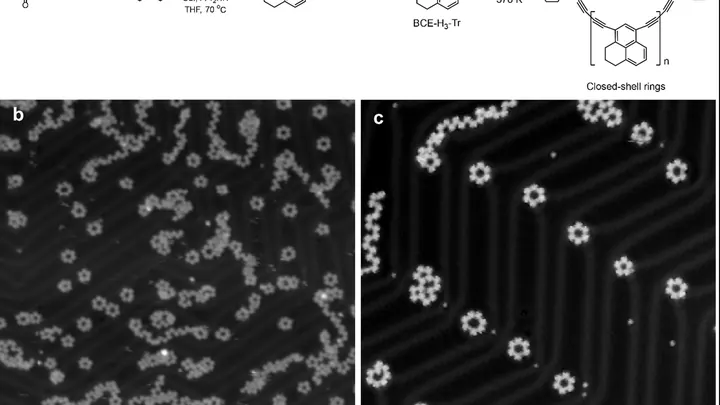
A ring of magnetic atoms resembles a round dance where each participant holds hands with their neighbors. In ordinary magnets, each atom has its own permanent magnetic moment, and they interact like little arrows striving to align opposite to each other.
Two layers of a magnetic material, rotated relative to each other by fractions of a degree, like two slightly offset screens on a window. In their normal state, they don't produce anything special, but at a certain twist angle, an unexpected effect emerges.
A crystal the size of half a matchbox was grown in a furnace, where a molten zone slowly crept along a rod, leaving perfectly ordered layers behind. Inside this crystal, copper ions sit at the nodes of a triangular lattice, but the triangles are slightly skewed, as if someone pressed on one corner. Each copper ion behaves like a tiny magnetic needle that can point up or down.
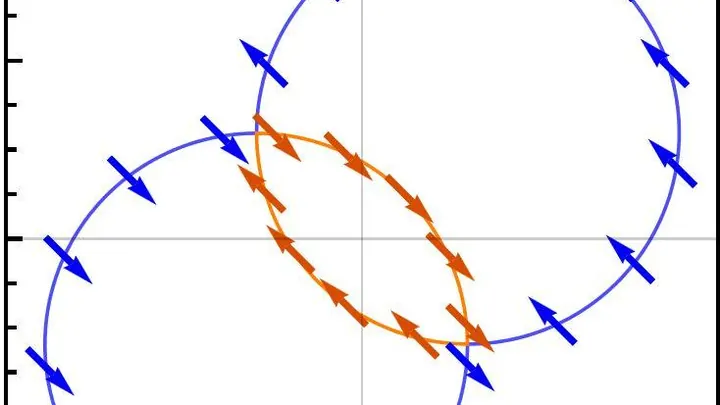
An electron is not just a tiny ball; it also spins around its own axis like a top. Under normal conditions, these tops point in random directions and quickly get knocked out of alignment. But in some materials, where spin is coupled to electron motion, an astonishing order emerges: all tops point the same way, and their direction does not depend on velocity.
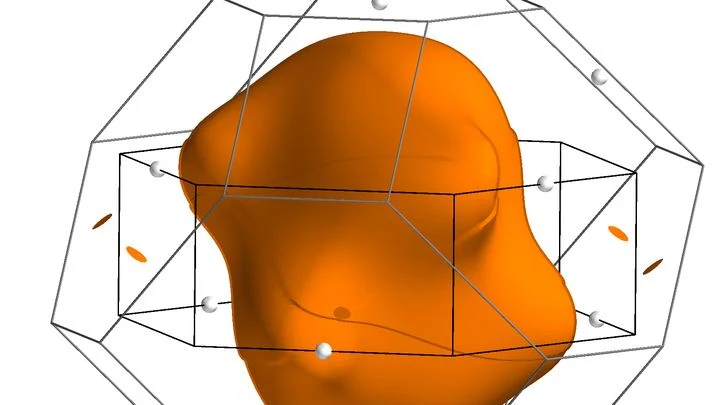
Altermagnets resemble a ballroom where couples spin in opposite directions: the hall itself is still, but inside, ordered motion seethes. Similarly, electron spins (the direction of their rotation) in these materials form intricate patterns without creating an overall magnetism.
In the dark cloud L43, where stars are born, dust grains twirl like tiny compasses. Light from a young star pushes them, while the magnetic field lines them up in a specific direction. When a grain is turned sideways to us, its heat reaches us polarized, like light passing through a narrow slit.
Two tiny magnetic vortices, called skyrmions, drift across a thin film. As they approach each other, the force between them isn't a simple attraction or repulsion, but an alternation of the two, as if two floats on water were converging and diverging, obeying an invisible wave.
In a pot of boiling soup, small bubbles churn, but gradually large-scale flows come to dominate. Something similar happens in cosmic plasma, where magnetic fields behave like tangled threads.
Two metal plates in a perfect vacuum attract each other. Even Richard Feynman compared emptiness to a boiling foam: particle pairs are born and immediately vanish, creating the Casimir effect. If the plates are asymmetric, they also start to twist — that's a vacuum motor.
But rotation doesn't require oddly shaped parts.
A thin rubber film lies on a table. Someone grabs it by the middle and slowly pulls upward. The film doesn't just rise: it arches into a dome, then wrinkles run along the dome's edge, like pleats on a skirt. Pull higher — the wrinkles gather into large folds that cross the entire film. And if you start lowering it, the folds don't disappear but collapse into new shapes.