Anomalous heat transport refers to heat conduction that deviates from the classical Fourier law, where heat flow is proportional to the temperature gradient. In thin films, nanostructures, or under strong external fields, heat can flow in unexpected ways — sometimes even against the gradient, or with a dependence on system size that defies bulk behavior. This phenomenon is crucial for managing heat in nanoscale electronics, where conventional cooling fails, and for understanding energy transport in astrophysical plasmas and turbulent systems.
History
The deviation from Fourier's law in low-dimensional systems was predicted theoretically in the 1960s–1970s, but experimental confirmation came only in the 2000s with advances in nanofabrication and measurement techniques. The term 'anomalous' was borrowed from plasma physics, where it was used in the 1950s to describe unexpectedly fast heat loss in fusion devices.
How it works
Classical heat conduction assumes that heat carriers (electrons, phonons) scatter randomly, leading to a diffusive flow. In nanostructures, the mean free path of carriers can be comparable to or larger than the system size, so heat transport becomes ballistic or quasi-ballistic, leading to size-dependent thermal conductivity. Under external fields (like magnetic or electric), carriers can be deflected, causing anisotropic or even 'negative' heat flow — where heat moves from cold to hot — due to quantum interference or non-equilibrium effects. In turbulent plasmas, anomalous transport arises from chaotic magnetic field lines that allow heat to escape much faster than classical collisions would predict.
In practice
Anomalous heat transport is key to designing efficient thermoelectric devices, cooling computer chips, and predicting heat loss in fusion reactors (tokamaks), where it can limit performance.
Fun fact
In some 1D chains, heat conduction can be 'ballistic' — meaning it flows without any resistance, like light in a vacuum — even at finite temperatures, a phenomenon that has no analogue in 3D materials.
Current in an ordinary metal flows like a crowd of people down a straight street: each electron is on its own, and if you turn on a magnetic field, the whole crowd shifts slightly sideways. This shift is called the Hall effect.
A laser hits an atom, and tears out an electron. The brighter the light, the stronger the kick, and the faster the electron flies away. That's how the familiar picture works, where light is a smooth wave. But what if the light isn't smooth but 'squeezed,' with quantum fluctuations, like the trembling of a string?
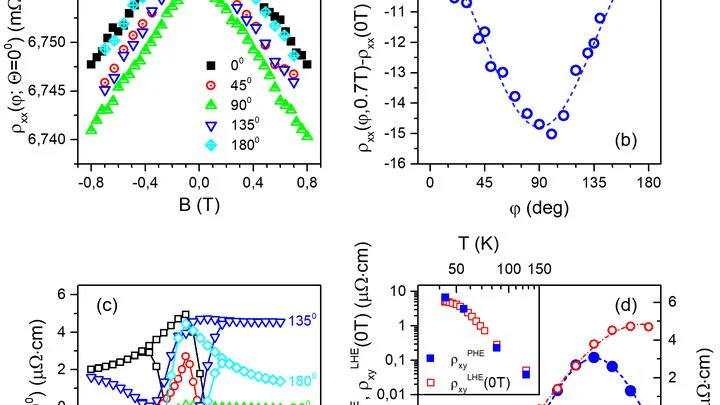
A magnetic field usually acts like a strict traffic cop: for heat to turn into electricity, it must stand across the road. If the field lies along the heat flow, the effect disappears, or so it was believed for decades.
Scientists took an ultra-thin film of a magnetic oxide — a material where electron spins are aligned in a plane, like compass needles on a table.
Toss a handful of sand onto a table — the grains scatter equally in all directions. But if a magnet is hidden under the table and the sand is iron, the trajectories get trickier: an invisible structure overlays the chaos. That's roughly how molecular motion works inside a living cell.
A basin of wet sand. You press in one corner, and water starts moving. But how exactly? Instead of an even circle, it might spread in tongues, linger in some spots, and rush through others. Underground, the same thing happens: oil, water, or gas migrate through rocks not by the textbook, but following the chaos of fractures and heterogeneities.
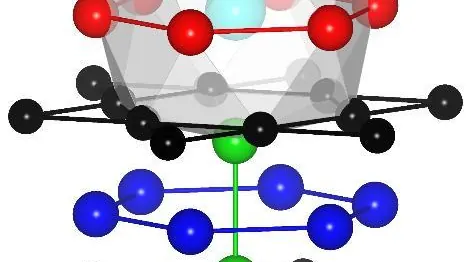
Imagine a skyscraper assembled not from individual bricks but from entire studio apartments. That's exactly how the Au₆Te₁₂Se₈ crystal is built: its nodes are not atoms but superatomic clusters of gold and chalcogens that behave as single quantum objects.
Usually, superconductivity is a story about cold. The lower the temperature, the easier it is for electrons to pair up and flow without resistance. But in a new study, physicists grew thin films of nickelates doped with europium and saw the opposite picture.
A thermometer that turns a heat flow into an electrical signal: that's the anomalous Nernst effect: in a magnetic material, heat generates a transverse voltage. Until now, engineers could only tweak this signal slightly by changing the proportions of two metals.
A tellurium crystal resembles a tiny spiral staircase: its atoms are twisted into a helix. When heat runs through such a crystal, it is carried not by electrons but by sound waves — vibrations of the lattice itself. These waves don't just push back and forth; they also rotate around their axis like a spinning top.
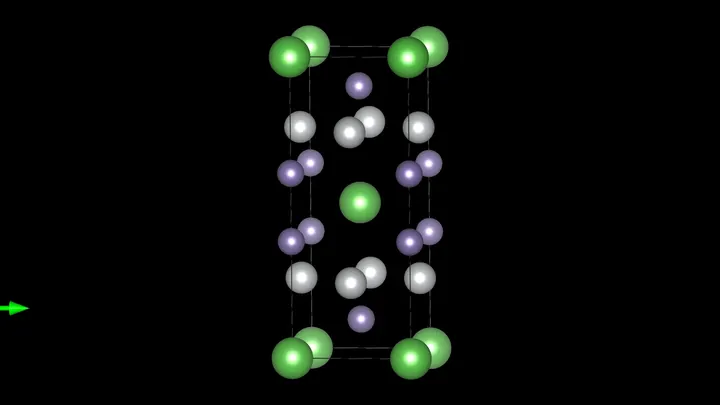
If you toss a handful of coins onto a table, they land in a jumble. But in some crystals, atoms arrange themselves into a pattern reminiscent of a woven basket — the kagome lattice. In the metal MgMn₆Sn₆, manganese atoms form such a lattice, and at room temperature they act like tiny magnetic needles.
In familiar metals like copper, electrons move almost independently, like cars on an open highway. Resistance arises from rare collisions and can be described by simple formulas.
A stone falls into a pond, and ripples spread across the water. But if the stone is very small and the water is not quite ordinary, the ripples pass right through it, as if it weren't there.
A crystal that looks like a stack of pancakes was placed on a smooth substrate of magnesium oxide. The result was a film only a few hundred atoms thick. When they ran a current through it and switched on a magnet, the resistance jumped by nearly a quarter—22.5% in a 9-tesla field.
Inside the film, electricity is carried by two streams of particles.
Among magnets, there are quiet masters of disguise. An ordinary magnet attracts paperclips and has two poles — north and south. But there are materials that are internally arranged like a magnetic chessboard: their atoms are aligned in a strict order, yet externally the material behaves neutrally, as if no magnet exists at all. Such substances are called altermagnets.
A mosaic floor made of many small tiles, each turned in a different direction. It seems that any pattern trying to cross such a floor would get scrambled and vanish. That's how people usually think about disorder in crystals: if atoms aren't arranged in a perfect lattice, delicate quantum effects should fall apart.
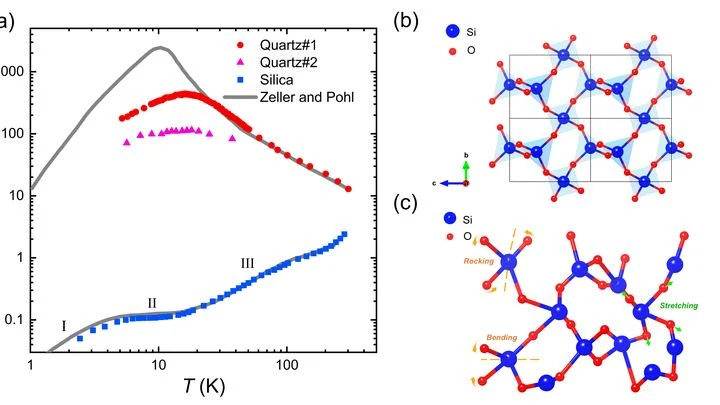
If you push heat through a piece of quartz, it usually goes straight, like water through a pipe. But switch on a magnetic field, and the flow veers slightly sideways, as if the pipe suddenly grew a side branch.
The young star HL Tau is surrounded by a disk of gas and dust — the cradle of future planets. Inside this disk, the gas is not static: it orbits the star, but it also trembles and churns, like water in a raging river. Astronomers have now directly measured the strength of this churning for the first time.
A thin film of nickel oxide, tens of nanometers thick, is like a sheet of paper folded hundreds of times thinner. At room temperature, it conducts electricity, but cool it slightly and it becomes an insulator.
Water in a stream doesn't flow in a uniform sheet; it carves winding paths where the current runs faster. Electrons in a Hall thruster, a device that pushes a spacecraft with a jet of plasma, behave much the same way.
Inside the thruster, a magnetic field confines electrons, which ionize the gas and produce thrust.
A thin superconducting wire, cooled to near absolute zero, can sense a single particle of light. Such detectors are indispensable for quantum computing and secure communication, but their temperament is spoiled by disorder — random irregularities and impurities that cannot be completely removed.
Instead of fighting disorder, physicists decided to tame it.
Toss a handful of peas into a pot of semolina porridge — the peas quickly sink, pushing the grains aside. But if you make the porridge very thick and sticky, the peas get stuck. That's roughly how light lithium atoms behaved in a cloud of heavy potassium atoms at temperatures just a few millionths of a degree above absolute zero.
Thirty nanometers is the distance over which a phonon sprinter hasn't yet had time to accelerate. In thin aluminum nitride films, thermal resistance remains almost unchanged up to this thickness: heat transport proceeds in the ballistic regime, where phonons (quanta of crystal lattice vibrations) fly…