Hot Spots from Tiny Black Holes express
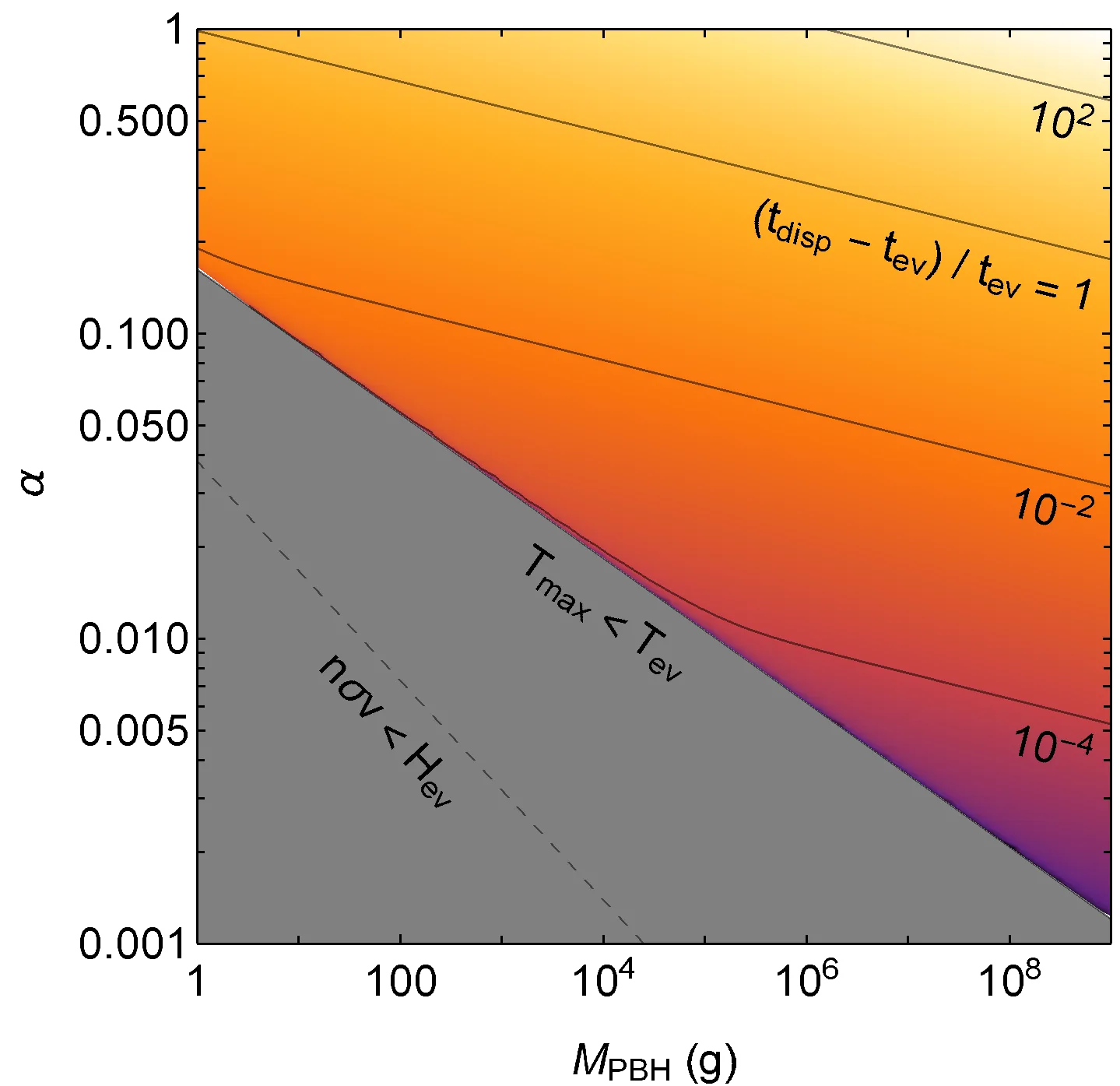
A tiny black hole zips through a gas cloud. Instead of swallowing the gas, it heats it up, like an iron left on a damp cloth. Radiation streams from the black hole, creating a hot spot — a region where the temperature is hundreds of times higher than in the surrounding space.
Previously, it was thought that such spots could live almost forever, cooling slowly according to a single law. But the new work takes into account that the universe is expanding. Expansion acts like a fan: it carries heat away faster than it would spread on its own. A hot spot first loses temperature sharply, then cools following a steeper law — not like in a static world.
In the end, all hot spots disappear in a finite time. This is an important conclusion: if such spots really existed in the early universe, their traces could have survived to this day only under special conditions. Now it is clear that we need to look for them differently — not as eternal beacons, but as short flashes that went out long ago.
Original abstract
as written by the authors arXiv:2605.08336
Light primordial black holes heat the surrounding plasma via Hawking radiation, forming localized hotspots whose temperature may far exceed that of the cosmological background. Previous studies of hotspot formation and cooling have treated the subsequent energy transport in flat spacetime, thereby neglecting the expansion of the Universe. We formulate the diffusion equation governing the hotspot evolution, in an expanding universe, and clarify the regime in which the formalism is valid. We find that hotspot formation is robust against cosmological expansion. We show that the critical distance scale, where Hubble expansion overtakes diffusion, coincides with the decoupling radius introduced in earlier work, and the temperature profile $$T\propto r^{-7/11}$$ essentially remains unchanged. However, the cooling stage is substantially modified. We find that the plateau temperature of a cooling hotspot initially undergoes a rapid drop and then follows $$T_{\rm plt} \propto t^{-11/15}$$, steeper than the flat-spacetime scaling $$t^{-7/15}$$. This scaling cannot be obtained by simply redshifting the flat-spacetime solution, because expansion also suppresses diffusive transport. As a consequence, all hotspots disappear within a finite time, as opposed to the flat-spacetime prediction of everlasting hotspots in part of the parameter space.
The temperature of a hot spot can be thousands of times higher than the temperature of the surrounding gas, like boiling water suddenly appearing in ice-cold water.