A hot spot in physics refers to a localized region within a material or system where pressure, stress, or temperature is significantly higher than the surrounding average. This concept is particularly important in fields like geophysics, materials science, and plasma physics, where such concentrated energy can trigger phase transitions, chemical reactions, or mechanical failure. In the context of planetary science, hot spots can indicate volcanic activity or mantle plumes, while in engineering, they are critical for understanding stress concentrations in structures.
How it works
Hot spots arise from the uneven distribution of energy or force within a system. For example, in a solid under stress, microscopic defects or geometric discontinuities can concentrate stress lines, leading to a hot spot where the material is more likely to yield or fracture. In thermal systems, hot spots can form due to localizedheat sources or poor heat dissipation, creating gradients that drive convection or other dynamic processes.
In practice
Hot spot analysis is used in the design of pressure vessels, electronic components, and geological models to predict failure points and optimize safety.
A light field, like a neat waffle iron, presses a regular pattern of bright and dark regions into space. Atoms get stuck in the brightest spots as if in tiny dimples: that's an optical lattice. It's a favorite tool for physicists who want to study quantum behavior of matter in its pure form.
In a vast hall, billiard balls are scattered about. At first they lie sparsely, each on its own. Then someone adds more, and suddenly the balls compress into dense clusters. This is a phase transition — the moment when matter abruptly changes its state.
Physicists have long described such a picture with the hard-sphere model: particles are identical balls that cannot overlap.
Space is full of invisible sprinters — particles racing nearly at the speed of light. They are caught in the solar wind, near neutron stars, and even in the intergalactic void between galaxies. But what accelerates them where there are no shock waves or magnetic reconnections?
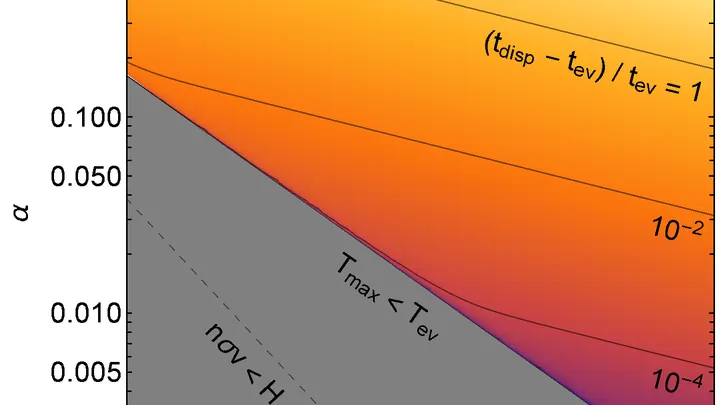
A tiny black hole zips through a gas cloud. Instead of swallowing the gas, it heats it up, like an iron left on a damp cloth. Radiation streams from the black hole, creating a hot spot — a region where the temperature is hundreds of times higher than in the surrounding space.
An aluminum pot on the stove melts at 660 degrees Celsius — everyone knows that. But what happens if you heat aluminum a hundred times hotter? The liquid starts to boil, and here's the puzzle: at what exact temperature does that happen?
In 2019, the Event Horizon Telescope gave humanity the first image of a black hole's shadow. Since then, astrophysicists have dreamed of more: seeing how matter moves in the very funnel of spacetime. One of the mysteries is chaos.