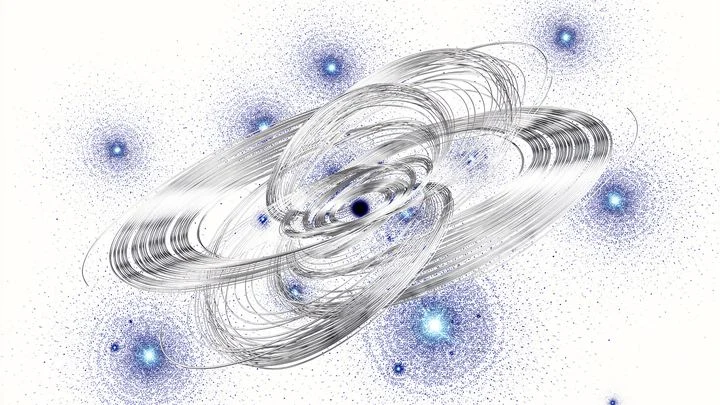
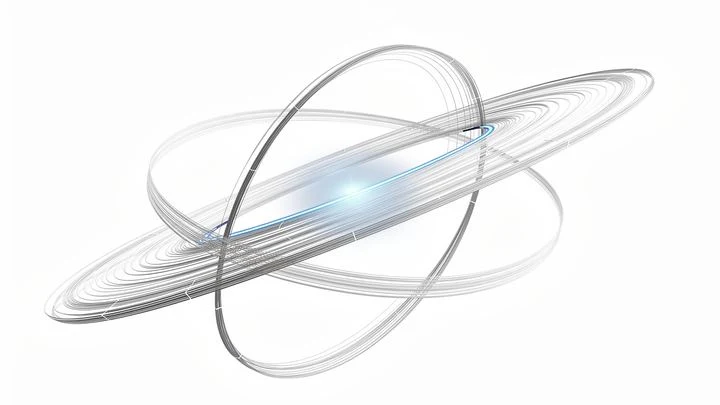
A galactichalo is the vast, roughly spherical region that extends far beyond the visible disk of a galaxy. It contains a sparse population of old stars, globular clusters, hot gas, and a dominant component of dark matter. The halo is the galaxy's outermost frontier, bridging the bright, star-forming disk to the intergalactic medium. It plays a crucial role in galaxy formation and evolution, as it is the reservoir from which gas accretes onto the disk and the gravitational scaffold that holds the galaxy together.
History
The concept of a galactichalo emerged in the mid-20th century with observations of globular clusters and RR Lyrae stars extending far above the Milky Way's plane. The dark matter component was inferred in the 1970s by Vera Rubin and others from flat rotation curves, though the term 'halo' for dark matter was already in use.
How it works
The halo's dark matter provides the gravitational potential well that attracts baryonic gas. As gas falls into the halo, it shocks and heats, eventually cooling and settling into a rotating disk where star formation occurs. The halo's hot gas component, visible in X-rays, can be stripped or accreted during galaxy interactions. The stellar halo, composed of ancient, metal-poor stars, is built up through mergers with smaller satellite galaxies, which are tidally disrupted and their stars scattered into the halo.
In practice
Galactichalos are studied to map dark matter distributions, test gravitational theories, and understand galaxy formation in cosmological simulations.
Fun fact
The Milky Way's halo contains a stream of stars torn from the Sagittarius dwarf galaxy, wrapping around our galaxy like a ribbon.
A light ray passing near a massive body bends around it, like a runner rounding the corner of a stadium. For a neutron star, this deflection angle is usually assumed to be the same as for a point mass. But if the star is wrapped in an invisible halo of dark matter, the picture changes: light passing through the halo is deflected less than the total mass would predict.
A river drawn on a map is always a single line. But stand on the bank, and you will see that within the channel there are faster currents, eddies, and branches that merge and split. The cosmic web is like that river, but made of dark matter, and until recently astronomers drew it as a single line.
The galaxy cluster RXC J0528.9−3927 is like a city shrouded in fog: at its center, a radio halo shines brightly, but farther out, beyond the usual boundaries, astronomers have spotted a barely visible glow. It stretches for two million light-years — three times farther than the halo itself.
The night sky looks black, but if you remove the stars and accumulate light for a long time, a faint glow emerges — the summed light of all galaxies born over 13.8 billion years. Astronomers call it the extragalactic background light.
The Andromeda galaxy is our nearest large neighbor, and like the Milky Way, it has an invisible gaseous shroud. This shroud of extremely hot, rarefied gas extends for hundreds of thousands of light-years. Seeing it directly is nearly impossible — the gas is too faint.
The most massive stars are like overinflated balloons: their envelope stops stretching and instead begins to furiously vent material. At a certain stage, the mass loss becomes so intense that the star stops growing in size. Astronomers see this moment as a kink in the diagram where stars are sorted by luminosity and temperature.
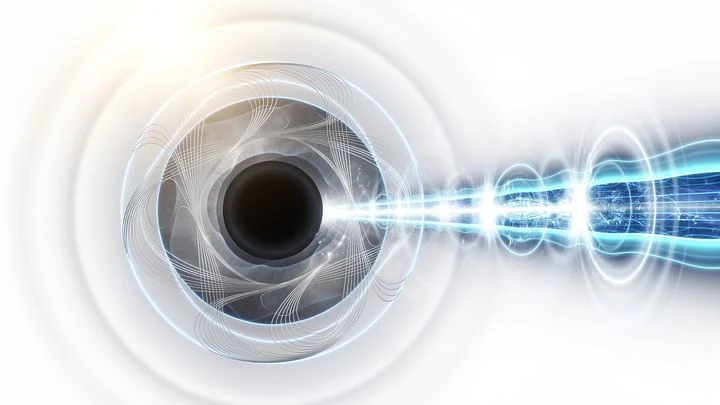
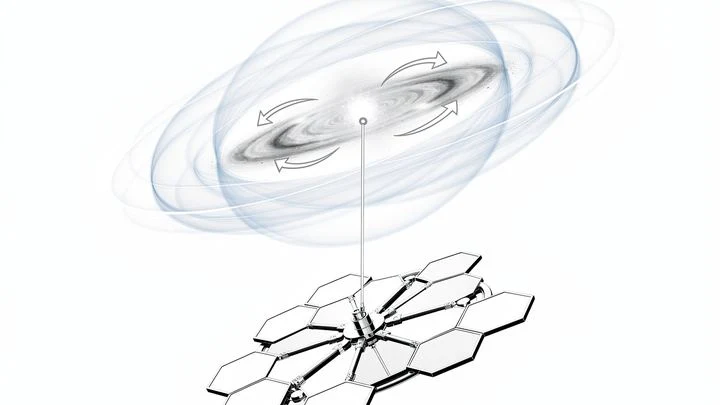
At the center of a galaxy sits a supermassive black hole, surrounded by a vast, tenuous cloud of dark matter. It doesn't shine or heat, but its gravity warps space and changes the rules of the game for everything orbiting nearby.
The universe rang piercingly in its first moments. During the inflation epoch, when space expanded faster than light, energies were monstrous — trillions of times higher than in the Large Hadron Collider.
In the galaxy NGC 1052 DF2, stars move at only 8 kilometers per second, as if there were no invisible mass around. For comparison: in our Milky Way, outlying stars accelerate to 200 kilometers per second, held by a massive dark matter halo.
Three invisible strings oscillate in the intergalactic void. This is not poetry, but a hypothesis about the nature of dark matter — an ultralight quantum field with spin 1, carrying three polarizations.
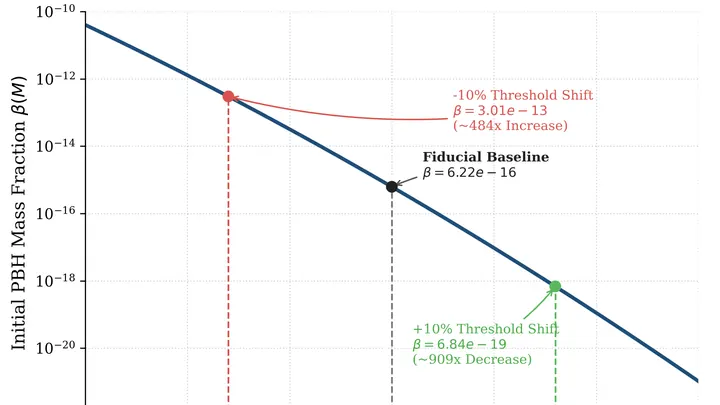
Dark matter is invisible to telescopes, but its gravity was revealed half a century ago by Vera Rubin. Since then, physicists have explored dozens of hypotheses, and one of the most elegant is primordial black holes, formed in the first moments after the Big Bang.
A cosmic detective story spanning a decade and a half has turned up an unexpected clue. The Fermi telescope, which scans the sky in gamma rays, has detected a steady, faint glow enveloping the entire Milky Way. It looks nothing like the light from stars or hot gas — more like a dim, all-pervasive haze.
Dark matter — the invisible foundation of cosmic architecture — makes up 85% of all mass, yet eludes direct observation. In the 1920s, Edwin Hubble discovered the expansion of the universe and the realm of galaxies; by the 1930s, Fritz Zwicky suspected hidden mass in their clusters.
Remember the sensational comet 1I/‘Oumuamua — the first object to come to us from another star? Its hyperbolic trajectory left no doubt: it was a wanderer from the interstellar void. But astronomers wondered: could some of these visitors not be strangers at all, but our own, escaped from the Solar System millions of years ago?
It all began not with emptiness, but with a boiling ocean of plasma. In that primordial broth, sound waves raced through the fiery matter, colliding and compressing it. Sometimes a clump grew so dense that light could no longer escape, and right out of the scorching gas, a primordial black hole was born.
A planet the size of Neptune wandered too close to its star. The star begins to pull the planet's outer layers onto itself — gas streams off the planet like water from an overflowing bucket. This process is called Roche-lobe overflow (astronomers use this term for the boundary beyond which a star can tear material away from a planet).
The young super-Jupiter TWA5B, a scorching ball 25 times Jupiter's mass, floats just fifty light-years away. Its faint infrared glow long hid its chemical makeup. Now, high-resolution spectroscopy with CRIRES+ has registered the ghostly trace of SiO — silicon monoxide.
In the silent theater of the cosmos, a star’s life plays out over billions of years. But sometimes an invisible director sneaks onto the stage — a primordial black hole.
Among the precious scatterings of the early Universe captured by James Webb, there are objects that resemble ruby beads scattered on black velvet. These are the 'little red dots' (LRDs) — compact sources with steep red spectra, inside which lurk supermassive black holes up to a hundred million solar masses.
A huge rotating pancake of gas and dust surrounds a young star. In such a "maternity ward" for planets, rings and gaps are often seen, as if an invisible plow had carved furrows. These are usually attributed to already-formed planets that clear paths with their gravity.
A tiny black hole zips through a gas cloud. Instead of swallowing the gas, it heats it up, like an iron left on a damp cloth. Radiation streams from the black hole, creating a hot spot — a region where the temperature is hundreds of times higher than in the surrounding space.
Recently, astronomers spotted three interstellar comets coming from deep space. One of them, 3I/ATLAS, turned out to be unexpectedly large: its nucleus is several kilometers across.
Right after the Big Bang, space rippled with gravitational waves, like those from a thrown stone. These tremors in the very fabric of the cosmos, predicted by Alan Guth, stretched across the entire universe. The ripples slightly compressed primordial matter in some places and thinned it out in others.
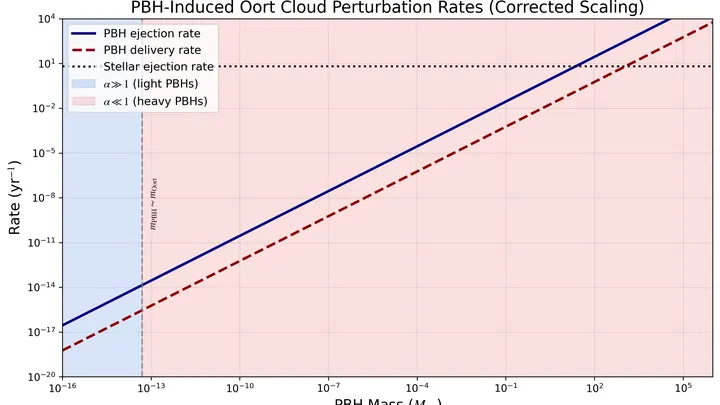
The Oort Cloud is a spherical swarm of trillions of icy bodies at the very edge of the Solar System, about a light-year from the Sun. These objects are almost motionless relative to one another until some gravitational disturbance breaks their calm.
In a vast dark hall, someone invisible plucks the strings. The cosmic gas, the tenuous hydrogen that filled the young universe, resembles stretched strings that can resonate at a radio wavelength of 21 centimeters. This is hydrogen whispering about its temperature.
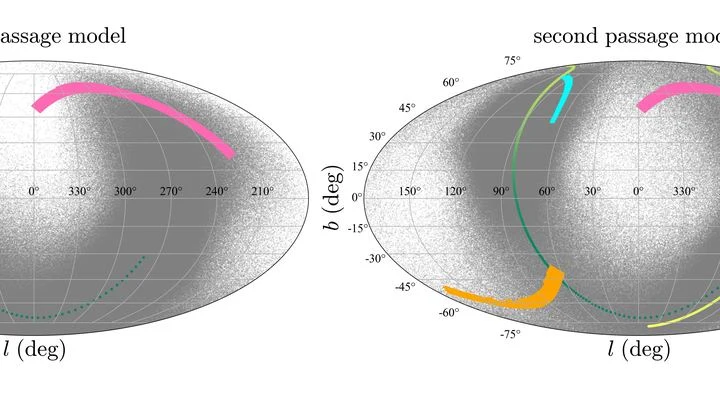
On the outskirts of our Galaxy, far beyond the familiar stellar disk, the Subaru Telescope has spotted something unexpected: a scattered cloud of stars spanning an area of one hundred square degrees across the sky.
Dark matter is an invisible substance that keeps galaxies from flying apart. If its particles occasionally decay near the Sun, they shoot out streams of fast particles, like invisible hammers striking light. Each impact turns a particle of sunlight into a gamma ray — a super-powerful flash that telescopes can spot.
In the Norma cluster, the nearest rich galaxy cluster to us, astronomers have spotted a shock wave. It arose when one cluster plowed into another, like the bow wave of a ship cutting through water. This wave compressed and heated the gas between the galaxies.
Two galaxies sit right behind the wave front.
On the outskirts of the Virgo Cluster, where galaxies crowd together but haven't yet clumped into a dense mass, lies VCC 693. Outwardly, it's an unremarkable dwarf: a small cloud of stars and gas. But astronomers suspected that behind its calm appearance lurks a turbulent past.
In 2015, astronomers were examining the Coma galaxy cluster and noticed something odd: huge, almost invisible "fluff balls." These galaxies are as large as our Milky Way but shine hundreds of times fainter.
In the Coma galaxy cluster, about 320 million light-years away, an invisible cloud stretches out. It shines in the radio band: this is a radio halo, a giant collection of charged particles accelerated to nearly the speed of light.
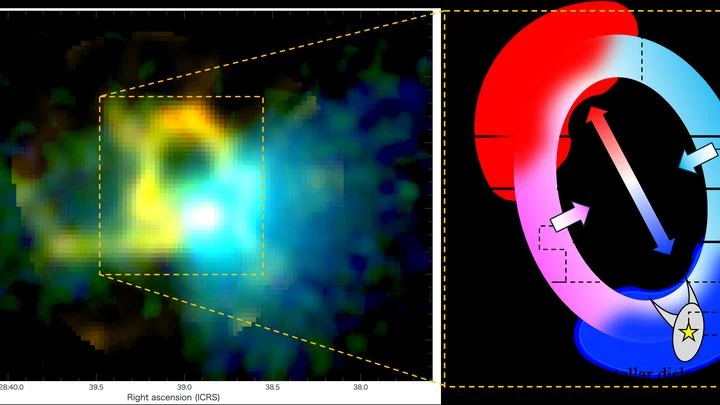
In a cold, dark cloud of gas where a star is just beginning to form, the ALMA telescope has spotted an unusual ring. It is made of gas that is warmer and denser than its surroundings. Such details were previously hidden because the gas at the cloud's center is opaque to ordinary observations.
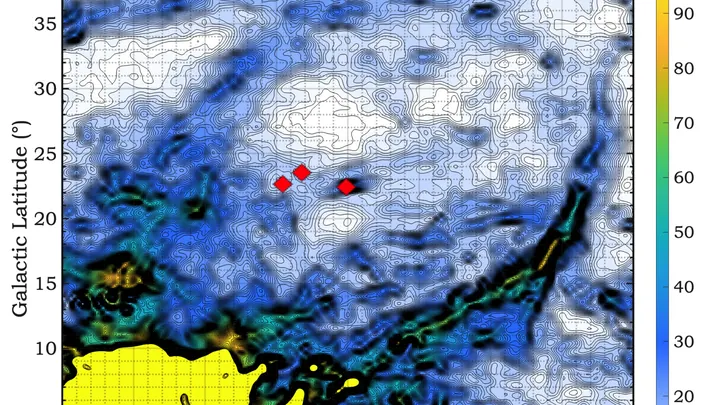
In radio sky data, like on old photographic film, two bright gas streaks have emerged. They move at different speeds but hang near the same dim star. The star and the streaks turned out to be inside a huge empty bubble in the interstellar gas. This bubble is like a blown soap bubble left over from an ancient supernova explosion.
In the first moments after the Big Bang, the universe was nearly uniform, like smooth dough. But within a billion years, in some places the dough began to rise faster: clumps of hundreds of galaxies emerged, which astronomers call protoclusters. These are the seeds of future giant clusters, the most massive bound structures in the universe.
By analyzing color indices — the ratio of brightness in different spectral bands in images from the James Webb Space Telescope, astronomers have identified galaxies whose light cuts off sharply in the ultraviolet.
Neutron stars are the compressed remnants of massive stars: their matter is squeezed so tightly that a thimble-sized amount would weigh a colossal amount. If dark matter, the mysterious invisible substance thought to hold galaxies together with its gravity, accumulates inside such an object, under certain conditions this accumulation becomes fatal.
The light from a distant galaxy split into two, then three, then four, and in the center a fifth ghost appeared. That is HerS-3: a young galaxy full of dust and newborn stars, whose light passed through a gravitational lens, a massive object that bends rays like a magnifying glass bends light.