Sky Patrol over Uruguay express
On a dark night over the Uruguayan pampa, a dazzling fireball silently flares up. It streaks for a few seconds, scattering sparks, and fades beyond the horizon. This is a bolide — a large asteroid fragment slamming into the atmosphere. If it survives the fall, a meteorite will land on the ground. Capturing such a moment and quickly finding the rock is the mission of the Bocosur network: two dozen cameras spaced about 120 km apart cover an area half the size of Germany.
Each station is a fully autonomous unit. They once relied on older cameras, but have now been upgraded to more sensitive and sharper models. The switch is like trading an old film camera for a modern digital SLR: the sky appears deeper, and the bolide's trail is recorded with greater precision. The comparison showed that the new cameras pinpoint an object's position with an error of just 5 arcminutes — roughly the thickness of a pencil held at arm's length.
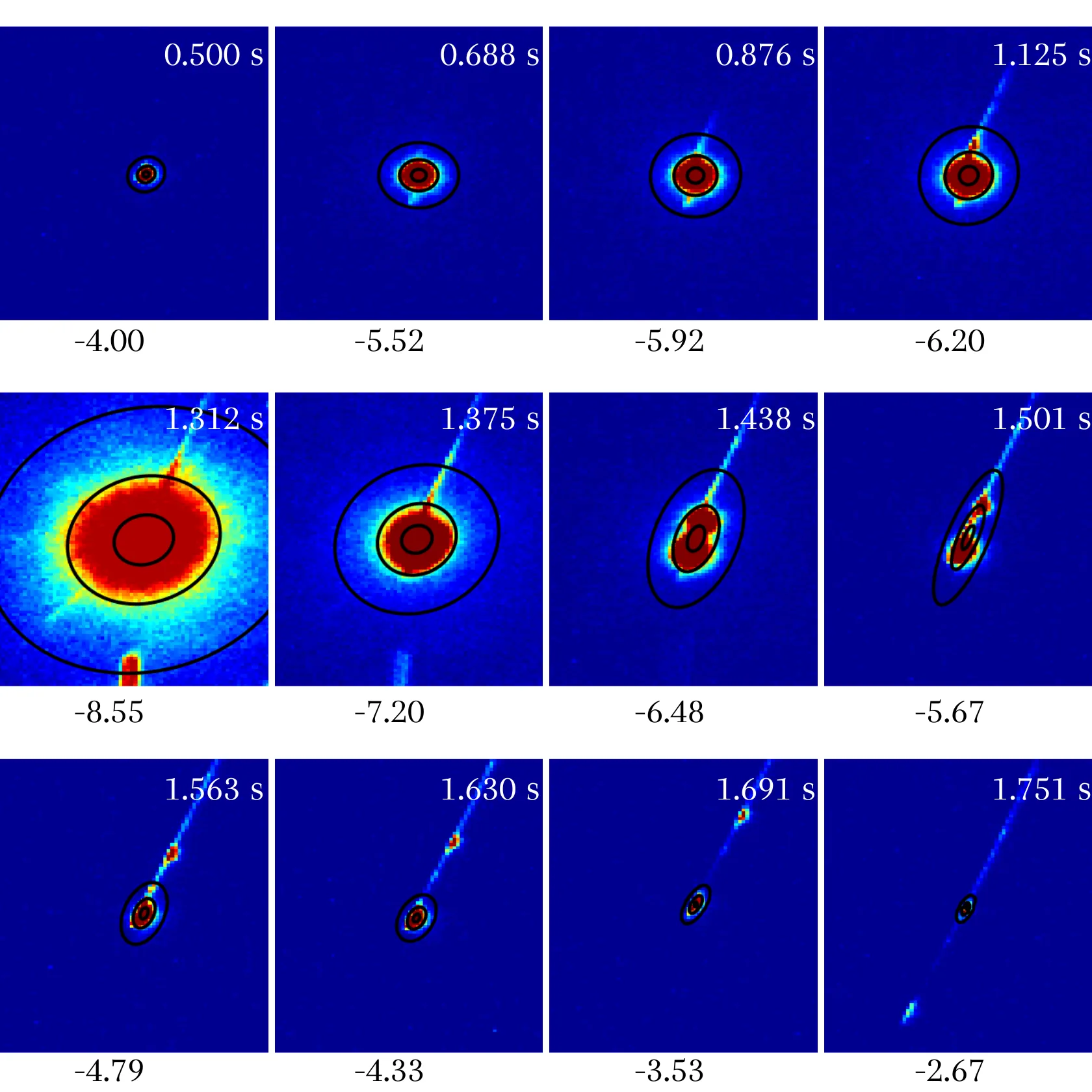
But how do you measure the brightness of a flash that outshines Jupiter? The authors devised a simple photometric method and tested it on familiar celestial benchmarks. For Jupiter, the error was only 0.18 magnitudes — about the difference between two adjacent bulbs in a string of lights. For the Moon, it was slightly larger, 1.2 magnitudes, but for such a bright and extended object, that's an excellent result. Now, when a bolide is captured by four stations simultaneously, its trajectory can be reconstructed with high precision, revealing where it came from.
All this machinery serves a dual purpose. On one hand, it aims to bring back a piece of an asteroid and read the history of the early Solar System within it. On the other, it ignites curiosity in schoolchildren: they help process the images and see how a bright streak across the night sky becomes a scientific discovery. A fireball flashing over the pampa becomes a bridge between deep space and the classroom.
Original abstract
as written by the authors arXiv:2605.08917
Over the past couple of decades, several networks for the automatic detection of fireballs have been deployed. Their primary scientific goal is to facilitate the rapid recovery of meteorites, determine their pre-atmospheric orbits, and look for possible dynamic links with parent bodies. The Bocosur network is a contribution to the global deployment of automated fireball networks and to the increase of the number of recoverable meteorite falls. It is located in Uruguay, South America (Lat: -30$$^{\circ}$$ to -35$$^{\circ}$$). Its main scientific goal is the detection of fireballs of asteroidal origin, massive enough to produce meteorites, and also to inspire secondary-level students and teachers through their involvement in this citizen-science oriented project. The deployment of this network started in 2019, and was completed in March, 2023, when we installed 20 stations separated $$\sim 120$$ km, covering an area of $$\sim 180,000$$ km$$^2$$. During this period of time, one major technological upgrade was made when we migrated from a well-known camera to a higher-resolution, more sensitive system. We were able to build a completely autonomous system at an affordable cost that can be replicated in all the stations. A comparison between the astrometric and photometric performance of these two detection systems is reported. Also, a photometric methodology for estimating the brightness of very bright fireballs is presented and validated against the known magnitudes of Jupiter and the full Moon. We obtain mean residuals of the astrometric reduction of $$\sim$$5', and the discrepancy between the obtained brightness of Jupiter and the Moon average to 0.18 and 1.2 magnitudes, respectively. Results on the processing of a very bright (M$$_{peak}\sim$$-9.0 mag) fireball detected in four stations are also presented.
The Bocosur network covers an area of about 180,000 km² — nearly twice the size of Portugal.