Sky Patrol over Uruguay express
On a dark night over the Uruguayan pampa, a dazzling fireball silently flares up. It streaks for a few seconds, scattering sparks, and fades beyond the horizon. This is a bolide — a large asteroid fragment slamming into the atmosphere. If it survives the fall, a meteorite will land on the ground. Capturing such a moment and quickly finding the rock is the mission of the Bocosur network: two dozen cameras spaced about 120 km apart cover an area half the size of Germany.
Each station is a fully autonomous unit. They once relied on older cameras, but have now been upgraded to more sensitive and sharper models. The switch is like trading an old film camera for a modern digital SLR: the sky appears deeper, and the bolide's trail is recorded with greater precision. The comparison showed that the new cameras pinpoint an object's position with an error of just 5 arcminutes — roughly the thickness of a pencil held at arm's length.
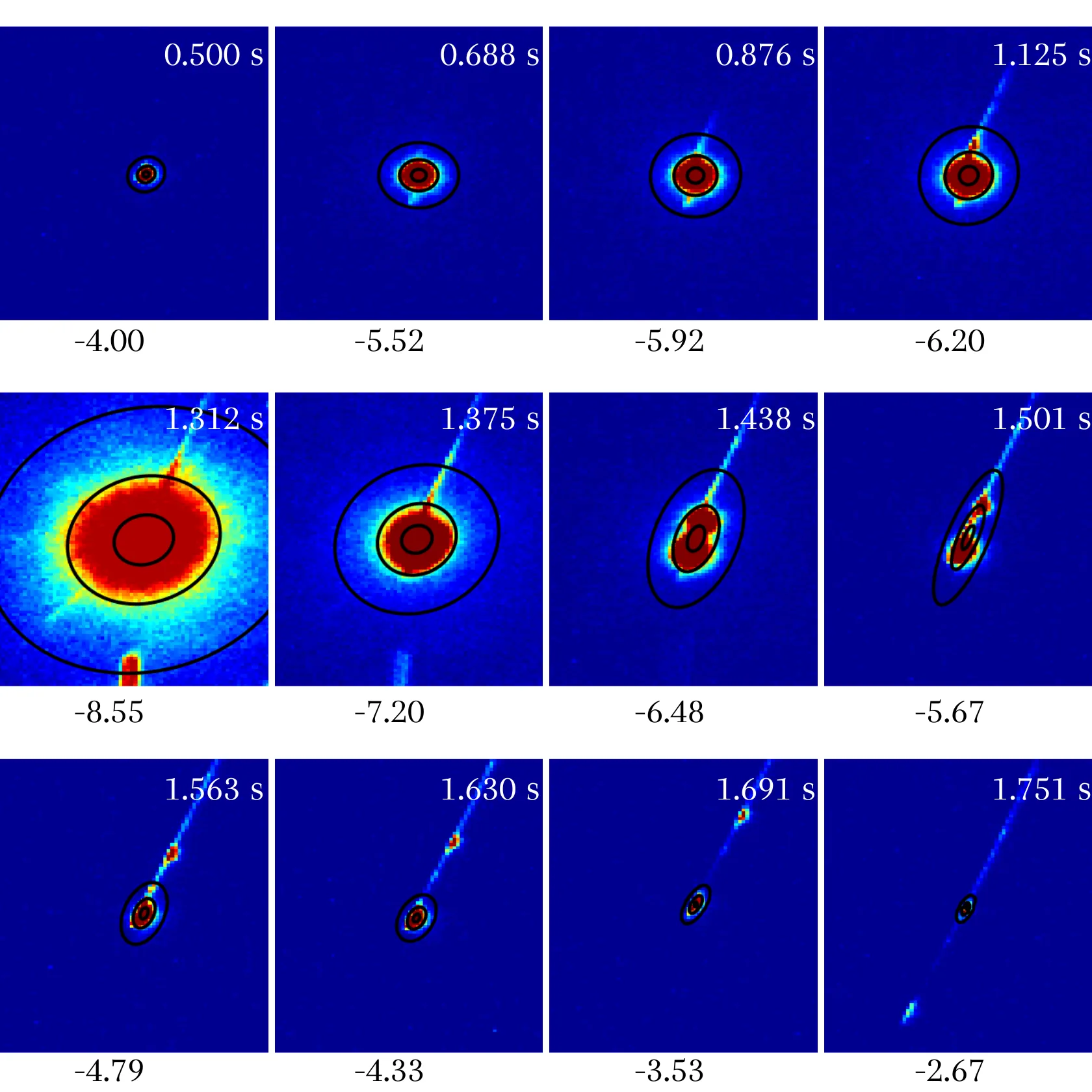
But how do you measure the brightness of a flash that outshines Jupiter? The authors devised a simple photometric method and tested it on familiar celestial benchmarks. For Jupiter, the error was only 0.18 magnitudes — about the difference between two adjacent bulbs in a string of lights. For the Moon, it was slightly larger, 1.2 magnitudes, but for such a bright and extended object, that's an excellent result. Now, when a bolide is captured by four stations simultaneously, its trajectory can be reconstructed with high precision, revealing where it came from.
All this machinery serves a dual purpose. On one hand, it aims to bring back a piece of an asteroid and read the history of the early Solar System within it. On the other, it ignites curiosity in schoolchildren: they help process the images and see how a bright streak across the night sky becomes a scientific discovery. A fireball flashing over the pampa becomes a bridge between deep space and the classroom.
The Bocosur network covers an area of about 180,000 km² — nearly twice the size of Portugal.