eROSITA (Extended Roentgen Survey with an Imaging Telescope Array) is a German-built X-ray telescope aboard the Spektr-RG spacecraft, launched in 2019. It surveys the entire sky in the soft X-ray band (0.2–8 keV), mapping the distribution of hot gas, black holes, neutron stars, and other high-energy phenomena. Its primary goal is to create a detailed atlas of the X-ray sky, revealing the large-scale structure of the universe, including galaxy clusters and the cosmic web.
History
eROSITA was developed by the Max Planck Institute for Extraterrestrial Physics under the leadership of Peter Predehl, with the project approved in 2007. It was launched on July 13, 2019, and began its survey in December of that year.
How it works
eROSITA consists of seven identical Wolter-I telescopes, each with a set of nested mirrors that focus X-rays onto a CCD detector. X-rays are reflected at grazing angles off the mirror surfaces, which are coated with gold for high reflectivity. The spacecraft rotates to scan the sky, and the detectors record the position, energy, and arrival time of each X-ray photon. Over multiple scans, the data are combined into a full-sky map, with sensitivity about 25 times better than the previous ROSAT mission.
In practice
eROSITA's data are used to study dark energy through galaxy cluster counts, to detect tidal disruption events, and to map the hot gas in the Milky Way's halo and in the interstellar medium.
Fun fact
In 2020, eROSITA detected a mysterious X-ray signal from the Sun's halo, later attributed to solar wind charge exchange, demonstrating its sensitivity to even faint local phenomena.
In the basement of the laboratory, an 8 tesla magnet hums. Inside it, like a bell in a bell tower, hangs a hollow copper cylinder tuned to a single note. If an axion, a dark matter particle, flies by, the cylinder responds with a faint ring. The trouble is that ordinary copper muffles this ring: at high frequencies, current flows only through a thin skin of the metal, and losses grow.
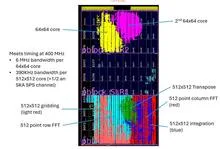
A radio telescope with thousands of antennas is like a giant ear that hears the whole sky at once. But an ear cannot draw a picture: signals from every pair of antennas must be multiplied, and in an array of ten thousand elements there are already fifty million pairs. A classical correlator does exactly that, and its complexity grows as the square of the number of antennas.
The night forest is full of fireflies, but before, we only saw those that happened to be in the beam of a flashlight. That was the case with ultraluminous X-ray sources: points in other galaxies that shine in X-rays more brightly than a stellar-mass black hole can steadily emit. Telescopes looked at galaxies chosen for other purposes, missing most of the fireflies.
From 1987 to 1991, astronomers last measured how Jupiter's icy moons reflect radio waves. Then came a long pause. In 2011–2024, researchers aimed a radar beam at Europa again: this time using the 70-meter antenna at Goldstone and the Green Bank Telescope.
Ice is nearly transparent to radio waves, like clear window glass is to light.
Betelgeuse, the red supergiant familiar from Orion's shoulder, keeps surprising us. After the mysterious Great Dimming of 2019–2020, when the star suddenly dimmed, it didn't just recover; it changed its ways.
Photographing an exoplanet orbiting another star is like trying to spot a firefly in front of a spotlight. Earth's atmosphere is constantly churning, which makes stars appear as dancing speckles through a telescope.
On March 26, 2026, the Chinese-European Einstein Probe observatory caught an X-ray flash that lasted a little over a quarter of an hour. A thousand seconds. The onboard WXT telescope registered a sharp rise in radiation, then a smooth decline, as if someone had screamed into silence, and the echo slowly faded.
The light of a distant star is no perfect beacon. Passing through the gravitational field of another star, it bends, splits, and magnifies, creating a fleeting Einstein ring in the sky. This is how gravitational microlensing manifests, predicted by Fritz Zwicky back in the 1930s.
A pebble drops into a night lake, and ripples spread across the water. You can't see the pebble itself, but the ripples give it away. Astronomers use a similar trick when hunting for dark bodies in space: these objects betray themselves by the way they warp the light of distant stars.
Imagine two neutron stars, compressed to the size of a metropolis yet weighing one and a half Suns each. They whirl in an unrestrained gravitational dance, drawing together and flying apart every 4.4 hours. At periastron — the point of closest approach — only a couple of light-seconds separate them, and their speed reaches three and a half million kilometers per hour.
Listening to the cosmos requires patience and a finely tuned ear. Astronomers chose the most sensitive low-frequency instrument for this: the OVRO–LWA antenna array — 352 dipole antennas scattered across two and a half kilometers of California desert.
LIGO, Virgo, and KAGRA detectors act like giant microphones, listening in on gravitational waves — vibrations of space itself. The new GWTC-5.0 catalog recorded 161 black hole mergers, bringing the total count to 390 events.
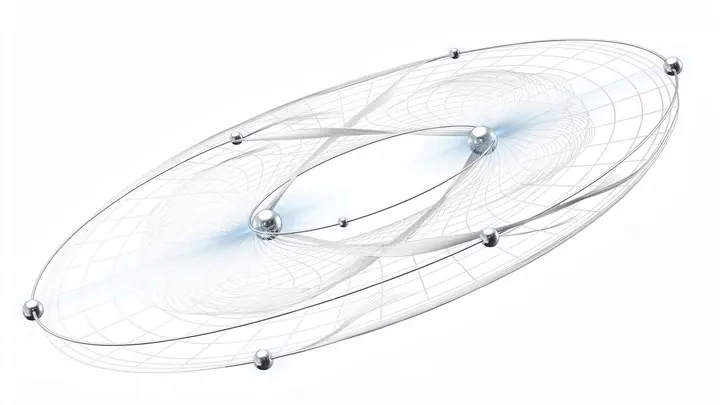
Two beams of light race around a closed loop, heading toward each other. Since the speed of light is constant, when the ring turns, one beam has to catch up with a moving finish line, while the other meets it sooner. Their meeting creates a pattern, and from that pattern we can tell how fast the whole system is spinning.
For decades, the search for extraterrestrial intelligence has waited for quiet, coherent signals from space — a kind of 'whistle' in the radio silence. However, our own technosphere has created a continuous radio background — the hum of a vast metropolis, emitted by all communications, radars, and broadcasting stations.
On a dark night over the Uruguayan pampa, a dazzling fireball silently flares up. It streaks for a few seconds, scattering sparks, and fades beyond the horizon. This is a bolide — a large asteroid fragment slamming into the atmosphere. If it survives the fall, a meteorite will land on the ground.
Searching for extraterrestrial signals is like trying to hear a whisper at a roaring stadium. The Green Bank Telescope listened to 70,000 stars, but 100 million bursts turned out to be earthly noise — from phones, satellites, microwave ovens.
Astronomers aimed JWST at the rocky exoplanet LHS 3844 b — a world orbiting another star, where a year lasts just 11 hours. The planet is tidally locked: one side always faces the star, with a permanent scorch of 770°C, while the night side is plunged into icy darkness.
The solar wind, a stream of charged particles from the Sun, slams into the tenuous gas that fills the space between the stars. The collision produces a faint X-ray glow. For astronomers, this is like fog in front of headlights: it obscures distant objects.
The night sky sometimes throws up riddles that take your breath away. One of them is a ring of galaxies stretching across a third of the horizon. Astronomers have named it the “Giant Ring on the Sky”: a cluster of galaxies stretched into a thin filament and closed into a circle about 400 megaparsecs in diameter.
In a distant galaxy, at a distance that light takes 11 billion years to cross, something flashed. The Einstein Probe X-ray telescope caught a brief, needle-prick-like burst: it lasted only a few dozen seconds.
The night sky looks calm, but if you listen in on the radio band, it's full of short clicks and rustles. Astronomers are combing the sky for solitary radio pulses — bursts lasting milliseconds that come from various corners of the Galaxy and beyond.
One such search is underway at the 100-meter radio telescope in Effelsberg, Germany.
Thirty-six years ago, a star exploded in a neighboring galaxy. The flash was named Supernova 1987A, and since then it has been monitored almost every year. Now the James Webb Space Telescope has looked at its remnant in the mid-infrared — the part of the spectrum where dust and heated gas glow.
Imagine you and your friends are in a dark room. You agree that after a common flash, each of you will turn on a flashlight ten seconds later, but with a correction for the light delay — since the light from the flash reaches each of you with a slight lag.
The night sky looks still, but many stars tremble like a drum after a strike. For seven straight years, the TESS satellite stared at the same patches of sky and caught this trembling in 19,151 red giants — old, bloated stars. Previously, far fewer of these 'singing' giants were known, and now the list has grown by 80%.
When an exoplanet briefly eclipses its star, starlight passes through its air and absorbs its chemical taste. This technique, the transit method, is the core of how the James Webb telescope works.
Massive stars end their lives in a colossal explosion, which Fritz Zwicky called a supernova. The core crushes down into a black hole or a neutron star.
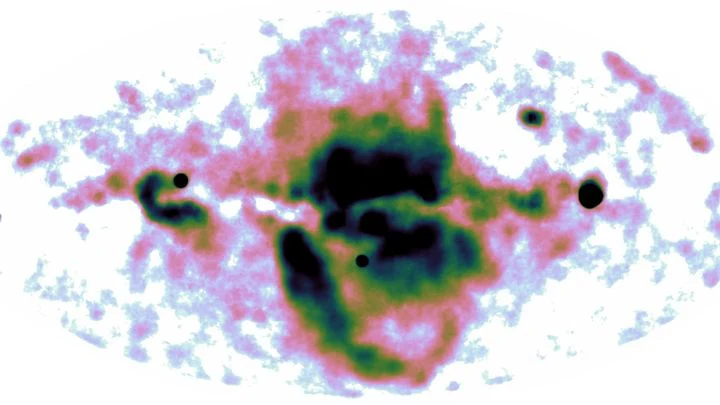
In 2020, the eROSITA X-ray telescope discovered a pair of enormous bubbles looming above and below the disk of our Galaxy. These clouds of gas heated to millions of degrees are the aftermath of a colossal energy release from the center.
The Gaia space telescope measures star positions with an accuracy of a microarcsecond, like spotting a coin on the Moon from Earth. In 2022, it noticed that the bright star HD 12800 was wobbling slightly, as if tugged by an invisible companion. Astronomers hypothesized that a planet orbits the star.
But a wobble can be deceiving.
A tiny ghostly particle zips through a piece of germanium. Usually it leaves no trace, but sometimes, like a billiard ball, it smacks into an atom's nucleus. The nucleus recoils, and that jolt can be detected. At Oak Ridge National Laboratory, the Ge-Mini detector caught such recoils for two years.
Neutrinos are the most elusive of known particles.
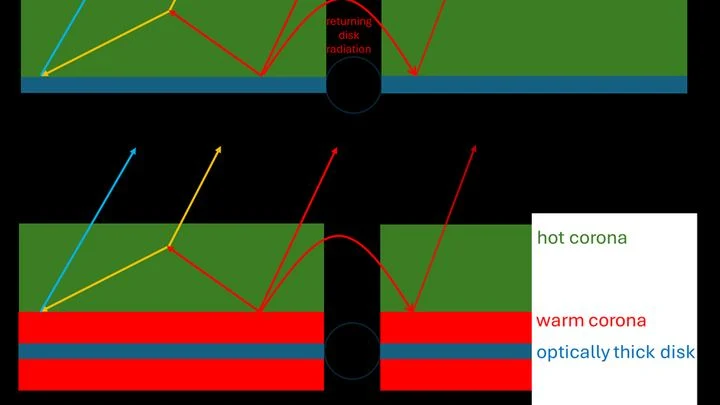
The black hole Cygnus X-1 is one of the most studied in our galaxy. It pairs with a normal star, pulling matter from it. The gas spirals into a glowing disk, like water down a drain, and above the disk hangs a scorching corona — a cloud of electrons at temperatures of hundreds of millions of degrees.
In October 2022, the cosmos put on a fireworks show that every detector on Earth noticed. The explosion, named GRB 221009A, was so bright that it was called the brightest ever observed. It's a gamma-ray burst — a short but incredibly powerful flash that releases as much energy in seconds as the Sun will produce in its entire lifetime.
Light from a star travels for millions of years, yet in a telescope it still appears as a point: it's just too far away. To see a star's surface, you need an instrument the size of a city. In Chile, such a giant is already under construction: ELT with a 39-meter mirror made of 798 hexagonal segments.
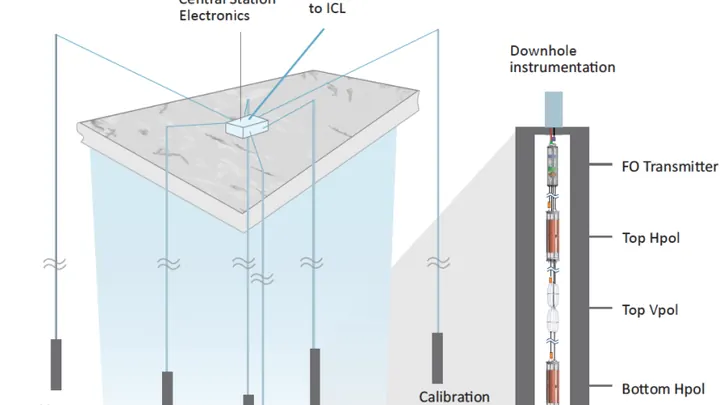
Deep within the Antarctic ice, at depths where sunlight never reaches, antennas hang suspended. They listen not for sounds but for radio waves, waiting for a signal from a particle that is nearly impossible to catch. A neutrino passes through the Earth like a bullet through fog, but occasionally, very rarely, it grazes an ice atom.
An X-ray image usually brings to mind a bulky machine in a hospital. But such a picture can be taken by a device the size of a palm, assembled from hobbyist electronics. The authors took a Raspberry Pi mini-computer, a 12.3-megapixel camera, and a screen that glows under X-rays.
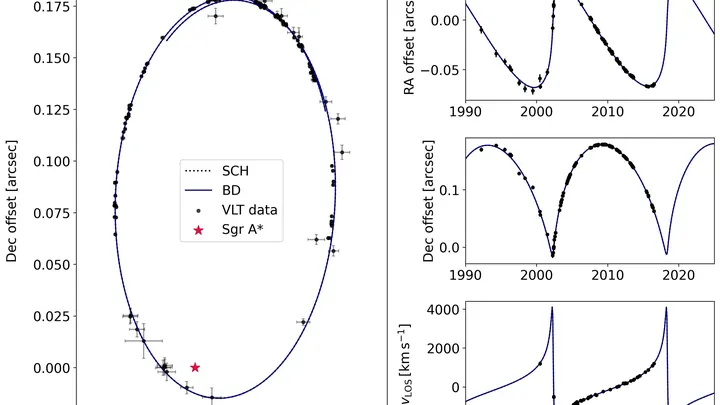
Something massive hides at the center of the Milky Way — four million times heavier than the Sun. The star S2, like a racer on a steep curve, loops around this object every sixteen years in an elongated orbit, accelerating to 7650 kilometers per second. By tracking exactly how it moves, astronomers are trying to figure out what that 'something' is.
A quiet flute melody gets lost in the roar of drums. That's what astronomers face when trying to catch the faint light that has passed through a distant planet's atmosphere while its star blazes nearby.
A team of scientists observed WASP-31 b — a hot Jupiter, a gas giant orbiting very close to its star.
The Bullet Cluster is a cosmic collision site where two vast clouds of galaxies, gas, and invisible matter slammed into each other. When light from distant stars passes near such a cluster, gravity bends its path like a lens. Astronomers study these distortions to work out where the mass is hiding.
You can't catch X-rays from stars with an ordinary mirror: they pass through glass like light through a window pane. To reflect them, you need a mirror almost parallel to the beam: then the X-rays skim along the surface like a flat stone skipping on water, only slightly changing direction.
An X-ray telescope captures light from hot gas around stars, but that light arrives 'blurred'—like a voice over a bad phone line. To make out the words, you need a dictionary of the exact frequencies at which atoms glow. Such a dictionary is written not only with calculations but also with direct experiments.
Radio telescopes scattered across the globe pick up waves from distant black holes. But two telescopes placed almost side by side see only a blurry blob — fine details are beyond them. Usually, such pairs are considered useless and discarded. But that's a mistake: even a blurry blob holds clues.