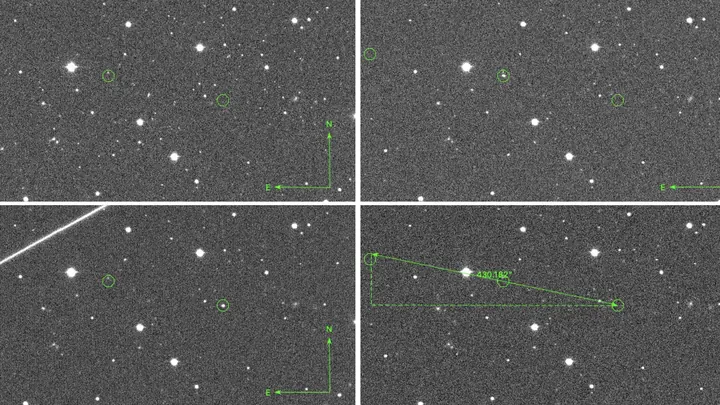
The Vera C. Rubin Observatory is a ground-based astronomical facility in Chile, designed to conduct the Legacy Survey of Space and Time (LSST) — a decade-long project that will repeatedly image the entire visible southern sky every few nights. Its primary goal is to detect transient and variable objects: supernovae, asteroids, Kuiper Belt objects, and any sudden changes in brightness. The corpus titles reflect its broad scientific reach: one article discusses using Earth's shadow as a natural filter to search for extraterrestrial artifacts, another describes detecting a supernova via neutrinos before its optical flash, and a third reports on the observatory's first test images. The observatory is named after Vera Rubin, the astronomer who provided key evidence for dark matter through galaxy rotation curves.
History
The observatory was originally proposed in the early 2000s as the Large Synoptic Survey Telescope (LSST), with construction beginning in 2015. It was renamed in 2019 to honor Vera Rubin, who died in 2016. First light images were obtained in 2024, and the full survey is expected to begin in 2025.
How it works
The observatory uses an 8.4-meter mirror with a 3.2-gigapixel camera — the largest digital camera ever built for astronomy. Every night, it takes a series of 15-second exposures, each covering an area of sky about 40 times the size of the full Moon. By comparing images of the same region taken on different nights, sophisticated software automatically detects changes: new objects, moving objects, or brightness variations. The telescope's wide field of view and rapid cadence allow it to map the sky's dynamic state with unprecedented completeness.
In practice
Beyond pure astronomy, the observatory's data will help identify near-Earth asteroids that could pose impact hazards, and its vast dataset will be publicly available for scientific research across many fields.
Fun fact
The Rubin Observatory's camera is so large that it contains about 200 individual sensors, and each image it produces is so big that viewing one at full resolution would require a screen the size of a tennis court.
The night sky is like an ocean: the longer you stare, the more faint lights you notice in the depths. That's how astronomers, peering into the outskirts of the Milky Way, found Aquarius IV — a tiny stellar system that had been hiding in the dark until now.
The system was spotted in images from an early survey by the future Vera Rubin Observatory.
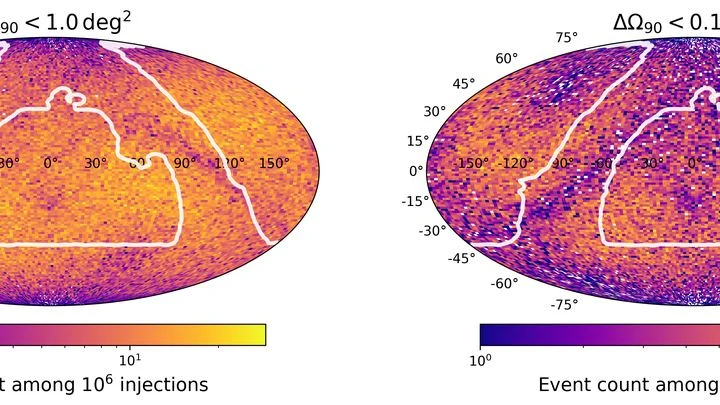
Predicted by Albert Einstein, gravitational waves are like beacons in the dark ocean of space. They flare up when black holes collide, sending ripples through the fabric of the Universe.
Within a field of view the size of a grain of sand held up to the eye, hundreds of galaxies lie hidden, smeared into arcs by the massive cluster Abell S1063.
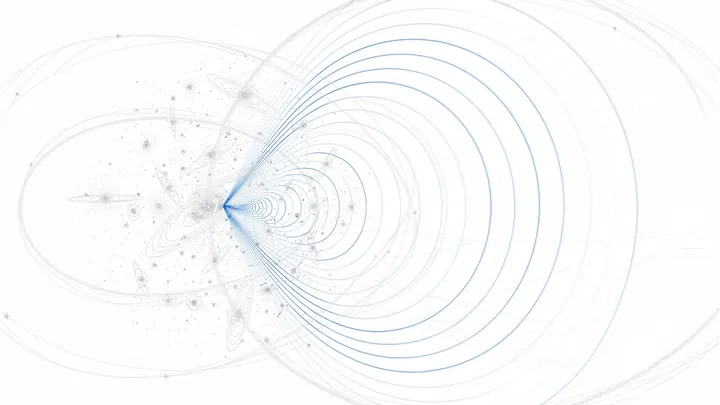
Two dead stars circle in a final dance. Their approach creates ripples in space — gravitational waves. But there may be a third, invisible partner in this dance. Its gravity accelerates the pair, and the signal changes pitch slightly, like the siren of a passing car.
When the James Webb Space Telescope turned its gaze deep into time, astronomers expected to see familiar galaxies. Instead, the images were dotted with a scattering of bright, incredibly compact red dots.
On a dark night over the Uruguayan pampa, a dazzling fireball silently flares up. It streaks for a few seconds, scattering sparks, and fades beyond the horizon. This is a bolide — a large asteroid fragment slamming into the atmosphere. If it survives the fall, a meteorite will land on the ground.
A stone falls into a well, and the splash reaches your ears with a delay. Something similar happens to light as it leaves Earth: its oscillations become less frequent, the beam seems to 'tire.' This is gravitational redshift — a phenomenon Einstein spoke of a century ago.
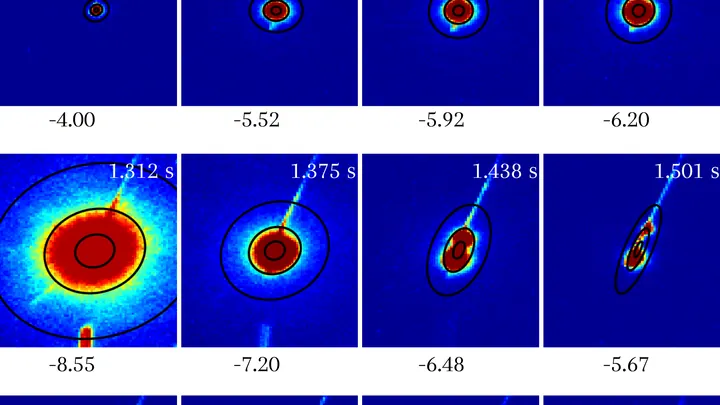
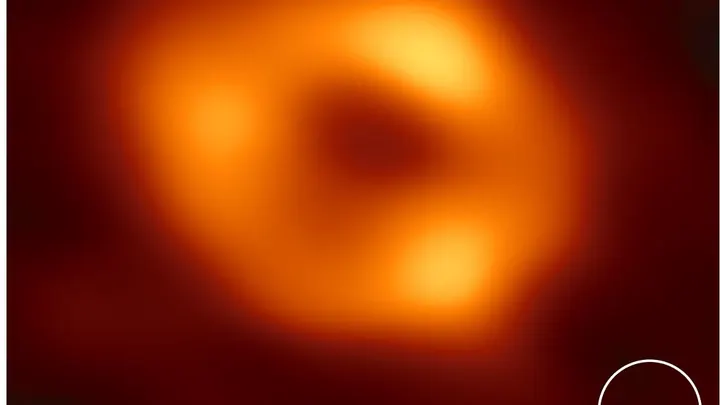
Einstein's theory of gravity explains how mass warps space and time. Its predictions have been tested near Earth, but the most grueling tests lie around black holes, where distortions reach their breaking point. Until now, astronomers saw them as blurry smudges on an underexposed photo.
At the edge of the solar system, far beyond Neptune, hundreds of icy chunks circle the Sun. Some of them move as if an invisible hand had aligned their orbits like compass needles. Ten years ago, this led astronomers to suspect that a massive planet, about ten times heavier than Earth, is hiding there.
Conventional dark matter detectors are like a soccer goalkeeper waiting for a powerful shot while the ball barely rolls. The invisible particles filling our galaxy often move too slowly to be noticed by sensitive sensors.
A massive star's explosion is bright but brief. The flash itself lasts weeks, but the dust it heats around it glows in infrared for years. It's like a camera flash illuminating a room, then hot dust particles lingering in the air — only on a cosmic scale.
Astronomers have tested the new Vera C. Rubin telescope in Chile, much like adjusting the focus and aperture on a brand-new camera. The first images covered a patch of sky the size of 60 full Moons, and immediately revealed millions of galaxies and stars. The imaging was done in various colors, from invisible ultraviolet to thermal infrared.
At the center of our Galaxy lies a supermassive black hole, with stars orbiting around it. Their motion resembles a cosmic dance: some race along elongated orbits, others follow nearly circular paths. If invisible dark matter exists near the black hole, it slightly distorts these orbits, like an unseen hand nudging a star off course.
For six straight years, the HARPS-N telescope on La Palma island stared at the Sun as if it were a distant star — taking spectra, tracking brightness, and recording every quiver of spectral lines. All this was to understand how to distinguish a star's subtle sway from a genuine planetary signal.
A star doesn't sit still: its surface boils like a pot of soup.
At the bottom of lunar craters, where sunlight never reaches, an eternal cold reigns — about minus 240 degrees Celsius. In these icy pockets, known as permanently shadowed regions, plans are underway to install a mirror resonator made of monolithic silicon.
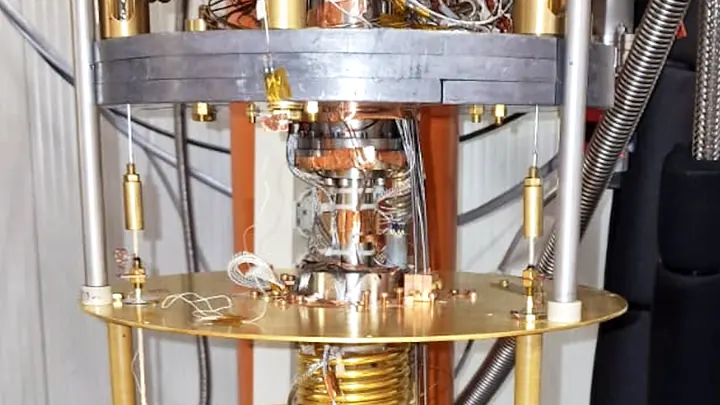
Ancient lead that lay on the seafloor for two thousand years has become the heart of a detector searching for the most elusive substance in the universe. From it, researchers grew a transparent lead tungstate crystal weighing 13 grams and cooled it to near absolute zero.
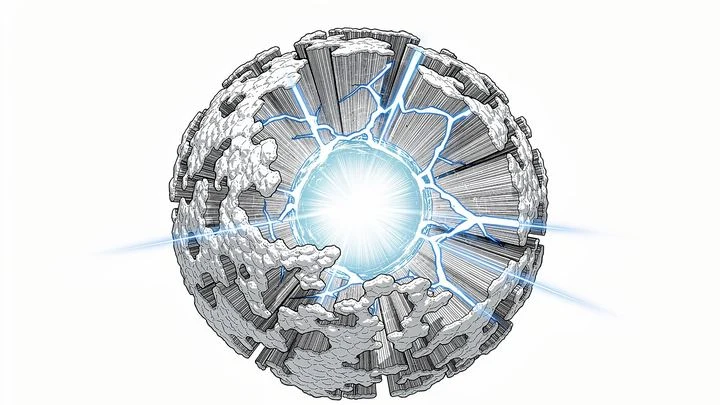
When a massive star runs out of fuel, it collapses and explodes as a supernova. An instant before the catastrophe, neutrinos — ghostly particles — burst from the core. They rush through the star and interstellar space like the smell of smoke, heralding a fire that will only ignite minutes or even days later.
When light from a distant galaxy travels toward us, dark matter along the way bends the rays slightly, like imperfect glass. Astronomers measure these distortions to understand where the invisible mass lurks. But galaxies also have their own, "intrinsic" distortions: they align not randomly but along the invisible threads of the cosmic web.
Thanks to gravitational lens — an effect predicted by Fritz Zwicky, where a galaxy cluster acts like a magnifying glass — the James Webb Space Telescope spotted two red dots in a galaxy 800 million years after the Big Bang.
A river of stars (not a cluster, but a distinctly elongated, glowing ribbon) crosses the outskirts of a distant galaxy. Such a stream was spotted in data from the first survey by the Vera Rubin Observatory. It stretches along the minor axis of the galaxy LEDA 751050, like a scarf streaming from the galactic disk.
The stream is enormous: 130 by 15 kiloparsecs.
Dark matter is the invisible scaffold of the Universe, revealing itself only through gravity. Vera Rubin, studying the rotation of galaxies, found that stars at the periphery move too fast, as if held by an unseen mass. This became compelling evidence for the existence of dark matter, yet its particles still elude direct detection.
Back in the 18th century, William Herschel was searching for life on Mars. Today, astronomers are targeting not planets but artifacts — for example, alien probes lurking in the Solar System. The problem is that spotting a tiny object next to the blinding Sun is nearly impossible.
At the heart of many galaxies lies an invisible beacon — a supermassive black hole. As it devours matter, it blasts a dazzling beam of gamma rays into space. If that beam points towards Earth, astronomers see a blazar — a bright but fickle point.
A firefly blinks for one ten-billionth of a second somewhere above the Siberian taiga. Seeing such a thing is impossible, but the TAIGA-HiSCORE array, spread across a valley in the Tunkinsky district of Buryatia, tried to catch exactly such flashes — not from insects, but from the depths of space.
Every clear night, a telescope in the Chilean desert records light from distant stars, and in those recordings, like old ship logs, traces of weather remain. The thin dark bands in the spectrum are imprints of water vapor that hung over the observatory at the moment of observation.
Every night, an invisible sentinel hangs over the Andes. The GOES-12 satellite, and later its successor GOES-13, watches Earth from an altitude of 36,000 kilometers, recording how the mountains breathe clouds. For five straight years, it tracked where the sky stayed clear and where it got wrapped in cotton.