Sunlight on a chip: catching a star's shimmer express
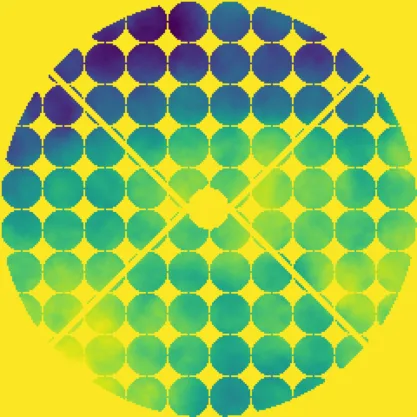
A solar telescope is like an eye trying to spot an ant through a pot of boiling soup. The daytime sky dazzles, the air shimmers, and the image swims. To freeze it, you need adaptive optics — a system that predicts distortions and corrects them hundreds of times per second. But on the Sun, the usual trick fails: there's no lone star to track, just a sprawling sea of fire.
Engineers at the observatory found a way out: they ditched the camera. In its place, light is caught by a photonic chip — a glass plate with a labyrinth of hair-thin channels. Light runs through them like water through pipes and meets itself. At the meeting point, fringes appear — an interference pattern. Their shift reveals how much one part of the wave has outraced another. It's like footprints in the sand that show one runner stumbled.
The authors built a computer model of such a sensor. It showed that the chip can distinguish even faint light swirls: those a camera would simply blur into a single blob. The key secret lies in a pair of "antennas" at the input: they capture light from two points, and the farther apart those points, the finer the details that can be reconstructed.
Now solar astronomy has a chance to see the daytime star with the same clarity as the night sky. A tiny chip promises to restore the vision that the atmosphere stole from telescopes.
Original abstract
as written by the authors arXiv:2605.10649
Context. Solar wavefront sensing has been a challenge for astrophysical instrumentalists, due to the low contrast between the Sun and the sky background compared to night-time observations, which limits the performance of adaptive optics systems. Aims. Wavefront correction in solar physics requires the analysis of extended images; meanwhile, at night the displacement of a punctual object is analysed. This technique limits the spatial resolution, and therefore the accuracy in the wavefront reconstruction. Methods. To solve this problem, a new method of direct wavefront sensing without the need for image formation was explored for this work. A novel and promising technology called integrated photonics was used to accomplish this task. It allows the direct measurement of phase differences across the wavefront without the need to form images, using the principle of interferometry. This technology offers a low-consumption, miniaturised solution to astrophysical problems. Results. For this work a mathematical model was derived to characterise the behaviour of the proposed wavefront sensor. The proposed system was verified and simulated using a Python-based adaptive optics simulator. These simulations demonstrate the physical behaviour of the proposed wavefront sensor and highlight the factors that must be taken into account for its correct functioning.
The photonic chip used to measure light shimmer works on the same principle as gravitational wave detectors, but instead of kilometer-long tunnels, here the channels are as thin as a hair.
In Stanisław Lem's novel "Solaris," the ocean of a living planet distorted probe signals — perhaps a photonic chip would have helped scientists realize sooner that they were dealing with a sentient element.