Single-photon detection is the ability to register individual quanta of light, the smallest discrete packets of electromagnetic energy. Unlike conventional light sensors that measure the average intensity of a beam, single-photon detectors are sensitive enough to record the arrival of each photon as a distinct event. This capability is essential for many areas of quantum technology, where information is encoded in the quantum states of single photons, and for fundamental physics experiments that probe the particle nature of light.
History
The first practical single-photon detectors were photomultiplier tubes, developed in the 1930s and 1940s. The concept of avalanche photodiodes for single-photon counting emerged in the 1960s, with significant advances in the 1980s and 1990s for fiber-optic applications.
How it works
Most single-photon detectors rely on avalanche multiplication. A photon absorbed in a semiconductor material creates a single electron-hole pair. A high electric field accelerates these charge carriers, causing them to collide with the lattice and generate additional electron-hole pairs, creating an avalanche of charge that produces a measurable electrical pulse. Other approaches include superconducting nanowire detectors, where a photon breaks Cooper pairs and creates a hot spot that changes the resistance, or photomultiplier tubes that amplify electrons through a series of dynodes.
In practice
Single-photon detectors are used in quantum key distribution for secure communication, in lidar and remote sensing for high-resolution imaging, and in medical imaging techniques like positron emission tomography (PET) scanners.
Fun fact
Some single-photon detectors are so sensitive that they can detect a photon that was never actually emitted, a phenomenon known as 'negative presence' explored in quantum optics experiments.
An assembly line spits out parts one by one per cycle. If the cycle is short and defects are few, the line runs fast. In quantum optics, a single-photon source plays the role of such a line: it must emit exactly one quantum of light per cycle, and the more cycles per second, the more photons go into the fiber.
Light passing by a tiny structure changes direction. If the structure is smaller than the wavelength of the light, it acts like a lens and focuses the light into a spot smaller than the wave itself.
A billiard ball hangs in midair. Tiny peas shoot at it from a blowgun. Each hit is barely perceptible, but if the ball is very light and barely trembles from heat, you can make out individual nudges. That's essentially the setup: a glass sphere the size of a bacterium levitates in a vacuum while a narrow beam of xenon atoms flies at it.
A single photon is like a perfectly smooth brick from which quantum technologies can be built. But to build a house, you need thousands of identical bricks. Rubidium atoms are natural emitters: each atom emits photons of exactly one wavelength, like a tuning fork that always produces a single note.
Starlight passing through the atmosphere and telescope optics shimmers like sunlight dancing on water. Hidden in that ripple are planets — faint sparks next to a blinding glare. To see them, you have to freeze the ripple: make the light as smooth as glass.
A handful of pebbles drops into a pond: each one sends out ripples. If the pebbles are different, the ripples will be different too: some sharp, some smooth. But when you look at the water from a distance and see only a small part of the ripples, all those differences blur together.
Each morning, dozens of telescopes swing toward the Sun. Their cameras catch a narrow band of red light — the Hα line, discovered by Johann Balmer. The images reveal dark, whimsically curved threads. They look like stitches in a giant tapestry sewn through the blazing corona.
Low-frequency radio waves (from 30 to 300 kilohertz) carry information through water and earth. But catching them with an ordinary antenna is hard: the wavelength reaches several kilometers, and a small receiver barely feels such a field.
A protein in a cell is not a frozen sculpture but a restless mechanism. Its parts are constantly vibrating, and these movements determine how it grabs molecules, transmits signals, or builds the cellular scaffold. But filming the life of a single protein was hampered by two nuisances at once. First, the movements last millionths of a second — ordinary cameras simply cannot catch them.
The quantum many-body world is a jazz ensemble, where each electron improvises, continuously listening to all the others, and the overall wave function is born from this tense dialogue.
A laser isn't just about light. If you make a particle oscillate like a pendulum and those oscillations sustain themselves, you get a phonon laser. Sounds complicated, but the idea is simple: instead of light waves, the device emits orderly waves of mechanical vibrations — phonons.
A smartphone camera captures everything indiscriminately, but the eye immediately picks out what matters. The retina doesn't just pass the image to the brain: it highlights contours on the spot, suppresses noise, and adjusts to brightness.
An ordinary photometry detector can't tell a left photon from a right one. But let it start moving, and everything changes.
Imagine a rower moving between two flutists playing the same note. His ear is perfectly tuned to that note and ignores all others. As he moves, the pitch from the flutist ahead sounds higher, and from the one behind sounds lower.
A solar telescope is like an eye trying to spot an ant through a pot of boiling soup. The daytime sky dazzles, the air shimmers, and the image swims. To freeze it, you need adaptive optics — a system that predicts distortions and corrects them hundreds of times per second.
Light in an optical fiber runs along the core, barely escaping outside. But if you get very close, you can feel a faint trembling of the field at the surface — the evanescent wave. It is in this 'light fog' above the surface of a tiny silicon ring that physicists have caught a single rubidium atom.
An ordinary rain gauge collects water in a bucket and shows the total volume of precipitation. But the new device is like a sensitive palm that feels every falling drop and keeps count, even when the drops number in the thousands.
That's exactly what physicists have built.
A tiny glass bead hangs in a laser beam like a speck of dust in sunlight. Around it is a rarefied gas: atoms of krypton, xenon, and heavy molecules of sulfur hexafluoride. They collide with the bead, and each hit transfers a tiny impulse, like a pea thrown at a taut sheet makes it tremble.
Impulse is a measure of motion: mass times velocity.
An ordinary light sensor answers the question "how much light" but not "where did it come from." To do that, you need lenses, mirrors, or entire arrays. In a new study, researchers propose a sensor that determines the direction of a light beam on its own, without any optics.
When two particles fly at almost the same speed in the same direction, their signals in the detector merge, like two voices in unison. Telling a duet from a soloist is an art in itself.
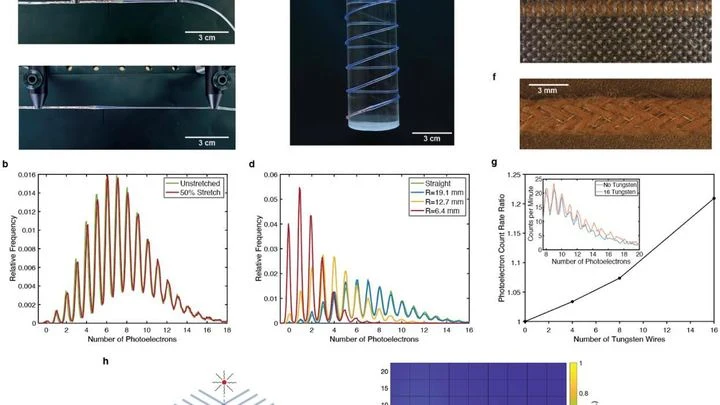
Inside an ultra-thin polymer thread are microscopic crystals — scintillators. When an invisible radioactive particle hits, they flash for a moment, like fireflies. A sensitive sensor catches each flash, turning the thread into a flexible detector.
An ordinary antenna picks up radio waves, but there are fields it barely feels. We're talking about slow electric fields: those that change once a second or less. For them, physicists built a sensor from a beam of rubidium atoms.
The light an atom emits is not just a flash. It carries an imprint of the atom's state at the moment of emission. Physicists took a superconducting qubit, an artificial atom the size of a microchip, and made it glow into an open waveguide, like a bulb in a long corridor.
An electron beam in an accelerator is like a flock of birds: it flies in a tight group, but over time it spreads out. To keep particles together, heavy magnets are usually used. Here they did without them — the beam squeezed itself.
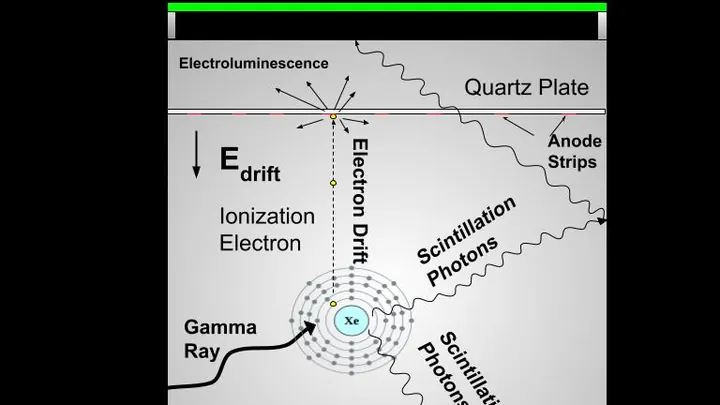
Underground, in a former gold mine, sits a tank of liquid xenon. If a dark matter particle flies through it, the xenon flashes. But it also flashes from ordinary particles, like neutrinos or leftover radioactivity. The task is to tell which flash comes from dark matter and which from noise.
The camera that hunts for tumors works like a highly sensitive camera: it catches the faint glow from a substance that accumulates in diseased cells. In conventional machines, the light is born in a crystal — a solid piece that resembles glass. But a crystal doesn't always convey exactly where the light flashed, so the image comes out slightly blurry.
Ordinary light is like a crowd in a square: each photon moves on its own, bumping into others and scattering. But in some media, photons start running together like a pack of dogs: they bunch up. Scientists have built a random fiber laser where light particles gather into especially dense clusters.
When light knocks an electron out of an atom, it flies off like a ball thrown into a crowd. Scientists have long wanted to know the exact moment each electron leaves the atom, but direct measurement disturbed the very process. Now physicists have proposed a method that uses a second light pulse to 'photograph' the moment of the electron's birth.
In quantum communication, a secret key is transmitted using single photons. Eavesdropping on such a channel is supposedly impossible: any interception attempt disturbs the particle and leaves a trace. But the idea has a weak spot — the real hardware, which sometimes behaves differently than theory dictates.
A fridge magnet attracts a paperclip: we can feel that field with our hands. Now shrink that field by a billion times. Atoms inside our bodies emit such weak signals, and they are very hard to catch.
Scientists built the sensor from special molecules that themselves behave like tiny magnets.
The tip of a scanning tunneling microscope approaches a crystal surface so closely that an electric current jumps between them. Electrons from the needle are injected into a layered semiconductor and land in an atomic vacancy — a spot where one atom is missing from the lattice. This void acts as a tiny trap for charge.
A single antiproton, trapped and cooled to near absolute zero, behaves like a tuning fork that needs a very precise strike to produce a clean note. Catching that 'note' directly is nearly impossible — the signal is too weak.
The night sky is not all that dark. Even far from cities, it glows faintly — which hampers astronomers trying to catch weak flashes from distant cosmic rays.
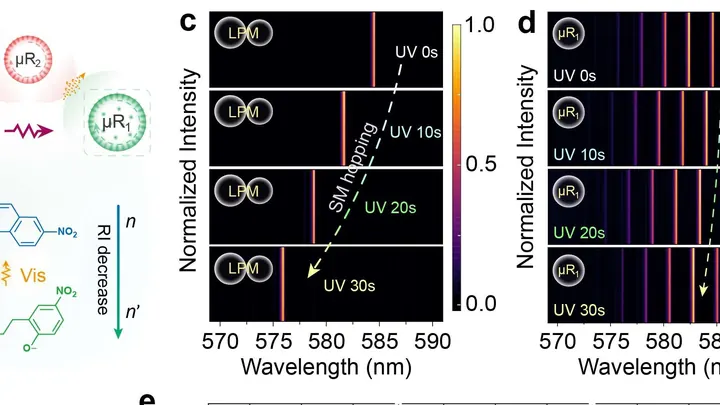
Two liquid droplets hanging side by side begin to sing in unison. One droplet is like a string tuned to a certain pitch, and together they form a laser that shines with a single, pure color. That's how a new type of sensor, a liquid photonic molecule, works.
The secret is that the droplets are slightly different in size.
Glowing spots on a dark background: that's what single-molecule images from MINFLUX look like. This microscope can reveal details smaller than five nanometers: roughly ten thousand times thinner than a human hair.
A camera that captures not light but a stream of electrons reflected off a crystal is a hybrid pixel detector. It can count every electron that hits it, generating almost no noise of its own. In normal mode, when the electron beam flows continuously, the detector works perfectly.
A photon is like a car in a multi-story parking lot, where each floor is its frequency (color). Usually it gets stuck on one level, but scientists added an elevator — a programmable modulator that moves the photon between floors on command.
An X-ray machine at the dentist's office takes a single flat image of a tooth. But if you need to see the insides of a microchip from all sides, you have to take the sample to a synchrotron — an accelerator the size of a football field.
Imagine a vast field of fireflies, each flashing alone rather than in a swarm: that's what the new automated setup is hunting for. It sweeps a laser across the sample like a flashlight and records the color and brightness of the glow at every spot.
A thin superconducting wire, cooled to near absolute zero, can sense a single particle of light. Such detectors are indispensable for quantum computing and secure communication, but their temperament is spoiled by disorder — random irregularities and impurities that cannot be completely removed.
Instead of fighting disorder, physicists decided to tame it.
At the Large Hadron Collider, physicists accelerate protons to nearly the speed of light and smash them together. Usually, the protons themselves take part in such collisions, but sometimes they pass close by without touching, and it is their electric fields that interact.