Photon counting is a detection technique that registers individual photons, converting each into a discrete electrical pulse. Unlike conventional detectors that measure the average intensity of light, photon counting resolves the arrival of single quanta of light, providing extremely high sensitivity. This method is particularly valuable for extracting weak signals from bright backgrounds, as it can discriminate between a few photons and a large background by counting events over time.
History
Photon counting was pioneered in the early 20th century with the development of photomultiplier tubes, but it became a standard technique in the 1960s with advances in electronics and single-photon detectors. The method was crucial in early experiments on photon statistics, such as those by Hanbury Brown and Twiss.
How it works
A photon counting detector, such as a photomultiplier tube or an avalanche photodiode, operates in Geiger mode: a single photon triggers an avalanche of electrons, producing a macroscopic current pulse. The pulses are counted by electronics, and the count rate is proportional to the photon flux. To extract a signal from a bright background, one can use time-correlated single-photon counting, where the arrival times of photons are recorded relative to a trigger, allowing the weak signal to be distinguished by its temporal signature.
In practice
Photon counting is used in fluorescence lifetime imaging, quantum key distribution, astronomical observations, and medical imaging such as positron emission tomography, where detecting single photons enables high-resolution imaging.
Fun fact
Modern photon counters can detect a single photon with an efficiency exceeding 90%, and some can even resolve the number of photons in a pulse, a capability known as photon-number resolution.
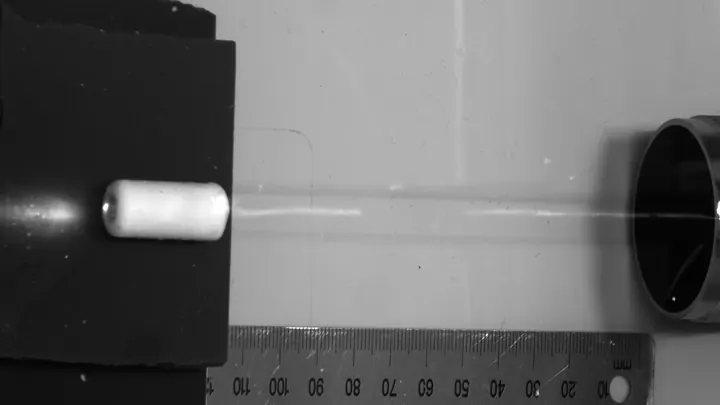
The antiproton beam hits the plate, and each impact bursts into a shower of charged particles. In the GBAR experiment at CERN, this picture is captured not by a sophisticated detector but by an ordinary industrial camera without a lens, pressed against the vacuum window from the outside.
Catching light one particle at a time is like hearing a whisper in a roaring factory. An electron-multiplying camera (EMCCD) can do exactly that: it turns a single photon hitting a pixel into an avalanche of electrons that can be measured. These cameras are mounted on telescopes to spot a barely visible planet next to a dazzling star.
In very dim light, photons arrive one by one, like drops from a leaky faucet — never in pairs. This effect, predicted by Roy Glauber and confirmed by Leonard Mandel, directly proves that light is made of particles.
You're pouring water into a glass, but you want exactly one million drops — not approximately, but exactly. An ordinary faucet pours a stream where the number of drops always varies. In the quantum world, photons have the same problem: a laser emits light where the number of particles fluctuates like a crowd in a square.
An ordinary photometry detector can't tell a left photon from a right one. But let it start moving, and everything changes.
Imagine a rower moving between two flutists playing the same note. His ear is perfectly tuned to that note and ignores all others. As he moves, the pitch from the flutist ahead sounds higher, and from the one behind sounds lower.
A solar telescope is like an eye trying to spot an ant through a pot of boiling soup. The daytime sky dazzles, the air shimmers, and the image swims. To freeze it, you need adaptive optics — a system that predicts distortions and corrects them hundreds of times per second.
Any light measurement runs into a fundamental limit: photons hit the camera sensor unevenly. This natural ripple (shot noise) blurs fine details, like trying to pick out a quiet instrument in an orchestra through the noise of the hall.
An ordinary rain gauge collects water in a bucket and shows the total volume of precipitation. But the new device is like a sensitive palm that feels every falling drop and keeps count, even when the drops number in the thousands.
That's exactly what physicists have built.
An ordinary light sensor answers the question "how much light" but not "where did it come from." To do that, you need lenses, mirrors, or entire arrays. In a new study, researchers propose a sensor that determines the direction of a light beam on its own, without any optics.
A neutral-atom quantum computer is like a library where books not only need to be read but also quickly returned to the shelf. Slow readout of results is like a sluggish librarian holding up the entire queue. Scientists have found a way to speed up this process by adding helpers.
When two particles fly at almost the same speed in the same direction, their signals in the detector merge, like two voices in unison. Telling a duet from a soloist is an art in itself.
Hunting for a single glowing spot in a dark sample is like trying to find a needle in a haystack: the microscope beam crawls line by line, wasting time and light. Physicists replaced this slow sweep with random light patterns. The sample is illuminated with a broad field, but each time with a new pattern of bright and dark patches, as if random shadows from a grid were projected onto it.
At the Large Hadron Collider, protons collide, and from the flash dozens of particles are born. Among them may be traces of rare processes — for example, the decay of a Standard Model Higgs boson into two W bosons. But these particles fly apart so quickly that their tracks merge into a single wide jet.
Light in a particle detector behaves like a voice in the mountains. One shout, and the echo repeats several times, growing fainter with each reflection. So it is in a silicon detector: a real flash from a particle gives rise to false ones that confuse measurements.
A security guard needs to check five rooms but can't go inside. He knocks on the door and listens: silence means someone is inside, while an echo means the room is empty.
The lighthouse in the Crab Nebula blinks thirty times per second. It's a pulsar — a dead star that, as it spins, shoots out narrow beams of light, and Earth sweeps through them like a ship crossing a lighthouse beam. This lighthouse has two beams: the main pulse and the interpulse.
Underground, in a former gold mine, sits a tank of liquid xenon. If a dark matter particle flies through it, the xenon flashes. But it also flashes from ordinary particles, like neutrinos or leftover radioactivity. The task is to tell which flash comes from dark matter and which from noise.
Dark matter is an invisible mass holding galaxies together. Its nature remains unknown, but one likely candidate is the axion — an ultra-light particle that barely interacts with matter. To catch it, physicists built a hybrid trap.
To spot a dim star above a brightly lit city, astronomers subtract one image from another — removing the glare of streetlights. They do the same with living neurons: their faint flashes drown in noise, but if you subtract everything unchanging, only they remain.
When light knocks an electron out of an atom, it flies off like a ball thrown into a crowd. Scientists have long wanted to know the exact moment each electron leaves the atom, but direct measurement disturbed the very process. Now physicists have proposed a method that uses a second light pulse to 'photograph' the moment of the electron's birth.
A single antiproton, trapped and cooled to near absolute zero, behaves like a tuning fork that needs a very precise strike to produce a clean note. Catching that 'note' directly is nearly impossible — the signal is too weak.
The night sky is not all that dark. Even far from cities, it glows faintly — which hampers astronomers trying to catch weak flashes from distant cosmic rays.
Glowing spots on a dark background: that's what single-molecule images from MINFLUX look like. This microscope can reveal details smaller than five nanometers: roughly ten thousand times thinner than a human hair.
Two clocks in different rooms need to tick in unison. Usually, this is done by sending bright pulses or pairs of photons that arrive one right after the other. But the signal can be so weak that photons barely make it through. In this work, clocks were synchronized with light a billion times dimmer than usual.
A camera that captures not light but a stream of electrons reflected off a crystal is a hybrid pixel detector. It can count every electron that hits it, generating almost no noise of its own. In normal mode, when the electron beam flows continuously, the detector works perfectly.
An X-ray machine at the dentist's office takes a single flat image of a tooth. But if you need to see the insides of a microchip from all sides, you have to take the sample to a synchrotron — an accelerator the size of a football field.
If light could be bottled, scientists would have the perfect assembly line: one bottle — exactly one photon, no stray drops. Such single particles of light are needed for quantum computers and secure communication: they carry information that cannot be eavesdropped on unnoticed.
Imagine a vast field of fireflies, each flashing alone rather than in a swarm: that's what the new automated setup is hunting for. It sweeps a laser across the sample like a flashlight and records the color and brightness of the glow at every spot.
Light from an ordinary bulb is a stream of individual photons, like drops from a faucet. But there is also light where photons come in pairs, like twins walking together. Such grouped light has long been desired for measuring distances and imaging objects hidden around corners. But sources of this light were either too dim, or their flashes too short for ordinary detectors to catch.
At the Large Hadron Collider, physicists accelerate protons to nearly the speed of light and smash them together. Usually, the protons themselves take part in such collisions, but sometimes they pass close by without touching, and it is their electric fields that interact.
Light traveling through an optical fiber is like a runner in a narrow corridor: it can run straight, or it can weave from side to side. The direction of these "weaves" is polarization. Physicists have learned to keep the runner on a straight path: they constantly check its trajectory and gently correct it, not letting it veer off.
A conventional thermal camera is like a thermometer that slowly heats up and cools down. It shows where heat is well, but it can't keep up with fast motion. The new sensor works differently: it counts individual quanta of heat, like a droplet counter during rain.
Even a laser beam has an invisible tremor — quantum noise. Physicists have learned to 'squeeze' it, like a balloon pinched at the waist: the noise quiets in one direction but amplifies in another. Scientists hid the excess noise where it doesn't interfere with precise light measurements.
Light, regardless of its source, consists of photons — elementary particles, quanta of the electromagnetic field. The simplest light detector, such as a photometric illuminance meter, operates in a binary mode: it merely registers whether photons hit it or not, giving a 'yes/no' answer.
A laser hits tissue, and the tissue responds with a barely audible click — a sound wave. Sensors pick it up, and from that, an image of what's inside is built. That's how photoacoustic imaging works: light reaches deep, and sound carries the picture out.
In the new scheme, there are no sensors. Instead, several thin light beams are sent through the area where the wave has passed.
Dark matter doesn't emit or reflect light, yet its gravity holds galaxies together. What it's made of is a mystery. One leading candidate is the axion, an ultra-light particle. Searching for axions is like listening for a very faint radio signal, but the receiver's own noise gets in the way.
In a dark room, you might notice a faint blue glow around some radiation sources. This is Cherenkov light: it appears when a charged particle travels through a medium faster than light can propagate in it. The result is a light shock wave, similar to the sonic boom from a supersonic jet, but made of photons.
Light is a great tool for studying tissues, but it fades fast deep inside the body. Within a few millimeters, photons scatter so much that you can't make out anything. Scientists came up with a workaround: instead of shining light from outside, deliver a tiny light source right inside. The challenge is how to power that source without wires.
The Wigner function is a kind of topographic map of probabilities: hills correspond to regions where a particle is most likely to be found, and valleys to where its appearance is practically ruled out.
A rubidium atom is like a lock that opens only with one key: a particle of light of a strictly defined color. Even under the fiery rain of the sun, where myriads of colorful 'keys' fall, the lock remains silent. But when the right one strikes, the atom gets excited for an instant, and the detector registers a click.