concept

optical sensor

A device that detects changes in a physical quantity by converting them into an optical signal.
29 related articles

Description

An optical sensor is a device that detects changes in a physical quantity by converting them into an optical signal, which is then measured and analyzed. These sensors are ubiquitous in modern technology, from smartphone cameras to industrial automation, and they are increasingly used in scientific research for high-precision measurements. The key advantage of optical sensors is their ability to be non-invasive, fast, and highly sensitive, often detecting single photons or minute changes in refractive index.

History

The development of optical sensors began with the photoelectric effect, explained by Albert Einstein in 1905, which laid the groundwork for photodetectors. The invention of the laser in 1960 and the development of fiber optics in the 1970s revolutionized the field, enabling highly sensitive and distributed sensing.

How it works

Optical sensors operate on various principles, such as photodetection, interferometry, or spectroscopy. In a basic photodetector, light strikes a semiconductor material, generating electron-hole pairs that create a measurable current. More advanced sensors, like those based on fiber optics, use changes in light intensity, phase, or wavelength to detect physical parameters like temperature, strain, or pressure. In quantum sensors, the interaction of light with matter is used to measure extremely weak signals, such as gravitational waves or magnetic fields, by observing how these fields alter the properties of the light.

In practice

Optical sensors are used in a wide range of applications, including medical imaging (e.g., optical coherence tomography), environmental monitoring (e.g., detecting pollutants), and in the detection of gravitational waves, as in the LIGO and Virgo observatories.

Fun fact

Some optical sensors are so sensitive that they can detect a single photon, the smallest possible unit of light, which is essential for quantum cryptography and quantum computing.
Concept graph →

Related articles · 29

Optics That Fix Themselves
An orchestra of a hundred musicians plays without a conductor. Every instrument is tuned perfectly, but one violin goes slightly off, and the harmony falls apart.
How to Bend a Ruler So It Matches a Globe
A globe sits on a table, and a ruler lies beside it: one is curved, the other straight. X-ray telescopes have lived with this mismatch for years. Their mirrors gather light onto a curved surface, like the globe, while the detectors that catch that light have been flat, like the ruler.
How to See Inside a Murky Slurry and Figure Out What's Going On
In a glass of murky liquid where starch is settling, the eye sees only a gray haze. Particles inside are moving, but what exactly is happening remains a mystery. Conventional optical instruments cannot penetrate such a suspension: light scatters already in the top layer.
Materials2026-08-122 minarXiv:2608.11910express
Reading Voltage by Light
Electricians working with high voltage are like divers: they need to see what's happening deep underwater without going down themselves. What's needed is a sensor that stays away from the dangerous current and relays information to the surface. Usually, light is used: a beam passes through a transparent crystal, and the electric field slightly rotates it.
Biological Physics2026-08-092 minarXiv:2608.08816express
The Boundary Sees All Better
If a smell seeps into a room through a slightly open door, you could stand in the middle and sniff. But the most accurate way to catch the moment the smell arrives is to stand right at the threshold. A cell behaves much the same way when it needs to measure the concentration of a substance around it.
Instrumentation2026-08-072 minarXiv:2608.07357express
The Telescope Listens to Itself
The orchestra plays, but the musicians can't hear each other. The conductor keeps stopping the music and walking over to each player to tune the instrument. That's roughly how space telescopes with segmented mirrors work.
Atomic Physics2026-08-022 minarXiv:2608.00910express
Optical Clocks Take Time Into Their Own Hands
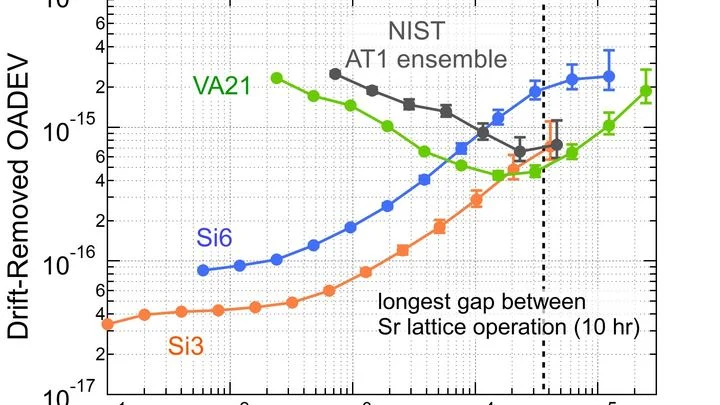
The world's most precise stopwatch still runs with one eye on an old pendulum. Hydrogen masers — the best radio-frequency flywheels (devices that keep the rhythm between comparisons with a reference)—accumulate error because noise between ticks leaks into the final signal.
Applied Physics2026-07-201 minarXiv:2607.17623express
Glowing Pollen Watches Over Water
A night river is dotted with tiny sparks. This isn't plankton: it's functional pollen-sensors, millimeter-sized devices that swim on their own and measure the water's chemistry. Each particle is a tiny lab. Inside, two reagents meet: one triggers a glow upon contact with a pollutant, and the second, a colored filter, blocks out interference.
Optics2026-07-172 minarXiv:2607.15925express
A Protein Caught in a Beam of Light
A protein in a cell is not a frozen sculpture but a restless mechanism. Its parts are constantly vibrating, and these movements determine how it grabs molecules, transmits signals, or builds the cellular scaffold. But filming the life of a single protein was hampered by two nuisances at once. First, the movements last millionths of a second — ordinary cameras simply cannot catch them.
Quantum Physics2026-07-071 minarXiv:2607.06395express
An Ultrafast Look at Light’s Quantum Quiver
Light waves are never perfectly smooth — they are constantly jittered by quantum ripples. These almost invisible nudges were studied by Nobel laureate Roy Glauber, who laid the foundations of quantum optics. Now physicists have learned to freeze these ripples.
Icy Whisper: O-PTIR Captures Amino Acids Beyond Diffraction
Spectroscopy has always been a way to hear the unheard. Back in the 19th century, Johann Balmer deciphered the elegant lines of hydrogen — a simple numerical harmony that foreshadowed quantum theory.
Light Quenches Light: Suppressing Instabilities in Gravitational Wave Detectors
In pursuit of gravitational waves, ripples in spacetime left by black holes and neutron stars, detectors like LIGO pump their arms with light of dazzling intensity.
Medical Physics2026-06-121 minarXiv:2606.14326express
Prick-Free Glucose Monitor: Spectroscopy Takes on Diabetes
Diabetes is a constant reminder of needles. To check glycated hemoglobin (HbA1c — a blood protein that reflects average sugar over three months), you need regular blood draws from a vein. It's unpleasant, requires a lab, and takes time. And if you live far from a city, every test becomes a major expedition. The new iGLU 5.0 device changes the game.
Quantum Physics2026-06-092 minarXiv:2606.10318express
String and Light: How to Tune Their Dance
A guitar string is stretched between two mirrors. A beam of light bounces back and forth between them, and the string shudders at every touch. Sometimes the light loses energy — the string takes it and dissipates it as heat, like a fading sound. Other times, the string shifts the pitch of the light itself, changing its color but barely dimming it.
Quantum Physics2026-05-201 minarXiv:2605.21206express
How Motion Teaches a Detector to Distinguish Directions
An ordinary photometry detector can't tell a left photon from a right one. But let it start moving, and everything changes. Imagine a rower moving between two flutists playing the same note. His ear is perfectly tuned to that note and ignores all others. As he moves, the pitch from the flutist ahead sounds higher, and from the one behind sounds lower.
Instrumentation2026-05-112 minarXiv:2605.10649express
Sunlight on a chip: catching a star's shimmer
A solar telescope is like an eye trying to spot an ant through a pot of boiling soup. The daytime sky dazzles, the air shimmers, and the image swims. To freeze it, you need adaptive optics — a system that predicts distortions and corrects them hundreds of times per second.
Quantum Physics2026-04-201 minarXiv:2604.18371express
One Molecular Hit Makes the Scale Tremble
A tiny glass bead hangs in a laser beam like a speck of dust in sunlight. Around it is a rarefied gas: atoms of krypton, xenon, and heavy molecules of sulfur hexafluoride. They collide with the bead, and each hit transfers a tiny impulse, like a pea thrown at a taut sheet makes it tremble. Impulse is a measure of motion: mass times velocity.
Mesoscale2026-04-191 minarXiv:2604.17591express
Light That Tells You Where It Came From
An ordinary light sensor answers the question "how much light" but not "where did it come from." To do that, you need lenses, mirrors, or entire arrays. In a new study, researchers propose a sensor that determines the direction of a light beam on its own, without any optics.
Materials2026-04-101 minarXiv:2604.09758express
Smell Is Not a Single Formula
The nose is an amazing instrument. A single coffee molecule entering a nostril can awaken a memory of a morning kitchen. Another, nearly identical in shape, smells like rotten eggs.
Quantum Physics2026-04-061 minarXiv:2604.04691express
One Photon Checks Five
A security guard needs to check five rooms but can't go inside. He knocks on the door and listens: silence means someone is inside, while an echo means the room is empty.
Optics2026-04-041 minarXiv:2604.03830express
Liquid Crystals Teach Light to Change the Rules
An ordinary lens always refracts light the same way. Its properties are frozen in glass forever. But now there's a surface that changes the game on the fly. Scientists made an ultrathin film with resonant elements and infused it with liquid crystals — the same stuff used in phone screens.
Optics2026-03-291 minarXiv:2603.27815express
How to Measure an Ultrashort Laser Pulse
A laser flash lasts a few femtoseconds — imagine a single instant stretched into a million parts. Such a flash mixes many colors, from red to violet. Instruments that measure the pulse shape often err: they see some colors well and others poorly, blurring the picture. The authors propose a simple fix.
Optics2026-03-192 minarXiv:2603.18365express
A Camera That Sees Color and Motion at Once
A regular camera captures the world as a series of frames: twenty-four, sixty, or even a hundred images per second. That's enough for filming a falling drop, but inside a living cell, events unfold a thousand times faster. Protein molecules carry cargo, membranes bubble, ions slip through channels — all in fractions of a millisecond.
Dynamical Systems2026-02-281 minarXiv:2603.00709express
How to Pick the Best Model Without Reading Tea Leaves
To understand a mechanism, you have to poke it. A child taking apart an alarm clock doesn't just stare at the gears: they turn the wheel and listen to how the ticking changes. Scientists do the same: instead of passive observation, they feed specially chosen signals into the system and watch the response.
Light Instead of Wires: How to Send a Signal Out of a Freezer
A thermos of liquid xenon cooled to minus 100 degrees Celsius. Inside are sensitive sensors that catch rare signals from dark matter particles. To bring these signals out, copper cables are usually used. But over the long haul, the signal weakens, and adjacent cables start 'cross-talking' — that's called crosstalk.
Medical Physics2026-01-221 minarXiv:2601.15947express
A Camera That Can See Tissues Breathe
Cells breathe. They need oxygen, and they take it from the blood flowing through the tiniest vessels. If blood flow is weak or oxygen is scarce, cells start to suffocate. Doctors need to see this as early as possible. But how do you look inside living tissue without cutting it open? The new device does it in two ways at once.
Quantum Physics2026-01-201 minarXiv:2601.13869express
A Dimmer as a Tool for Unveiling the Quantum Nature of Light
Light, regardless of its source, consists of photons — elementary particles, quanta of the electromagnetic field. The simplest light detector, such as a photometric illuminance meter, operates in a binary mode: it merely registers whether photons hit it or not, giving a 'yes/no' answer.
Materials2026-01-141 minarXiv:2601.09370express
A Crystal That Smells Solvent
In the air of factory floors and laboratories, invisible solvent molecules drift. One of them, acetonitrile, has a faint smell, but at high concentrations it can harm health. Typical sensors for it are bulky and expensive, but here we have a thin crystalline film that responds on its own to the presence of vapor.
The Triad That Beat Quantum Noise
A laser beam is trapped between two mirrors, one of which trembles under an invisible force. Each vibration of the mirror changes the phase of the light, and from these changes you can infer the force. But the light itself pushes on the mirror, which is quantum backaction, and it imposes a fundamental limit on measurement accuracy.