The Universe as a Spring: Eternal Cycle of Birth and Expansion ✛ ✦
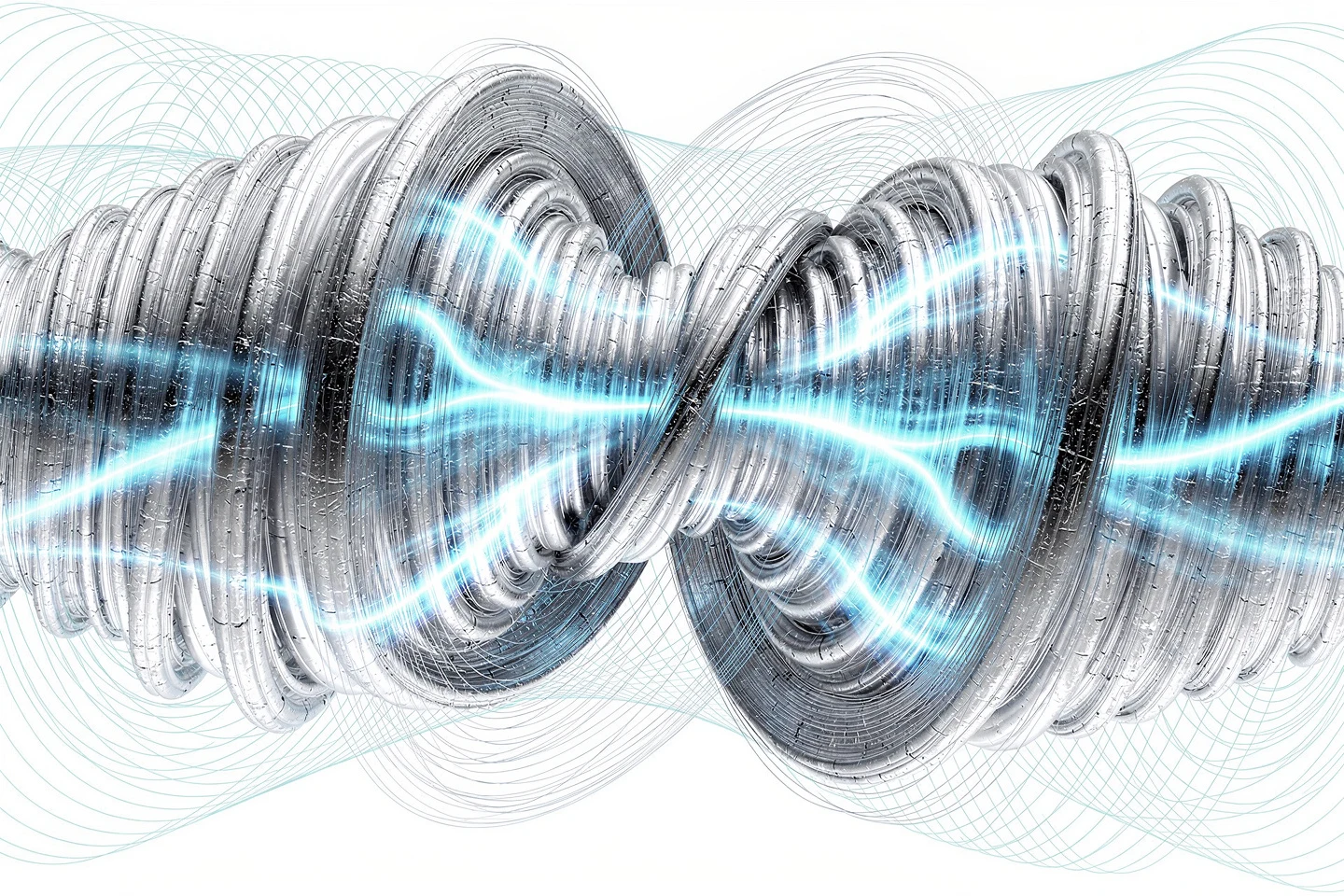
The story of the Big Bang is often presented as the start of everything. But Stephen Hawking and Roger Penrose proved that ordinary gravity leads to a point of infinite density where the laws break down. Cyclic models avoid this: the universe eternally contracts and expands – like a spring that compresses and then snaps back sharply. But that motion alone doesn't explain the appearance of galaxies or the uniformity of the cosmos.
The savior is inflation – ultra-fast expansion proposed by Alan Guth. Two quantum fields, like invisible springs, control this: one handles the contraction and expansion, the other delivers a powerful jolt at the point of maximum compression. The jolt smooths out the curvature of spacetime and creates the seeds of future clusters. Each cycle resets the accumulated disorder. Surprisingly, the inflationary jolts are not identical. In the cosmic microwave background – the cooled light of the Big Bang – there may lurk imprints of previous cycles, real echoes of other universes. Satellite data already confirm the predicted pattern of this radiation.
The model also hints at the nature of dark energy: perhaps it is a leftover field from past inflations. Eternity, then, is not a dull repetition but a series of ever more complex bounces.
Inflationary jolts vary slightly in each cycle, so the cosmic microwave background may hide faint imprints of past universes – a kind of cosmic 'echo'.
An eternally repeating universe is a frequent guest in science fiction. In Poul Anderson's novel 'World Without End', the heroes experience the contraction of the cosmos and a new Big Bang.