Cosmic Bellows: How Eternal Inflation Resurrects the Universe from the Ashes ✛ ✦
The classic story of the Universe’s birth from a blazing point called the Big Bang raises uncomfortable questions: why is the cosmos so homogeneous, and what was before the singularity? Alan Guth proposed inflation as an instantaneous expansion that smoothed out all irregularities, but inflation itself seemed like a one-off miracle. The theorems of Roger Penrose and Stephen Hawking assert the inevitability of an initial singularity, making talk of previous epochs seemingly pointless. Yet nature abhors 'one-off' scenarios. The new model takes two fundamental elements — gravity and quantum fluctuations — and turns cosmology into a cyclic craft, where inflation becomes not a miracle, but a recurring stage of cosmic forging.
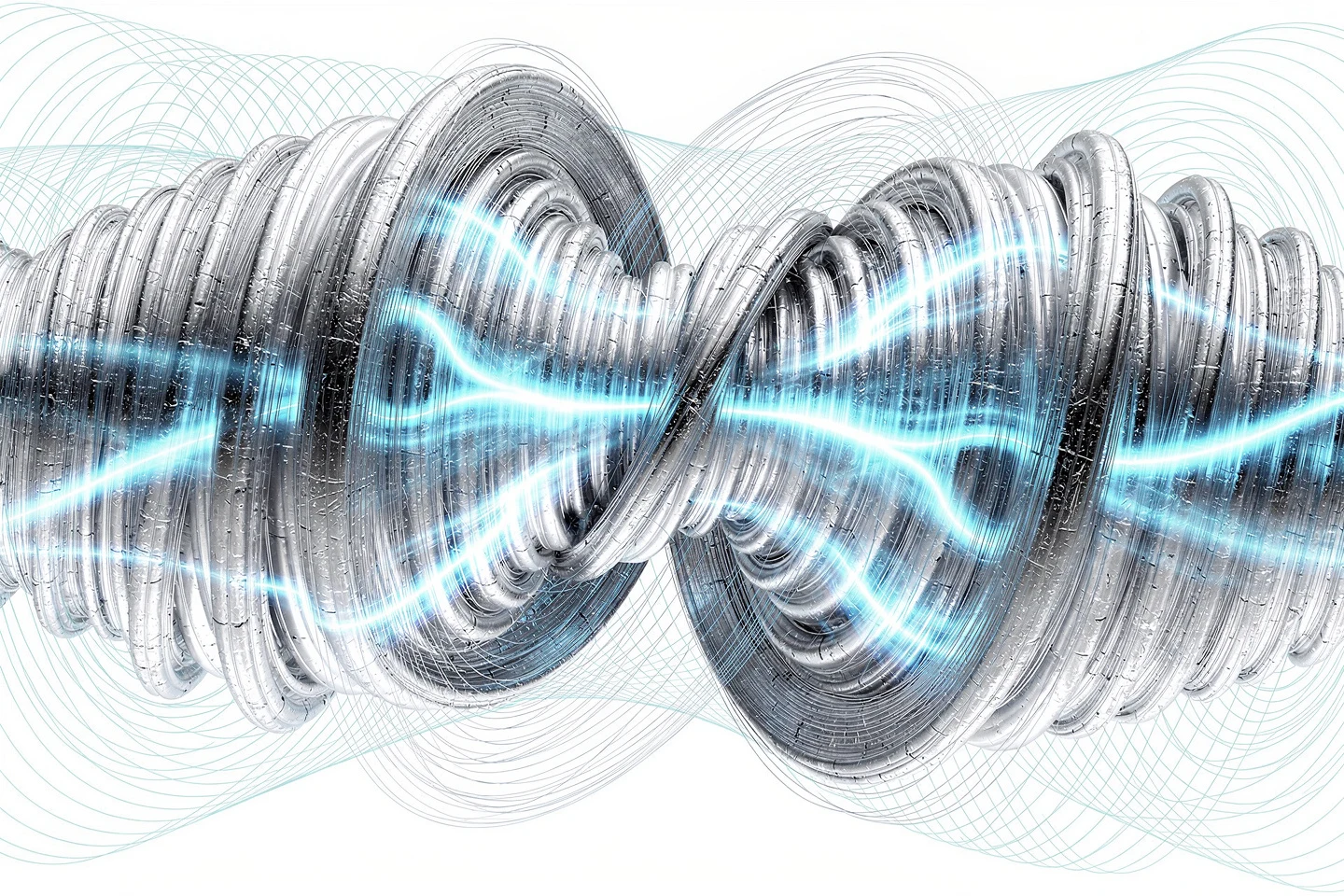
Imagine colossal cosmic bellows. One scalar field acts as the handle, compressing and releasing the Universe in cycles of collapse and subsequent expansion. The second field is the valve, injecting energy at the moment of maximum compression. When the bellows close, all matter and radiation are crushed into a superdense clump, but instead of destruction, a rebound occurs — and the valve opens. It triggers a violent inflationary stage: space inflates with unthinkable acceleration, smoothing out any irregularities. Thus, from the chaos of the previous cycle, a smooth, nearly perfect blank for future galaxies is born. The forge heats the metal red-hot, and inflation strikes it like a hammer, forging it into uniformity.
The beauty of the model lies in its mathematical naturalness. Equations with two fields show that an inflationary phase inevitably arises after the bounce, even without fine-tuning of parameters. The spectral index of primordial perturbations, extracted from the cosmic microwave background, takes the form $n_s$ ≈ 1 – 2/$N_{CMB}$, where $N_{CMB}$ is the number of e-folds between horizon exit of modes and the end of inflation. For $N_{CMB}$ ~ 50–60, the value comes out to about 0.965 — exactly what the Planck satellites recorded. In other words, the pattern of hot and cold spots on the celestial sphere is predicted by the model without additional tweaking. This is not just a coincidence; it’s a sign that our Universe may indeed have gone through a succession of contractions and inflationary expansions.
But the bravest consequence is that entropy does not accumulate fatally; instead, it is reset in each new cycle, like a blacksmith shaking off the scale before a new forging. Thus, the eternal return does not violate the Second Law of Thermodynamics. Moreover, dark energy and spacetime curvature may turn out not to be fixed constants but dynamic quantities that store the memory of past cycles. We look at the cosmic microwave background and, perhaps, see not only the infancy of our cosmos but also the scars from previous births. Hidden in the polarization of the background may be gravitational waves from epochs that preceded our Big Bang.
This opens an exciting prospect: peering beyond the 'wall' of the Big Bang. The next step is to include quantum corrections from quantum fields and trajectory turns in field space to compute nonlinear spectral distortions. If experiment confirms the presence of certain types of non-Gaussianities, that will be direct evidence of a cyclic prehistory. The model requires no fine-tuning of initial conditions — cycles themselves are the natural state of spacetime, and inflation is a necessary stage of rebirth. And if dark energy is not an eternal constant but a fading echo of past cycles, then in the distant future a new collapse and a new forging of stars may occur. The Universe transforms from a one-time fireworks display into an echo chamber of eternity, where each cycle forges stars from the ashes of the previous one, and we hear only the last reverberation of this grand symphony.
If inflation indeed repeats, then the observed homogeneity of our Universe may be the echo of inflationary phases in countless previous cycles, and gravitational waves from those eras may have left a faint imprint in the polarization of the cosmic microwave background.
Cyclic cosmology with repeated acts of creation has also inspired science fiction writers: in Paul Anderson's novel 'Worlds Without End,' the protagonists witness the collapse of the cosmos and a new Big Bang.