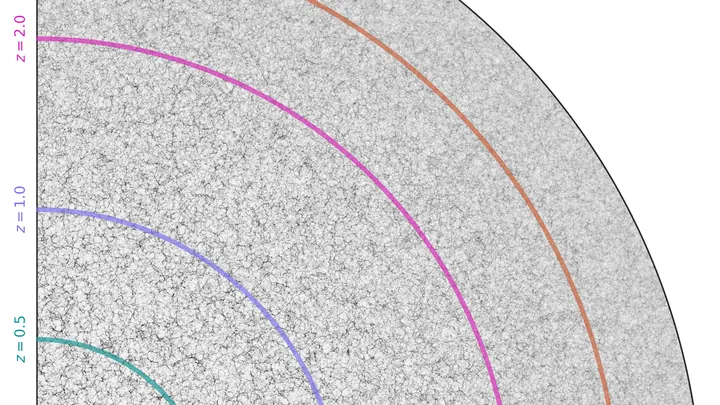
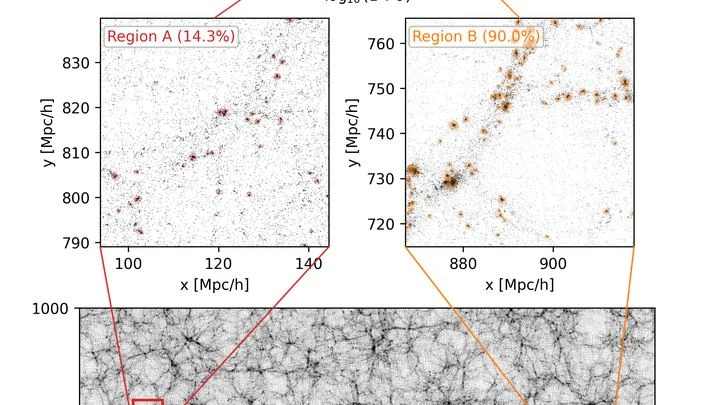
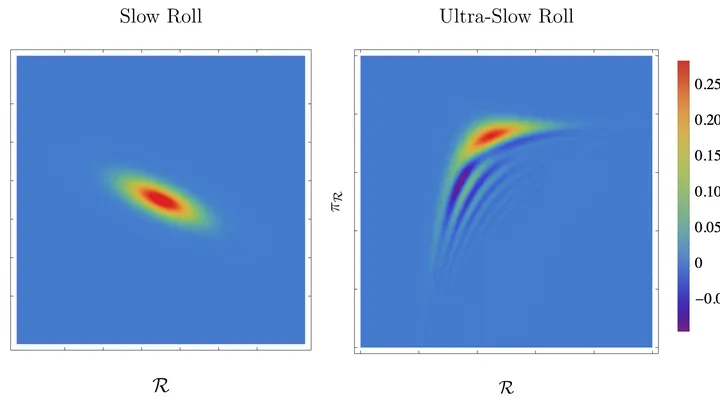
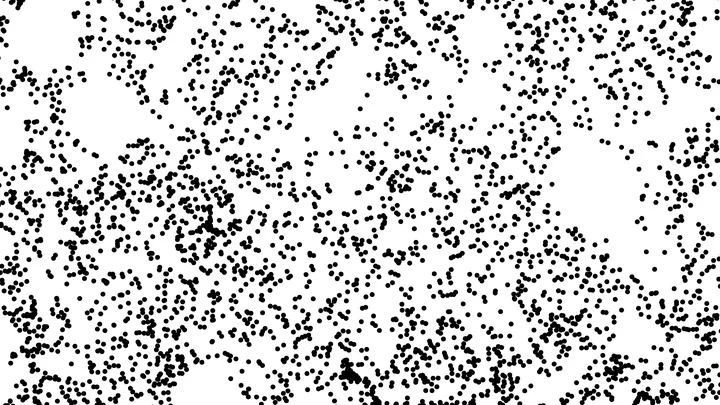
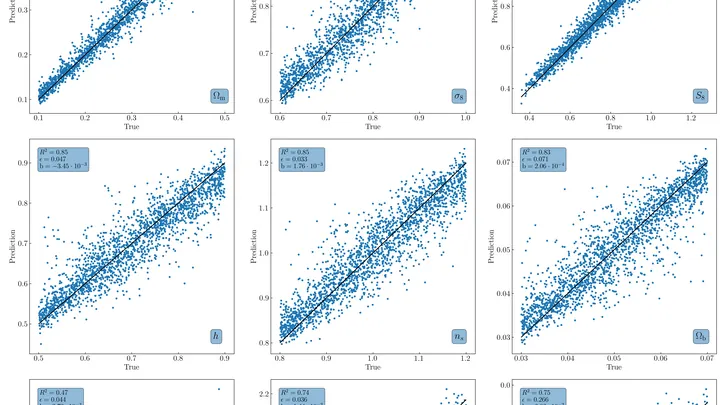
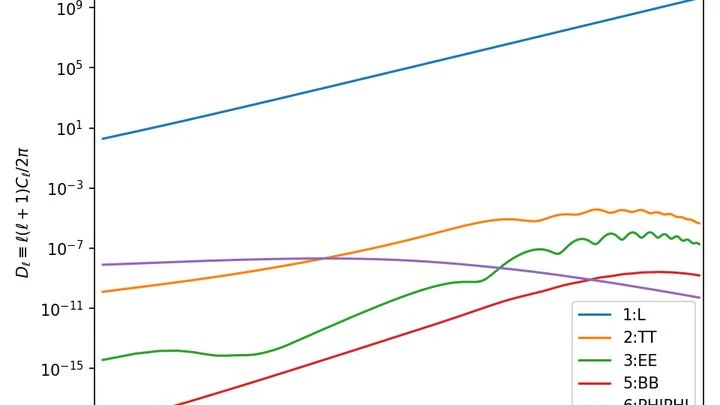
Cosmological simulations are computational models that recreate the evolution of the universe on large scales, from the Big Bang to the present day. They solve the equations of gravity and hydrodynamics for billions of particles, each representing a chunk of dark matter or gas, to see how cosmic structures like galaxies, clusters, and filaments emerge. These simulations are essential because the universe's evolution is too complex for analytical solutions — the interplay of gravity, expansion, and gas physics can only be explored numerically.
History
The first cosmological N-body simulations were performed in the 1970s by groups including Peebles and his collaborators, who simulated a few thousand particles to study galaxy clustering. The field grew rapidly with computing power, leading to the large 'Millennium' and 'Illustris' simulations in the 2000s and 2010s.
How it works
The simulation starts with a nearly uniform distribution of particles, seeded with tiny density fluctuations derived from observations of the cosmic microwave background. The code then steps forward in time, calculating gravitational forces between particles (often using tree or mesh methods for efficiency) and modeling gas dynamics, star formation, and feedback from supernovae and black holes. Modern simulations also include dark energy and neutrino physics, and some use machine learning to speed up the calculations or to emulate full simulations from smaller runs.
In practice
Cosmological simulations are used to interpret galaxy surveys, test models of dark matter and dark energy, and predict the distribution of matter for upcoming telescopes like Euclid or the Vera Rubin Observatory.
Fun fact
Some simulations now track the evolution of trillions of particles, and the data they produce can fill thousands of hard drives.
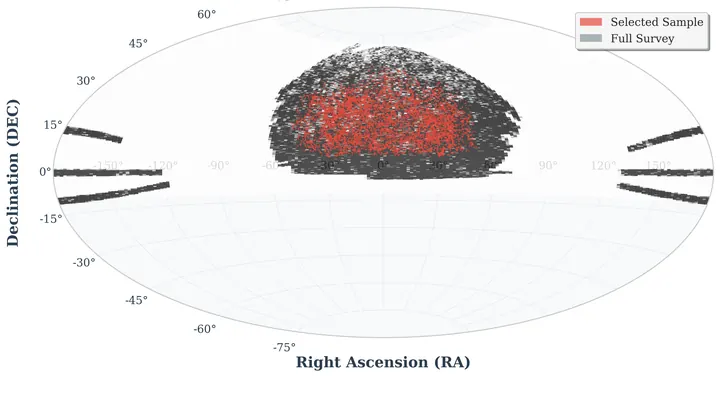
A census by body shape: that's one way to describe what astronomers did with 6348 massive galaxies. Instead of height and weight, they measured how concentrated the light is toward the center, how flattened the galaxy is, and how asymmetric its shape is. Then they ran the same measurements on galaxies from three computer models of the universe and compared the results.
A gravitational wave from a black hole merger is like a bell tolling in the night. The loudness tells you how far away the source is. But to learn how fast the night itself, the cosmos, is expanding, you usually need a second signal: a flash of light or a catalog of galaxies. Both are rare to catch.
The early universe was less like a calm pond and more like a boiling cauldron. Matter flowed, collided, and swirled against the backdrop of rapid spatial expansion. To understand how stars and galaxies emerged from this hot soup, physicists build digital simulations.
This new work is the third part in a series on lattice-based cosmological modeling. The first two focused on fields; this one deals with fluids.
In a dark room, music plays. Powder is scattered on the floor — fine, almost invisible. Low frequencies make it gather into intricate patterns: filaments, clumps, voids. In much the same way, gravity over billions of years weaves galaxies into the cosmic web — except here, attraction does the work instead of sound waves.
Clocks in the Universe are tricky things. Usually, in calculations of the birth of the world, a special scalar field plays the role of a clock — something like an invisible fluid filling all of space. It ticks, and physicists watch how the world changes relative to that ticking. But these clocks are man-made, introduced for convenience.
The authors of the new work took a different path.
A galaxy collision is like a slow dance in which two partners gradually draw closer. Hidden at the center of each is a supermassive black hole — an invisible flywheel with a mass of millions or billions of suns.
The universe rang piercingly in its first moments. During the inflation epoch, when space expanded faster than light, energies were monstrous — trillions of times higher than in the Large Hadron Collider.
In the first moments of its life, the universe resembled a boiling cauldron. Matter wasn't spread evenly — clumps and voids were brewing within it, and their violent motion gave rise to a trembling of space itself: gravitational waves.
2.1 × 10⁻⁹ — that's the temperature variation across the sky, about the same as measuring ripples a fraction of a millimeter high on the ocean surface. This microscopic non-uniformity is imprinted in the cosmic microwave background and tells the story of the very beginning of time.
The first three minutes after the birth of the world are a cosmic kitchen where nature cooked the lightest atomic nuclei. The recipe is set by gravity: it controls the cooling rate of the hot 'broth' of particles. If gravity worked differently than we are used to, the dish would have turned out different — with different amounts of helium and deuterium.
A quantum wave is like a long-exposure photograph: everything’s blurred, but the blur itself reveals motion. Usually these frozen waves are treated as convenient abstractions. Yet if at each point in the image you estimate, by brightness, the moment on the particle’s internal clock it landed there, flat space suddenly acquires curves.
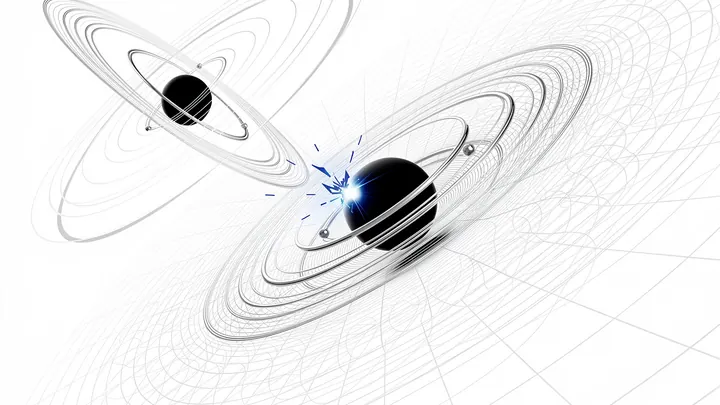
At the heart of almost every galaxy slumbers a supermassive black hole — the invisible conductor of a stellar orchestra. When galaxies collide, their central monsters draw closer, entwining in a gravitational dance. Sometimes a third partner joins the duo, and then a triple waltz begins, its outcome unpredictable.
In the first moments after the Big Bang, the Universe was not a silent void but a seething cauldron of plasma, threaded with sound waves. As the temperature dropped, the cosmos underwent phase transitions — spontaneous reorganizations that gave birth to bubbles of a new phase.
The universe hasn't always been expanding. In some models, it first contracted, nearly empty and flat, and then, upon reaching a limit, bounced back and started growing, like the world we know. This scenario is called bouncing cosmology.
Galaxy clusters are the greatest gravitational ensembles in the Universe. In X-ray glow from hot plasma, the story of cosmic expansion, hidden dark matter, and enigmatic dark energy is encoded.
After the Big Bang, the universe may have been stuck in a false vacuum — a temporary state like a soap bubble ready to pop. A rare true vacuum bubble could then erupt, stretching space in the blink of an eye.
In the first instants after birth, the universe might have been multidimensional, like a sheet of paper that suddenly gained thickness. This "thickness"—the extra dimensions — began to inflate rapidly. Such superfast growth is called inflation.
Through the ripples on the water, pebbles at the bottom of a pool look shifted and warped. In a similar way, the gravity of invisible dark matter bends the light of distant galaxies — a phenomenon known as weak lensing.
Astronomers build maps of galaxies and listen to the radio whisper of neutral hydrogen. The signal is so faint that even a working TV would drown it out, but sensitive antennas pick it up from the depths of the Universe.
The end of the Universe is not just the fading of light. If dark energy, the mysterious substance accelerating cosmic expansion, tears it apart in a Big Rip scenario, or if expansion reverses into a contraction that pulls everything back to a point like a big bang in reverse, a…
A balloon doesn't deflate all at once: first, dents appear on its surface, which run, merge, and finally the balloon shrivels into a point. Domain walls behave in much the same way — thin partitions that divided space in the first moments after the Big Bang.
The classic story of the Universe’s birth from a blazing point called the Big Bang raises uncomfortable questions: why is the cosmos so homogeneous, and what was before the singularity?
The Universe's expansion is accelerating, and maybe gravity doesn't work the way we think. Physicists come up with alternative theories, but to test them, they need to calculate how ripples after the Big Bang grew into galaxies. Such calculations involve long equations with hundreds of terms, where it's easy to get lost.
The early universe resembled a rapidly inflating balloon: it expanded so fast that light couldn't keep up with its own edges. Then this frantic acceleration gave way to calm expansion. The balloon was no longer being blown up, and it began to slowly deflate. At the moment of the regime change, emptiness didn't stay empty: from it, as if from an overheated boiler, pairs of particles burst forth.
A rubber band stretched in different directions behaves differently from a whole sheet of paper. If you pull on an edge, the deformation does not spread evenly but seems to linger in certain spots.
The Universe is vast, and figuring out how galaxies and dark matter are distributed within it is no easy task. Usually, scientists run computer simulations that "play out" the evolution of entire regions of space billions of light-years across. But such calculations demand colossal resources and time.
Toss a handful of glitter into a river, and some flakes will drift straight while others spin in tiny eddies. Galaxies in the universe do something similar: they don't just recede due to cosmic expansion: they also swirl in giant currents, like wood chips caught in invisible whirlpools.
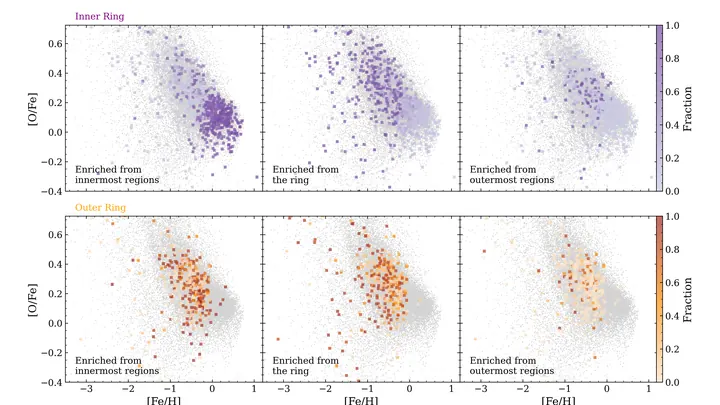
A star inherits the chemical makeup of its parent gas cloud, just like a child inherits genes from its parents. Astronomers turned this into a method: by measuring the fraction of carbon and other elements with spectroscopy (splitting light into colors), they construct family trees for the stars in a galaxy.
Drop two identical pebbles from a mountain peak: one lands a centimeter to the left, and a minute later they end up in different valleys. A galaxy is the same mountain, only with billions of pebbles and a slope that stretches over millions of years. The authors of a new study simulated a disk of 40 million point-like stars and tested how quickly it forgets where it started.
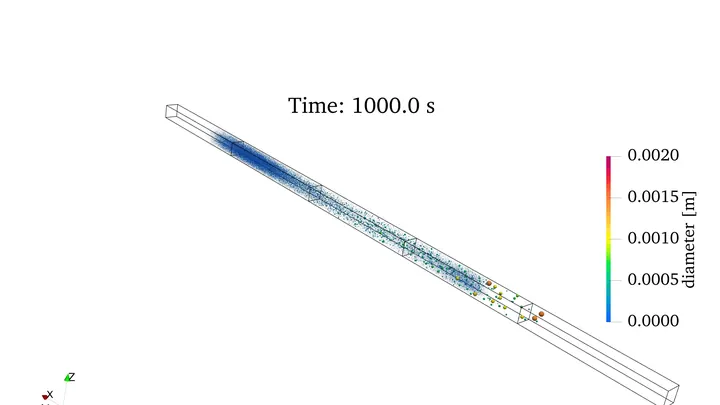
In a cloud, thousands of tiny water droplets hang in the air. For rain to fall, they need to grow: stick together into larger drops and become heavy enough to fall to the ground. But how exactly do droplets find each other in a huge cloud?
Scientists created a computer model that tracks each droplet individually, as if each one had its own little sensor.
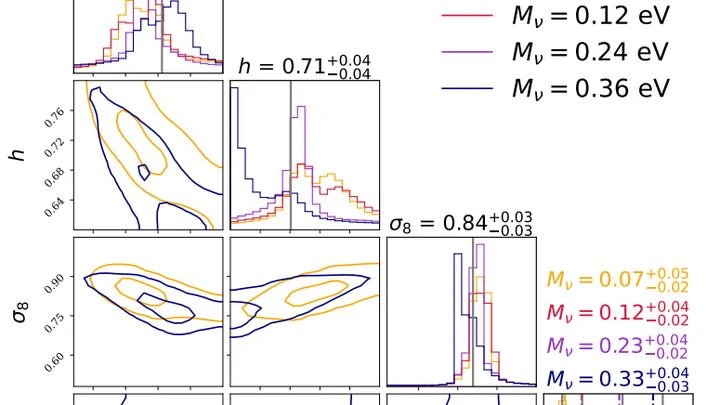
The Universe is a colossal web of invisible dark matter and galaxies, stretched by the expansion of space. Neutrinos, nearly intangible ghost particles, barely cling to the threads, but their collective mass subtly shifts the tension of the entire network.
It all started with tiny quantum flickers on the primal canvas. Inflation — an avalanche-like expansion proposed by Alan Guth — stretched those brushstrokes to the scale of galaxies.
When a typical computer searches for a law of nature from data, it tries to guess a complete formula in one go. It's like a cook who, without knowing the recipe, dumps all the ingredients into a pot at once and hopes for soup. Most often, the result is an inedible mess: the formula is long but meaningless, and it fails on new data.
Dark matter is invisible, but its gravity holds galaxies together. For a long time, it was thought that dark matter particles pass right through each other without noticing. However, in small galaxies, the density of dark matter in the center turns out to be lower than calculations predict.
Light born at the moment of the Big Bang has traveled to us for almost 14 billion years. But along the way, it passed through the gravitational fields of galaxies and clumps of dark matter, which bent its rays. To an observer, this looks like an image stretched and smudged by an old window pane.
The Universe looks like a giant spiderweb: galaxies aren't scattered randomly but are gathered into knots and along filaments. Inside the filaments, there's plenty of gas, and that's where new stars most often flare up. But how has this changed over time? Scientists compared data from a computer model with real observations of thousands of galaxies.
A programmer writes code, runs it, sees an error, and fixes it. Now this process can be handed over to the program itself. Machine learning can already improve algorithms, but it usually requires lots of data and ready-made examples.
Traditional cosmology begins with the Big Bang — the idea of Georges Lemaître. However, a new approach, inspired by the work of Stephen Hawking, bypasses the mystery of the initial moment.
Thousands of universes were born in a computer, all to tell us about our own. Each one has its own galaxy clusters, arranged by the laws of gravity like peas in a jar shaken with varying force. From how the peas settle, you can tell what kind of hand shook the jar.