Earth's Breathing and the Hunt for Gravitational Waves express
A giant musical instrument hides underground. It picks up not sound but the trembling of space itself — gravitational waves from the mergers of dead stars. But this instrument has a problem: it is bothered by Earth's 'breathing.' Winds, storms, even the changing seasons make the ground vibrate, creating noise.
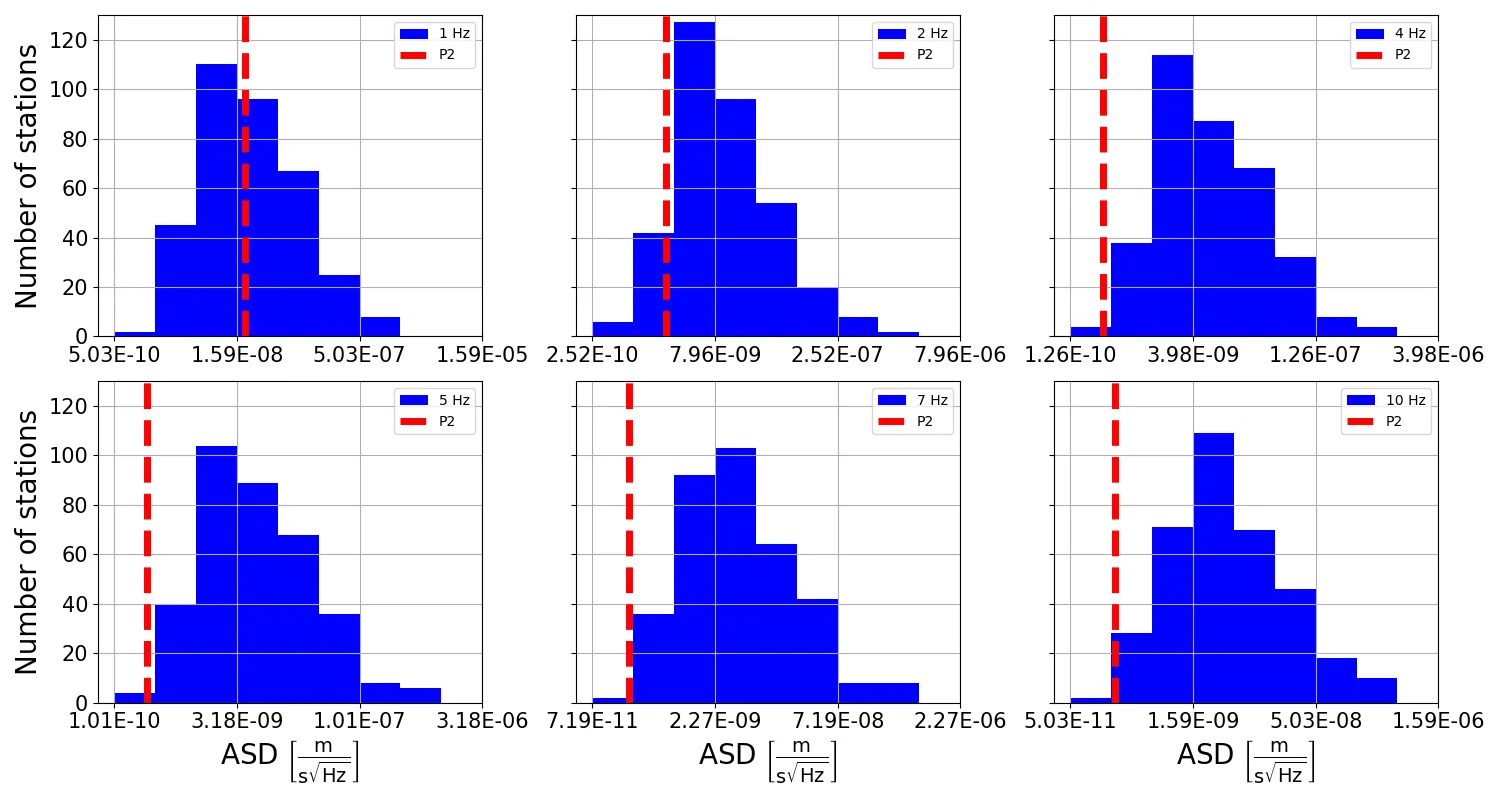
A team of researchers studied how strong this noise is on Sardinia — an island considered as one of the sites for the new gravitational-wave detector, the Einstein Telescope. From 2022 to 2025, they recorded seismic noise in deep boreholes and compared the quietest month (July) with the noisiest (December). The difference turned out to be small. Even in December, when the ocean is stormy, the extra noise reduces the clarity of the signal by just a couple of percent.
This is good news: the detector will be able to operate steadily all year round, without expensive noise suppression systems. The silence of Sardinia's depths proves to be a reliable ally in the hunt for cosmic cataclysms. When the telescope starts working, it will hear even the most distant 'sighs' of the universe — in summer and winter alike.
Original abstract
as written by the authors arXiv:2605.18135
This work investigates the impact of seasonal variations in seismic noise on the low-frequency performance of the Einstein Telescope (ET) at the Sardinia candidate site, focusing on implications for compact binary coalescence observations. Using seismic data collected between 2022 and 2025 in deep boreholes, we characterize monthly noise variations and identify representative best and worst case scenarios, corresponding to July and December. The measured seismic spectra are used to estimate the Newtonian noise contribution in the 2-10 Hz band and to derive modified ET sensitivity curves. These are implemented in a simulation framework to evaluate their effect on the signal-to-noise ratio (SNR) of binary neutron star and intermediate mass black hole signals, assuming the triangular ET configuration. We find that the low seismic noise of the Sardinia site results in only minor seasonal variations in detector sensitivity. The corresponding impact on SNR is limited to a few percent, even without including Newtonian noise mitigation. These results indicate that seasonal environmental fluctuation have a minor effect on the early inspired detectability of compact binaries, confirming the suitability of the Sardinia site for achieving ET low-frequency sensitivity goals.
Gravitational waves from the merger of two neutron stars stretch and squeeze space on Earth by less than the diameter of a proton, so detectors must be incredibly sensitive.
In Carl Sagan's novel 'Contact,' a signal from space also had to be extracted from noise, but there the interference was man-made, not natural.