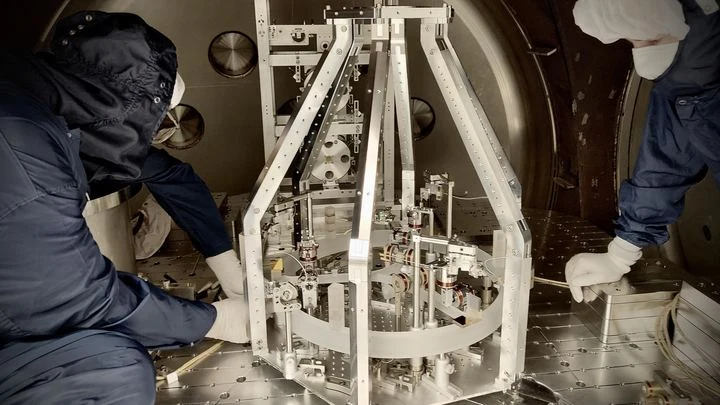
The Einstein Telescope is a proposed underground gravitational-wave observatory, designed as a third-generation detector with roughly ten times the sensitivity of current instruments like LIGO and Virgo. It would consist of three nested interferometers arranged in a triangle, each with arms 10 kilometers long, enabling detection of gravitational waves from much farther away and across a broader frequency range. This would allow observation of mergers of neutron stars and black holes throughout most of the observable universe, as well as continuous waves from spinning neutron stars and possibly a stochastic background from the early universe.
History
The concept was first proposed in 2010 by a European consortium, and the design has been refined since, with the project currently in a preparation phase for construction in Europe.
How it works
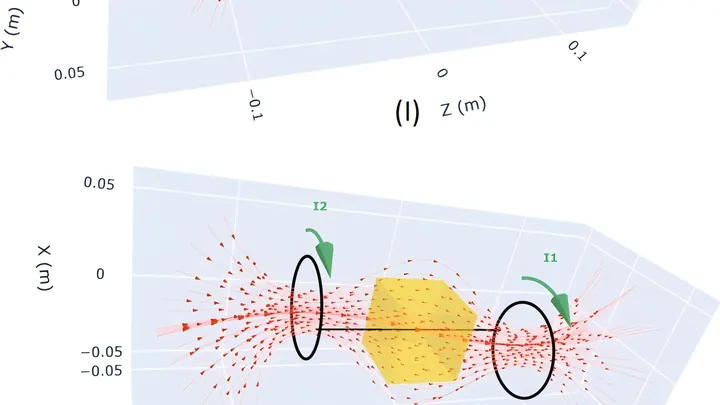
Like current detectors, it uses laser interferometry: a passing gravitational wave stretches one arm and compresses the other, changing the interference pattern of laser light. The Einstein Telescope improves sensitivity by using multiple interferometers with different arm lengths, cryogenic mirrors to reduce thermal noise, and advanced quantum squeezing to beat the standard quantum limit. Being built underground reduces seismic noise, and the triangular layout allows simultaneous measurement of both polarizations of the wave.
In practice
It will enable precision tests of general relativity, measure the equation of state of neutron stars, and probe cosmology by measuring the Hubble constant independently of other methods.
Fun fact
The Einstein Telescope would be sensitive enough to detect gravitational waves from a neutron star merger at a distance of 18 billion light-years — nearly the entire observable universe.
Imagine an interpreter distracted by every rustle in the hall, turning a one-hour meeting into two. That's roughly how gravitational wave detectors behaved when analyzing long signals: each turn of the Earth added noise to the calculations, and processing a day-long neutron star merger threatened to stretch into weeks.
A quantum detector is like a sensitive pendulum suspended in empty space. If a sharp gravitational wave passes by, you might expect the pendulum to swing. But the calculation shows otherwise: the wave doesn't swing it: it damps any existing oscillations.
Imagine a simultaneous interpreter in a room where two people are speaking: they must keep up with both meaning and intonation, but if the speech is too fast, only a paraphrase remains. That's roughly how scientists feel as the stream of gravitational waves from black hole and neutron star mergers grows, while precise signal calculations lag behind.
Gravitational-wave detectors are like extremely sensitive ears: they pick up the trembling of space when black holes or neutron stars collide somewhere in the universe. But even the most sophisticated "ears" cannot hear everything. The new LIGO A# project is like replacing the eardrum with a thinner, more sensitive membrane.
A black hole is like a spinning top that never stops on its own. But if a cloud of ultra-light particles, bosons, forms around it, the picture changes. This "fog" acts like an invisible brake: the particles drain the hole's spin, slowing it down.
The calm surface of a lake suddenly ripples — somewhere in the depths, an underwater cliff has collapsed. The water trembles almost imperceptibly, and the circles spread wider and wider until they reach a bobber near the shore.
In a dark room, a whisper is barely audible. To make out the words, you need to get close, or set up many sensitive microphones. That's roughly the reasoning behind the new work: the authors place quantum "ears" right inside a resonator, where a high-frequency gravitational wave turns into an electromagnetic echo.
A bell rings not from the strike but from a fleeting shudder of space. A gravitational wave, like ripples on a pond, passes through a massive magnet, and it deforms ever so slightly. That deformation can be turned into an electrical signal.
13.8 billion years ago, the universe swirled in a waltz. The right turn was forbidden. Today, the echoes of that cosmic ball reach us as a barely perceptible ripple in spacetime — gravitational waves. Their existence was predicted by Albert Einstein.
Two neutron stars spiral closer and collide. The result: a gravitational wave, a ripple in spacetime, a short gamma-ray burst, and a faint glow astronomers call a kilonova. But sometimes the signal passes by a massive galaxy.
A low rumble coming from underground could be the noise of a distant construction site, or it could be the echo of an ancient earthquake. Astronomers faced a similar puzzle in 2023 when they detected ultra-low-frequency gravitational waves — the trembling of spacetime itself, rippling across the universe.
The light of a distant star briefly brightens when a massive invisible object passes between it and a telescope. This phenomenon, gravitational microlensing, acts as a natural telescope. Usually, the lens is a black hole, warping the spacetime around it.
A gravitational wave observatory is like a set of microphones scattered across the Earth. When a signal arrives from space (say, from a black hole merger or a supernova explosion) each microphone hears something slightly different.
In 2015, detectors caught a gravitational wave for the first time — a ripple in space that traveled from merging black holes. Since then, such signals have become a new window into the universe for astrophysics. But gravitational waves can do more: they carry the imprint of the very theory of gravity.
When a distant galaxy sends us light, it dims with distance, and from that dimming, we can tell how far away it is. Gravitational waves work in much the same way: the farther their source, the weaker the ripple in space that detectors on Earth pick up.
The universe is like a layered cake, and our layer (stars, planets, and people) is just one of many. In a neighboring layer, which physicists call the hidden sector, processes are boiling away. This work describes one such process: a first-order phase transition, where matter abruptly changes state, like water turning into ice.
A dead star with a magnetic field billions of times stronger than Earth's is a magnetar. Its crust cracks, sending a powerful X-ray burst into space. But some of that light doesn't reach us in its usual form. In an ultra-strong field, photons can turn into gravitational waves — the trembling of space itself.
When two neutron stars, compressed to the size of a city, approach in their final dance, the spacetime around them comes alive, emitting gravitational waves.
It was Edwin Hubble who discovered that galaxies are rushing apart, and Georges Lemaître linked this to the expansion of space. Today, the ΛCDM model, relying on dark energy and dark matter, asserts that the Universe is flat as a perfectly stretched canvas.
Gravitational waves are the trembling of spacetime itself. Usually we only catch their overall hum, but each wave also has a direction of oscillation – polarization. Old maps were built only from signal loudness, which led to errors. It's like trying to see the bottom of a pond through sun glare.
Two beams of light race around a closed loop, heading toward each other. Since the speed of light is constant, when the ring turns, one beam has to catch up with a moving finish line, while the other meets it sooner. Their meeting creates a pattern, and from that pattern we can tell how fast the whole system is spinning.
Spacetime is not a passive void but a dynamic membrane capable of elastic deformation. When neutron stars (ultra-dense objects the size of a city, where matter is compressed to nuclear density or black holes) regions with gravity so strong that even light cannot escape their bounds collide, the membrane shudders, generating…
Imagine a giant orchestra where every musician is a particle born in the fire of the Big Bang. When time's baton gives the downbeat, these particles begin to decay into lighter ones. Each decay is accompanied by a quiet chord — the emission of gravitons, tiny quanta of gravity.
Gravitational waves are ripples in space from the mergers of black holes and neutron stars. Existing detectors, built with contributions from Kip Thorne and Rainer Weiss, work like highly sensitive microphones but only hear the highest 'notes'.
A distant orchestra plays a symphony, but the recording is full of noise. The melody is written for two instruments, yet a third voice seems to break through the static — quiet and unfamiliar. This is how astrophysicists listen to gravitational waves, trying to catch the slightest deviations from Einstein's predictions.
A flat crystal of charged atoms suspended in an electromagnetic trap behaves like a perfectly calm pond. The slightest breeze, and ripples spread across its surface. This 'pond' catches the splashes from dark matter particles and the ripples of spacetime — high-frequency gravitational waves.
A clock isn't just hands. Every atomic nucleus is a natural metronome: it oscillates with nearly perfect regularity. If you lift one such metronome a couple of meters, its rhythm speeds up ever so slightly — that's time warping, as predicted by Einstein.
In the headphones used to listen to a distant orchestra, there is an occasional crackle. The crackle can be so loud that it drowns out the music or even blends in with it.
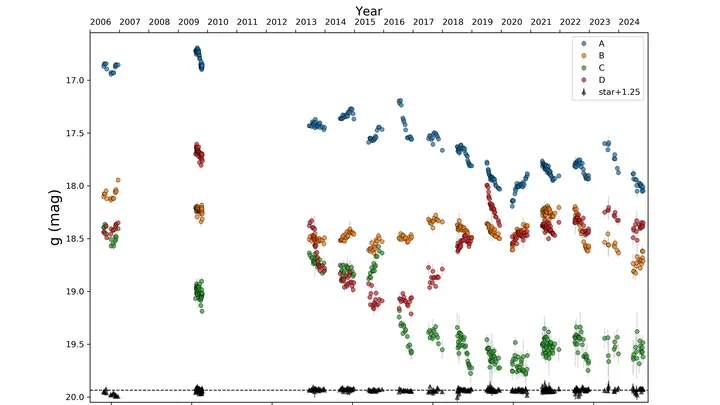
A distant quasar appears as four points of light arranged in a cross. This is how the gravity of a galaxy lying along our line of sight distorts the view: it acts like imperfect glass, multiplying the image. Each point is the same object, but its light travels different paths.
In 2015, two giant facilities in the United States caught the shiver of space — a gravitational wave from the collision of black holes. Since then, such signals have been caught regularly, but the detectors themselves are enormous: their arms stretch for kilometers.
Light from a star travels for millions of years, yet in a telescope it still appears as a point: it's just too far away. To see a star's surface, you need an instrument the size of a city. In Chile, such a giant is already under construction: ELT with a 39-meter mirror made of 798 hexagonal segments.
According to Einstein's theory, massive objects cause spacetime curvature, like a heavy ball warping a rubber sheet. As they accelerate, they create ripples — gravitational waves, akin to the circles from a stone dropped in a pond.
Even Einstein predicted gravitational waves — a trembling of the very fabric of spacetime. Today they are captured by gigantic installations like LIGO, created thanks to Rainer Weiss and Kip Thorne.
In August 2017, gravitational wave detectors caught a signal from the merger of two neutron stars — the ultra-dense remnants of exploded stars. At that very moment, life on Earth was business as usual: planes were landing, cars were driving, and navigators were plotting routes.
In a dark corner of the Milky Way, a natural metronome is at work. Every 8196 seconds, about 2 hours and 16 minutes, X-ray light flares on the surface of a neutron star. The star EP J171159.4-333253 pulls gas from a neighboring star, and this gas, falling inward, accumulates on its surface.
Right after its birth, the Universe wasn't just expanding: it was inflating at an unimaginable pace. This stage, called inflation, was proposed by Alan Guth. New models compare the process to inflating a balloon with quick, jerky pumps.
The merger of two neutron stars is like a strike on a gong: a ripple in space, a gravitational wave, spreads through the universe. Detectors on Earth catch this ripple and, from its strength, calculate the distance to the source.
Measuring the universe’s expansion is like timing a race when the track stretches. Neutron star mergers act as standard sirens: their gravitational waves ring out with a known “volume,” so fainter signals mean greater distance.