Virtual Universes Reveal the Cosmos with Greater Precision express
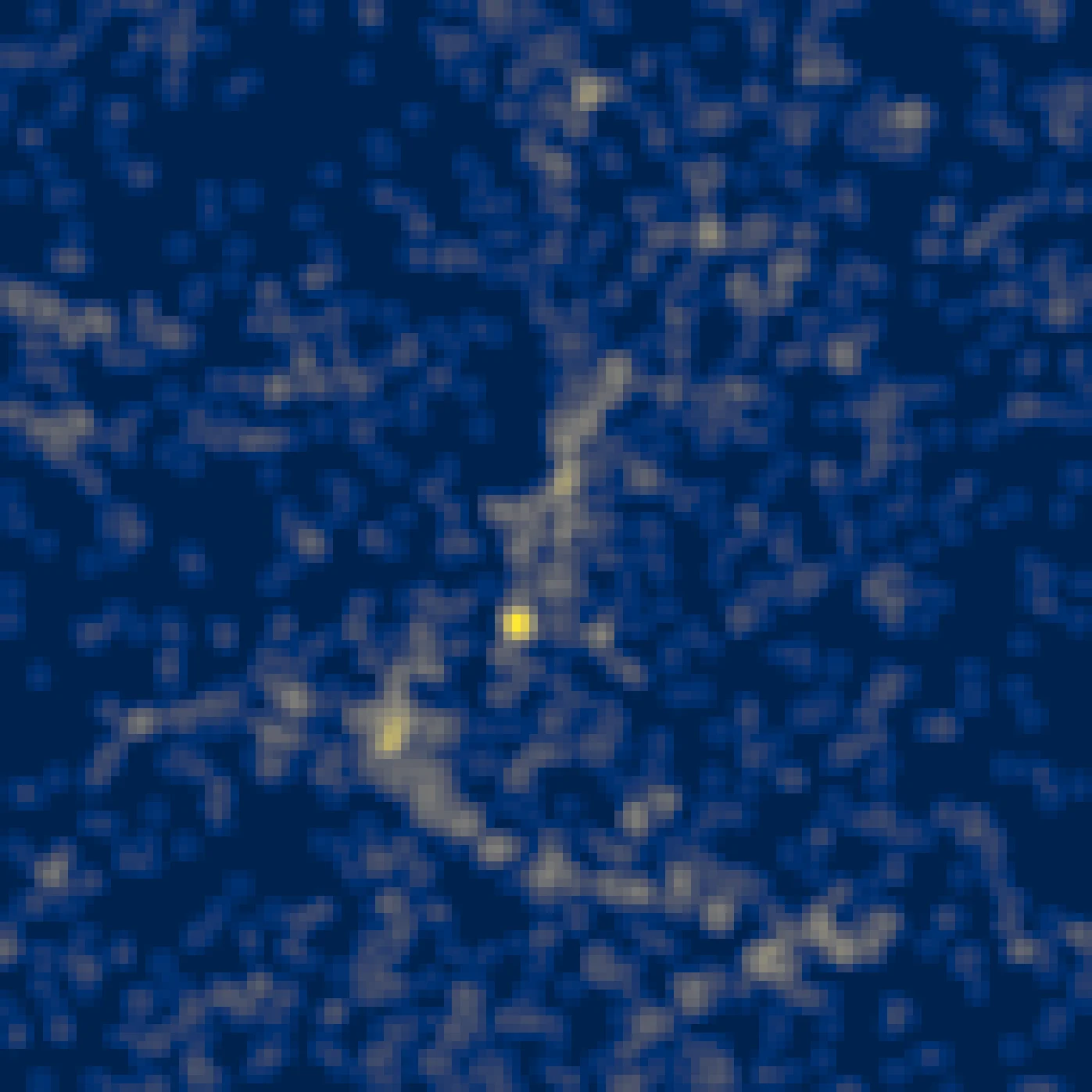
Astronomers build maps of galaxies and listen to the radio whisper of neutral hydrogen. The signal is so faint that even a working TV would drown it out, but sensitive antennas pick it up from the depths of the Universe. To understand how much dark matter it contains and how fast it's expanding, a process driven by the expansion of space, scientists have turned to computer simulations.
The method is like a chef who, by trying different combinations of ingredients, recreates an unknown recipe. Thousands of virtual universes are launched with varying amounts of dark matter and other parameters, until one produces a map indistinguishable from the real thing.
Applying the approach simultaneously to galaxy and hydrogen maps improved accuracy 2–7 times. 3D maps add another threefold gain. This will allow us to peer into the early Universe and see if dark matter holds any new surprises.
Original abstract
as written by the authors arXiv:2605.26210
Extracting maximum cosmological information from current and upcoming large-scale structure data requires going beyond summary statistics as currently used in likelihood-based inference. Simulation-Based Inference (SBI) promises to enable the exploitation of field-level information and the rich physics of modern hydrodynamical simulations. We develop a proof-of-concept SBI pipeline to explore its potential to constrain the cosmological parameters $$\{\Omega_{\rm m}, \sigma_8\}$$ from galaxy number counts, neutral hydrogen (HI) intensity mapping and their combination. We use neural emulators trained on full hydrodynamical simulations to generate galaxy and HI maps from fast, approximate dark matter simulations. Combined with neural posterior estimation, this enables the estimation of cosmological parameters while marginalizing over astrophysical effects. We perform inference both on the power spectrum and on representations derived from field-level 2D or 3D maps, comparing results from each probe and the combination of both tracers, and assessing the impact of data compression and multi-tracers information on cosmological constraints. Combining galaxy and HI fields improves constraints with respect to single-tracer cases by a factor 2 to 7 in terms of a Figure of Merit describing the joint precision on cosmological parameters, depending on the tracer/configuration. Moving from summary statistics to field-level inference leads to a consistent gain in constraining power of about a factor 3, with 3D maps providing the most precise and well-calibrated posteriors. This gain in precision is robust even when astrophysical parameters are marginalized over. Further developments (including realistic survey effects and improvements in emulators' faithfulness) will enable the application of this analysis pipeline to upcoming surveys.
The signal from neutral hydrogen comes at a wavelength of 21 centimeters. It's so faint that a working TV could drown it out, but astronomers capture it with sensitive antennas.
In the iconic Matrix trilogy, reality turned out to be a computer simulation. In this work, scientists, on the contrary, use simulations to uncover the true nature of our world.