Hunting Invisible Giants express
A vast hall where hundreds of orchestras play at once. Amid this din, you need to pick out one specific duet — two supermassive black holes circling each other in a distant galaxy. That's how pulsar timing arrays work: they listen to the "hum" of the entire sky, created by gravitational waves from many such pairs.
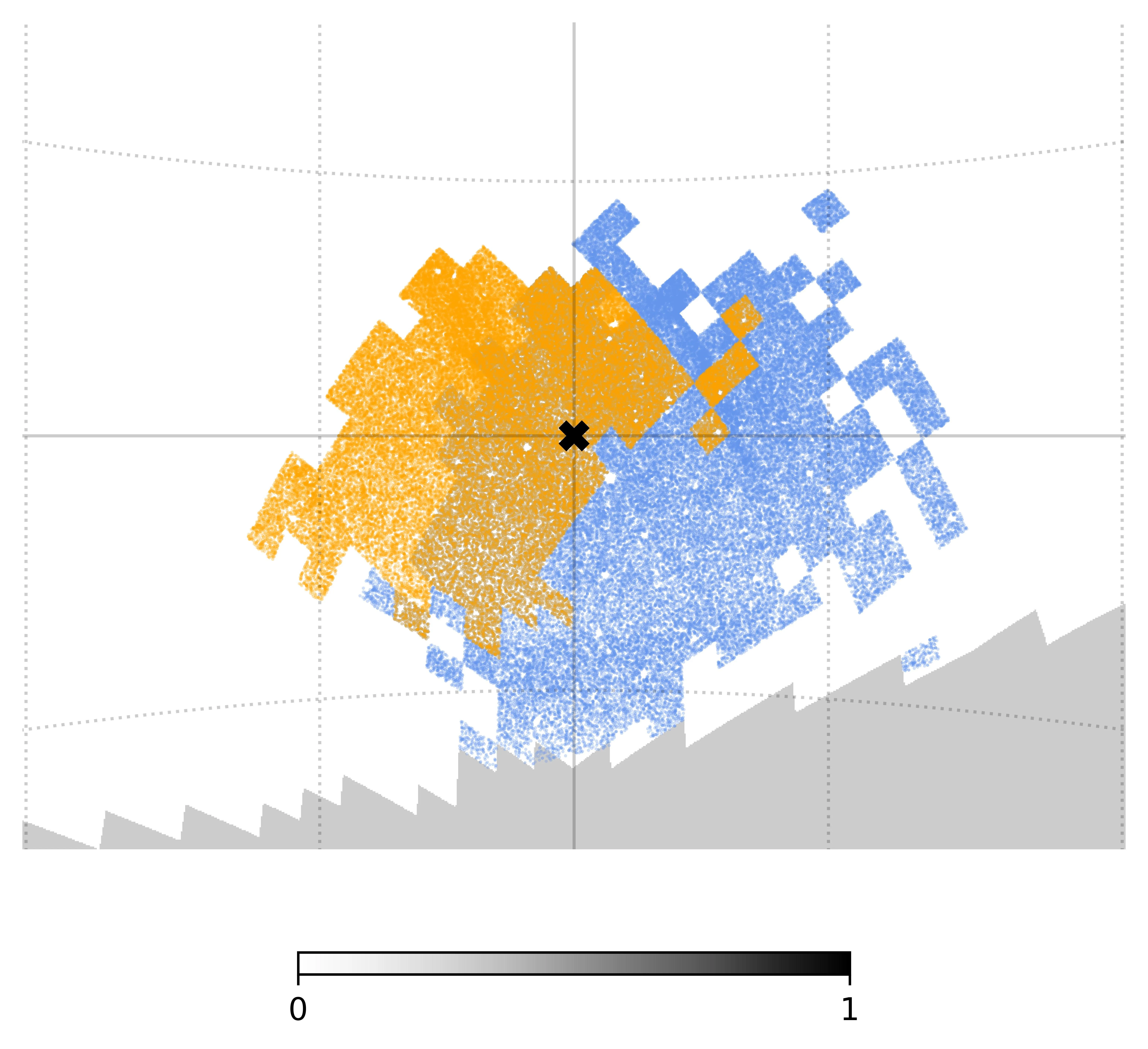
But then the orchestra begins to play softer, and a solo part breaks through the general noise. It's loud enough to be discerned. According to calculations, the chance of catching such a signal in the next 5 years is about 38%, and after 10 years — already 51%. However, hearing is not enough. You also need to point your finger at that very galaxy among thousands of others in a huge region of the sky. This region can be hundreds of square degrees in size, like several hundred lunar disks.
To avoid sifting through all of them, astronomers devised a ranking system. First, they discard galaxies whose properties don't match what the gravitational waves "told" about the mass and distance of the black hole pair. Then they sort the remaining ones by the probability of hosting the duet. If the catalog has data on the central black hole's mass and redshift (the spectral shift due to the universe's expansion), the method works great — almost half of the candidates are filtered out. But when you have to rely only on the galaxy's apparent brightness, the efficiency drops sharply.
So the hunt is just beginning. Each year, the arrays will hear fainter signals, and the search zone will shrink like the circle of light from a flashlight that is gradually being focused. And one day, that beam will land on a single galaxy where two invisible giants are waltzing.
Supermassive black holes at the centers of galaxies can weigh as much as billions of suns, but their dance produces gravitational waves with periods of years, so slow that one "swing" lasts longer than a human lifetime.
In Carl Sagan's novel "Contact," the heroine hears a rhythmic signal from space — much like pulsar timing, except instead of black holes, there were engineers from a distant civilization.