M87 is a giant elliptical galaxy located about 55 million light-years away in the Virgo cluster. It is one of the most massive galaxies in the nearby universe, containing trillions of stars and a supermassive black hole at its center, known as M87*. This black hole gained worldwide fame in 2019 when the Event Horizon Telescope collaboration released the first-ever image of a black hole's shadow, showing the glowing ring of hot gas around the dark silhouette of the event horizon. M87 is also known for its prominent relativistic jet—a stream of plasmaejected from the vicinity of the black hole at nearly the speed of light, extending thousands of light-years into intergalactic space.
History
M87 was cataloged by Charles Messier in 1781. Its jet was discovered in 1918 by Heber Curtis, who described it as 'a curious straight ray' emanating from the galaxy. The black hole M87* was imaged for the first time in April 2019 by the Event Horizon Telescope collaboration.
How it works
The supermassive black hole at M87's center, with a mass of about 6.5 billion solar masses, accretes surrounding gas and dust. As matter spirals inward, it heats up and emits intense radiation. Some of this matter is channeled along magnetic field lines into two opposing jets, which are visible across the electromagnetic spectrum. The black hole's shadow, imaged by the Event Horizon Telescope, arises because the black hole's gravity bends light and captures some photons, creating a dark region against the bright emission from the surrounding accretion disk.
In practice
M87 serves as a natural laboratory for studying black hole physics, jet formation, and galaxy evolution. Observations of M87* provide tests of general relativity in the strong-field regime and inform models of active galactic nuclei.
Fun fact
The image of M87*'s shadow required a virtual telescope the size of Earth, combining data from radio observatories across the globe, and the data processing took about two years.
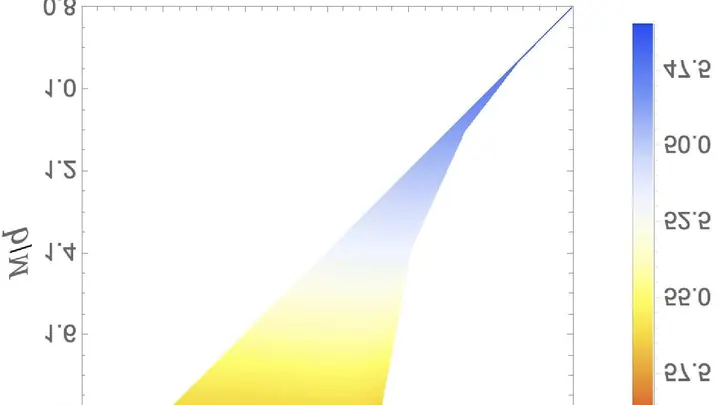
The heart of a black hole beats unevenly. One thump is brighter, another dimmer, and this rhythm encodes the temperature of the electrons swirling right at the horizon. Astronomers call this rhythm the spectral index: a number that shows how much brightness changes as you move from one radio frequency to another.
Twenty thousand years ago, the star that would become supernova 1987A put on a ring. Not one — three. The two outer ones, like lampshades, tilted relative to the equatorial ring, and the star's light, struggling through them, barely reached an observer who happened to be in the plane of the equatorial ring.
In the dense galaxy cluster Abell 2744, where gravity bends light like a lens, the James Webb Space Telescope spotted a new point of light. It appeared in images from 2023 and then began to change brightness. It was a supernova, the explosion of a dying star, but not just any kind: a Type IIP.
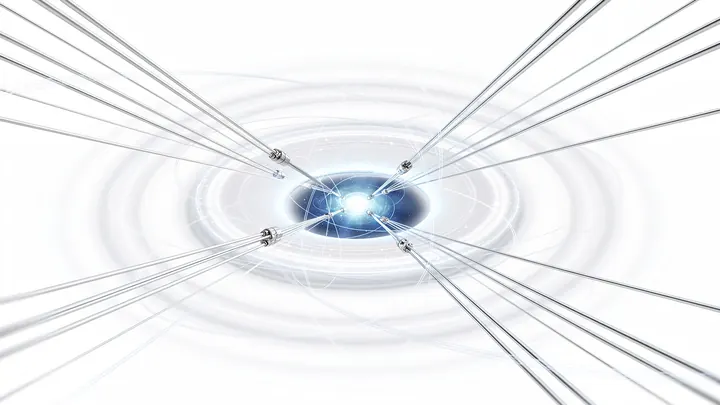
A network of radio telescopes scattered across the planet catches the whisper of a distant black hole. Each antenna records a signal, but how do you combine these recordings if the clocks at the stations tick at different rates and the atmosphere distorts incoming waves?
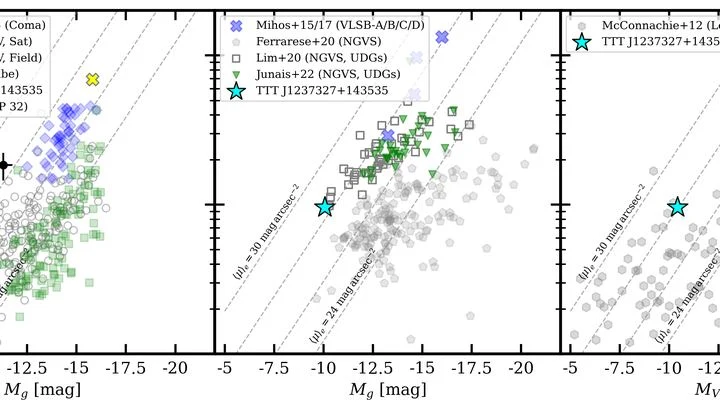
The night sky only looks black: telescopes reveal millions of galaxies, but some are so dim they blend into the background. Astronomers caught just such a "nearly invisible" one by chance while observing the Virgo Cluster with the two-meter telescope at Teide Observatory.
The galaxy is named TTT J1237327+143535.
Light from a distant galaxy reaches us through its own dust. This dust is not a smooth haze but ragged clouds, like wisps of cotton. Old models treated it as a uniform mist, and then the galaxy didn't add up energetically: too much light disappeared in the ultraviolet and too little came back in the infrared.
Astronomers did what a cook does when they dice a potato instead of tossing it in whole.
The galaxy cluster RXC J0528.9−3927 is like a city shrouded in fog: at its center, a radio halo shines brightly, but farther out, beyond the usual boundaries, astronomers have spotted a barely visible glow. It stretches for two million light-years — three times farther than the halo itself.
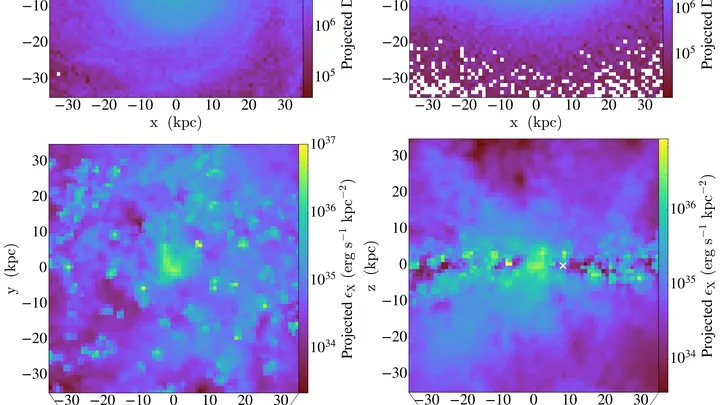
The Andromeda galaxy is our nearest large neighbor, and like the Milky Way, it has an invisible gaseous shroud. This shroud of extremely hot, rarefied gas extends for hundreds of thousands of light-years. Seeing it directly is nearly impossible — the gas is too faint.
A dance floor where couples whirl. At the center, an invisible master of ceremonies sets the rhythm. This is the supermassive black hole at the heart of the Milky Way, and the couples are stars whose orbits astronomers have tracked for years. But what if the master himself is wrapped in a fluffy fur coat of tenuous matter?
The five-hundred-meter FAST radio telescope picked up a signal at the 21-centimeter wavelength — the telltale glow of cold hydrogen. The signal came from a cloud named Cloud-9. It hangs in space near the galaxy M94, but it contains not a single star.
A black hole's shadow isn't just a black circle. Usually, we see a dark void surrounded by a glowing ring of hot gas. But if a black hole wasn't born from a dying star but has existed forever, its shadow might hide a surprise.
An eternal black hole is a solution to Einstein's equations with no past and no collapse.
In a distant galaxy about 290 million light-years away, the object HLX-1 lies hidden. It once flared brighter than hundreds of billions of suns, but now it has quieted down. From 2018 to 2022, the Hubble, Chandra, and Swift space telescopes tracked its fading.
1799 kilometers per second — that's the speed at which star S5-HVS1 is permanently leaving the galaxy. 4.8 million years ago, it was ejected from the center of the Milky Way during a close encounter with the supermassive black hole Sgr A*.
Ten billion years ago, the universe was speckled with strange crimson sparks. The JWST spotted them in images at distant redshifts — compact sources blazing like entire galaxies yet no larger than a tiny central region. Astronomers nicknamed them “little red dots.” Their nature long defied explanation.
It takes the stellar pair J05+50 nearly two months to complete one orbit around their common center. From Earth, it appears as a faint point in the constellation Hercules — 4625 parsecs away. Photometry of the binary star only captures a steady flicker of brightness, like the pulse of a giant heart.
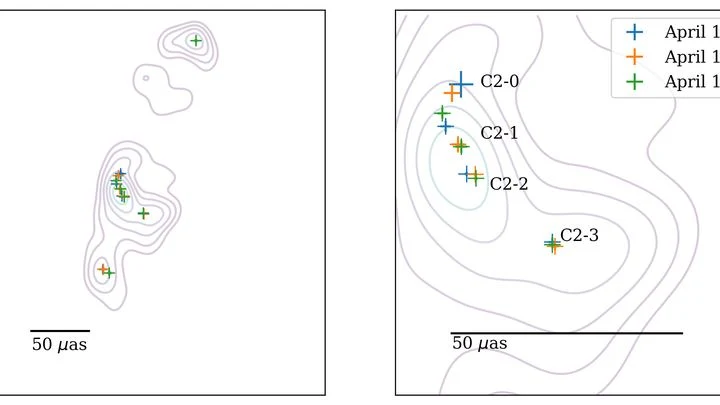
In April 2021, the antennas of the Event Horizon Telescope (EHT)—a global network of millimeter-wave radio telescopes — zeroed in on a tiny spot in the constellation Virgo.
The cosmos is full of screams we can't hear. Every time a black hole tears a star apart, a blinding flash is born, and often — a narrow relativistic jet, shooting out thousands of light-years. But if that searchlight is aimed away from Earth, we see only a faint afterglow — a radio echo arriving with a delay.
In 2024, the Hephaestus project sifted through millions of stars and flagged a few dozen suspicious ones: they shone brighter in the mid-infrared than a normal red dwarf should. Two of these candidates, labeled D and E, looked especially tantalizing, as if an invisible heater were working next to the star.
A cosmic detective story spanning a decade and a half has turned up an unexpected clue. The Fermi telescope, which scans the sky in gamma rays, has detected a steady, faint glow enveloping the entire Milky Way. It looks nothing like the light from stars or hot gas — more like a dim, all-pervasive haze.
In the Galactic bulge, where the light of billions of stars merges into a continuous glow, four cold giants passed unnoticed. You can't see them through a telescope — too far, too dim.
At the center of the Milky Way, where the supermassive black hole Sagittarius A* reigns supreme (its metric first derived by Karl Schwarzschild), star S4714 makes a dizzying voyage.
In 1933, Fritz Zwicky first spoke of an invisible mass holding galaxy clusters together. Decades later, Vera Rubin mapped galactic rotation, revealing the ghostly presence of dark matter. Today we know it pervades the cosmos, but its particle nature remains elusive.
Hundreds of light-years away, there's a planet that looks like a giant mirror. LTT9779b reflects most of the light that hits it — far more than you'd expect from a Neptune-sized body. Astronomers have long debated what makes it so shiny: a thick carbon-rich haze or a layer of clouds.
The James Webb Space Telescope has helped settle the debate.
The early Universe is often imagined as a nursery: most galaxies there are amorphous blobs, rowdy and irregular, choking on gas and bursts of star formation.
Nearly a decade and a half ago, the Fermi gamma-ray telescope spotted mysterious "bubbles" — giant plasma blobs, as if inflated by invisible lungs, towering tens of thousands of light-years from the Galactic center.
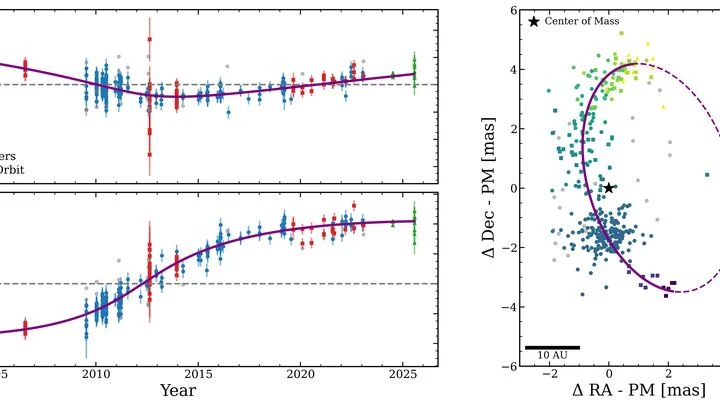
For 23 years, Hubble and James Webb have peered into the heart of Omega Centauri, a globular cluster where millions of stars crowd into a space just 150 light-years across. In this stellar beehive, the motion of the stars betrayed an invisible partner: a main-sequence star (one that has not yet left the main evolutionary branch) seemed to be tugged in a dance with an unseen weight.
A giant cloud of invisible matter acts like a funhouse mirror — distorting the light from a distant galaxy. From these distortions, astronomers can weigh the cloud and peer into its depths.
Cosmic black holes at the centers of galaxies are like giant banyan trees: their aerial root‑filaments stretch for kiloparsecs to harvest nourishing matter. For decades astronomers have debated: how does cooling gas from cluster atmospheres fall into the sphere of influence of a supermassive hole?
Galaxies without dark matter are like beads from which the invisible thread has been ripped. Stretching around the elliptical NGC 1052 is a chain of eight ghostly dim dwarfs: they contain almost none of the mysterious mass that makes spiral arms rotate. Vera Rubin first showed that without the invisible framework, stars would fly apart.
A vast hall where hundreds of orchestras play at once. Amid this din, you need to pick out one specific duet — two supermassive black holes circling each other in a distant galaxy. That's how pulsar timing arrays work: they listen to the "hum" of the entire sky, created by gravitational waves from many such pairs.
Pairs of black holes dance in three different styles before merging. The first is a neat waltz: the objects swirl in the same direction, like partners facing the same way. Such pairs are born from binary stars and often have unequal masses. The second is chaotic disco: spins are scattered, masses nearly equal.
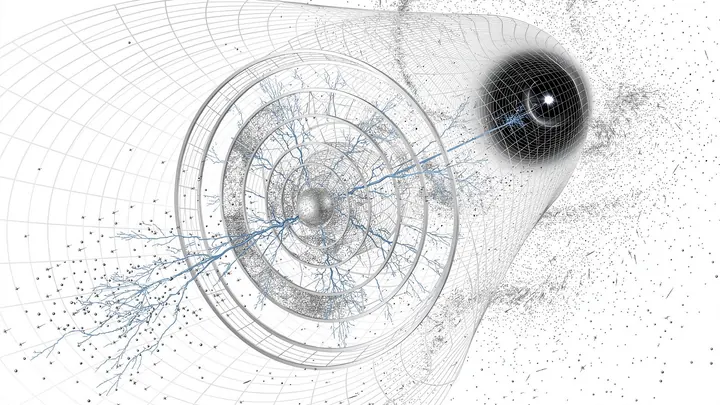
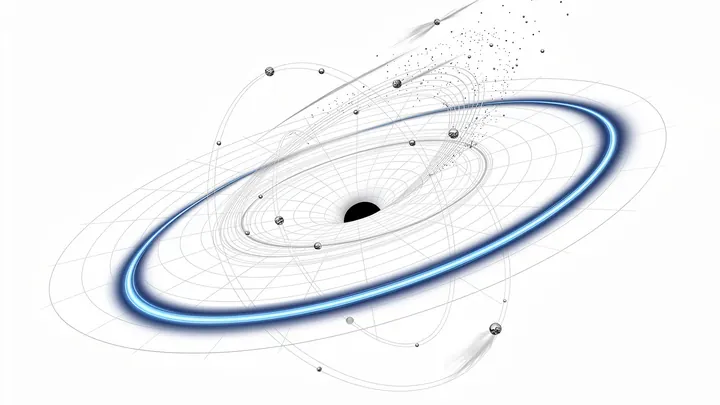
The shadow of a black hole is not just a silhouette. It's the edge of the abyss, where space and time are twisted so tightly that even light is forced to swirl like a wood chip in a whirlpool. This 'cosmic whirlpool' arises from the monstrous mass warping spacetime.
A tiny black hole, no larger than an atomic nucleus, hovers in a cloud of hydrogen. It doesn't swallow everything around it; instead, it slowly radiates away, losing mass with every moment.
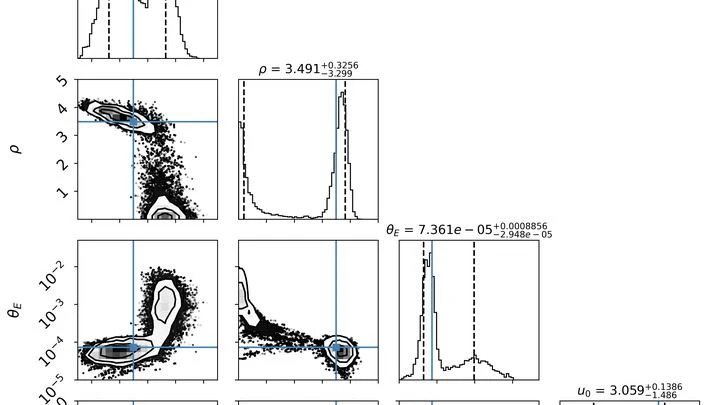
A spotlight shines through a dark hall. Between the lamp and the wall, an invisible lens drifts by, and the spot of light briefly brightens and shifts. That is exactly what the DECam telescope, aimed at the Large Magellanic Cloud, a satellite galaxy of our Milky Way, was watching for five consecutive nights.
Black holes come in lightweights, born from dying stars, and supermassive ones at galactic cores. The missing intermediate link had been hiding. Fast radio bursts, cosmic signals lasting milliseconds but carrying the energy of days of sunlight, helped crack the case. Think of these bursts as cries from the depths of the universe.
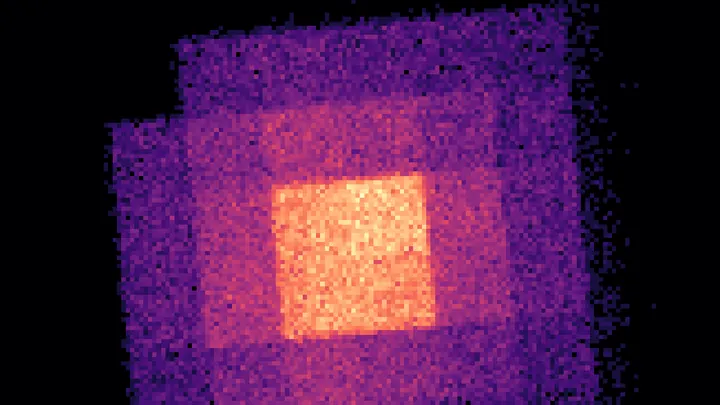
The XRISM X-ray telescope spent 170,000 seconds staring at the core of galaxy Cygnus A — one of the most powerful radio sources in the sky. At its center lurks a supermassive black hole that sucks in matter and heats it until it glows in X-rays. The instrument caught light from iron atoms that had lost electrons.
The cosmos is full of mimicry. The clearwing moth wears a wasp's mask, a harmless fly buzzes like a bee. And in the world of gravity, the role of impersonator is perhaps played by boson stars — colossal clumps of scalar field, indistinguishable from black holes.
Astrophysicists have conducted a census of invisible objects that betray their presence only through the trembling of space. They studied the fresh catalog GWTC-4 — a list of dozens of black hole mergers recorded by the gravitational wave detectors LIGO, Virgo, and KAGRA.
Around our Galaxy, like an invisible crown, stretches a tenuous cloud of gas heated to millions of degrees. It is called the galactic halo. Seeing this glow directly is difficult: it emits soft X-rays that are absorbed by Earth's atmosphere.