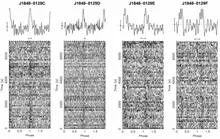
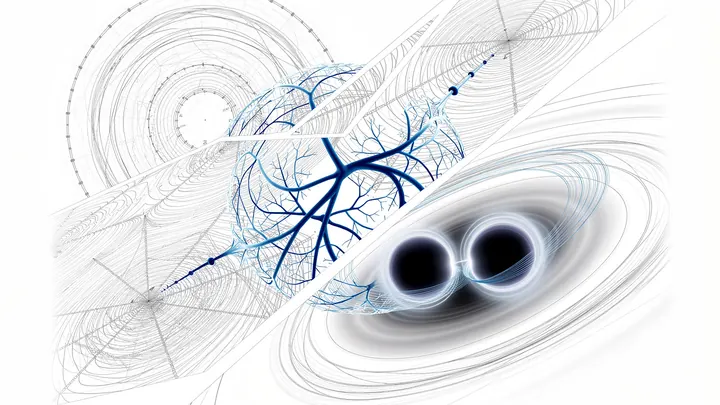
A pulsar timing array is a network of precisely monitored pulsars — rapidly rotating neutron stars that emit regular pulses of radiation — used to detect gravitational waves. By measuring the arrival times of these pulses with extreme accuracy, scientists can look for correlated deviations caused by passing gravitational waves, which stretch and compress space-time. This technique is particularly sensitive to ultra-low-frequency gravitational waves, such as those produced by supermassive black hole mergers, which are invisible to ground-based detectors like LIGO.
History
The concept was proposed in the 1980s by several researchers, including Sazhin and Detweiler, and has been developed by collaborations such as NANOGrav, the European Pulsar Timing Array, and the Parkes Pulsar Timing Array. In 2023, these collaborations announced strong evidence for a gravitational wave background, likely from supermassive black hole binaries.
How it works
Pulsars act as cosmic clocks, with their pulses arriving at Earth with remarkable regularity. A gravitational wave passing between the pulsar and Earth will slightly alter the distance, causing the pulses to arrive early or late. By comparing the timing residuals of many pulsars across the sky, scientists can distinguish a genuine gravitational wave signal from noise, since the wave would create a characteristic spatial correlation pattern. The array effectively turns the entire galaxy into a giant gravitational wave detector, with the pulsars serving as reference points.
In practice
Pulsar timing arrays are used to study the gravitational wave universe, providing insights into galaxy evolution, black hole mergers, and the early universe, potentially even probing physics beyond the Standard Model.
Fun fact
The precision required is so extreme that pulsar timing arrays can detect changes in the distance between Earth and a pulsar of just a few meters over thousands of light-years.
At night in fog, a searchlight works worse than in daylight: tiny droplets scatter the beam, and distant objects drown in the murky haze. Much the same way, radio waves from pulsars get lost in the interstellar medium when there are many free electrons between us and the star.
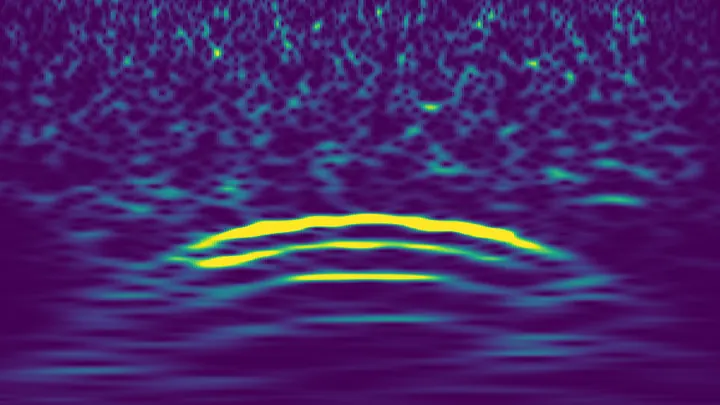
Radio waves from a distant pulsar travel through the interstellar medium, encountering invisible magnetic structures the size of the distance from the Sun to Earth. One such structure is a current sheet, where the magnetic field abruptly changes direction, like a compass needle flipping from north to south.
Gravitational-wave detectors are like extremely sensitive ears: they pick up the trembling of space when black holes or neutron stars collide somewhere in the universe. But even the most sophisticated "ears" cannot hear everything. The new LIGO A# project is like replacing the eardrum with a thinner, more sensitive membrane.
A lighthouse flashes for a fraction of a second and goes dark again. The MeerKAT telescope in South Africa catches such flashes in the radio band. During its observations, it picked up 27 new sources that no one had seen before. Neutron stars are the remnants of exploded stars, compressed to the size of a city.
A black hole is like a spinning top that never stops on its own. But if a cloud of ultra-light particles, bosons, forms around it, the picture changes. This "fog" acts like an invisible brake: the particles drain the hole's spin, slowing it down.
Imagine a lottery where instead of money, you win black holes. Each ticket is a random spot on the sky, and the prize is a gravitational wave from the merger of two giants. The chance of hitting the jackpot is minuscule, but if you do, the wave is heard across the entire universe.
Pulsars are rapidly spinning neutron stars that emit radio pulses like a lighthouse. But some of them stay silent almost all the time, occasionally emitting a single pulse. Such objects are called rotating radio transients (RRATs). They were discovered nearly twenty years ago, but they remain a mystery.
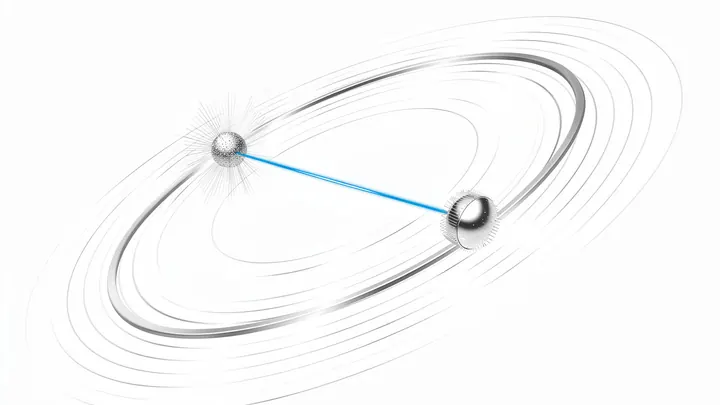
Somewhere in the depths of space, two supermassive black holes are circling each other. Their dance is not smooth — the orbit is stretched, like a rubber band that alternately tightens and relaxes. Each revolution sends ripples through the fabric of spacetime — gravitational waves.
Somewhere in the depths of the Milky Way, radio pulses flare up from time to time — rare, steady, like the ticks of a distant metronome. These long-period radio transients were discovered only recently, and they immediately puzzled astronomers.
At the end of a massive star's life, its core collapses in a fraction of a second, giving birth to a supernova flash. This cataclysm shakes spacetime itself, emitting gravitational waves — ripples that race across the Universe.
You could send a short radio pulse toward a black hole and wait for the reflected echo. Intuitively, the shorter the signal, the better it would probe the finest details of spacetime right at the horizon: that region from which even light cannot return.
At the heart of our Galaxy lives the supermassive black hole Sagittarius A*. If an invisible companion orbits nearby, their dance can be spotted through the light of other stars. The pair's gravity works like a lens: as the black holes pass in front of a background star, its light briefly brightens and splits into two.
The galaxy is not a smooth lake but a pond with ripples. These ripples are created by ultralight dark matter (particles billions of billions of times lighter than an electron).
A huge bowl of water. Drop a stone into it — ripples spread across the surface. The fabric of spacetime works much the same way: when two massive stars merge, they create ripples — gravitational waves. These waves travel to Earth and are picked up by giant detectors like LIGO and Virgo.
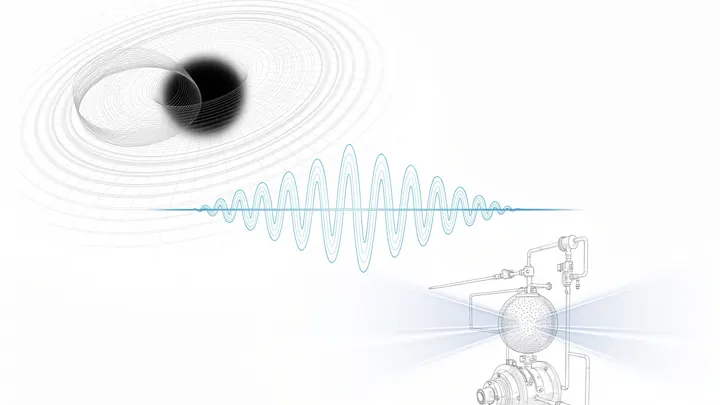
In 2034, a rocket leaves a spaceport with an unusual payload: two spheres the size of a large globe, each weighing nearly a ton. No engines, no electronics. Just a mirrored surface of hundreds of corner-cube reflectors — tiny prisms that return light exactly to where it came from. This is the future space tuning fork.
Gravitational-wave detectors are like sensitive microphones, listening for the whispers of distant cataclysms. But every now and then, a sharp crack bursts in — a brief noise spike known as a glitch.
In the ocean of space, every storm of birth or merger of supermassive black holes generates ripples — gravitational waves traveling at the speed of light. Over billions of years, these waves superimpose, merging into a low-frequency hum, like a distant surf.
Isolating the signal from a single pair of supermassive black holes is like hearing a dancer's footsteps amid the roar of a hurricane. Somewhere in space, these monsters spin in a slow gravitational tango, distorting spacetime itself.
A pair of neutron stars, locked in a gravitational embrace, traces invisible circles in the void. A century ago, Albert Einstein described this dance as waves of curved geometry, but for a long time we could only catch glimpses — through the feverish flicker of radio pulses.
When two neutron stars circle each other, they don't remain rigid spheres. The partner's gravity stretches each star, creating tidal bulges — much like the Moon raises ocean tides on Earth. But unlike water, here it's superdense matter that deforms: a teaspoon of this stuff weighs billions of tons.
A gravitational wave observatory is like a set of microphones scattered across the Earth. When a signal arrives from space (say, from a black hole merger or a supernova explosion) each microphone hears something slightly different.
A hum resonates across the universe. It is not sound, but a trembling of space itself — the gravitational wave background. It is produced by pairs of supermassive black holes circling each other at the centers of distant galaxies. Each pair is like a bass instrument in a vast orchestra.
A translator records a multi-hour conversation. If they try to hold the entire dialogue in their head, they're bound to garble details by the end. That's roughly how gravitational observatories work: they listen to the 'conversation' of massive bodies spiraling together.
Gravitational waves from a tiny body falling into a black hole work like an X-ray image. Only instead of a bone, they illuminate the curved spacetime itself.
Pulsars are dead stars spinning with flawless rhythm. Their radio blips are more precise than atomic clocks. However, gravitational waves — ripples in the fabric of spacetime, predicted by Einstein — disrupt that rhythm.
Imagine an orchestra where each musician plays their own part, and the conductor tries to catch a faint rhythm common to all. That's roughly how astronomers search for gravitational waves from pairs of supermassive black holes (weighing billions of suns) circling each other in distant galaxies.
When two neutron stars, compressed to the size of a city, approach in their final dance, the spacetime around them comes alive, emitting gravitational waves.
Astronomers listen to the cosmos like an old radio: they twist the knob not to find a particular station, but to catch any unusual noise. This approach breaks the mold: instead of hunting for gravitational waves using memorized patterns, they catch everything — without bias.
A lighthouse spins in dense fog. Its beam cuts through the gloom, but the fog itself remains invisible. That's roughly how astronomers search for dark matter: it doesn't emit light, yet it can affect the signals that reach us.
A vast hall where hundreds of orchestras play at once. Amid this din, you need to pick out one specific duet — two supermassive black holes circling each other in a distant galaxy. That's how pulsar timing arrays work: they listen to the "hum" of the entire sky, created by gravitational waves from many such pairs.
Two dots on the surface of a balloon: that's all the reference points you have when trying to figure out how it inflates. That's roughly how cosmologists reconstruct the history of the universe's expansion.
The universe sometimes resembles a pot of boiling water. With enough heat, liquid turns to vapor: that's a phase transition. Something similar could have happened in the early universe: a field filling space suddenly changed its state, like water becoming gas.
Spacetime is not a passive void but a dynamic membrane capable of elastic deformation. When neutron stars (ultra-dense objects the size of a city, where matter is compressed to nuclear density or black holes) regions with gravity so strong that even light cannot escape their bounds collide, the membrane shudders, generating…
A spinning top whirls at great speed and, instead of a steady hum, emits a quiet buzz — because it is slightly dented. Neutron stars work much the same way: city-sized spheres compressed to such density that a teaspoon of their material weighs as much as a mountain.
Two heavy balls orbit on the surface of a pond. Ripples spread from them: these are gravitational waves. As the balls spiral closer, the waves carry away energy, and the ripples become more frequent.
The universe is permeated by an invisible substance, dark matter, whose gravitational influence is obvious, but whose composition remains a mystery. One hypothesis suggests it consists of ultralight particles so light that they exhibit wave-like behavior, forming a kind of cosmic ripple.
When black holes or neutron stars merge, they disturb the very fabric of spacetime, producing gravitational waves — ripples predicted by Einstein in his general theory of relativity.
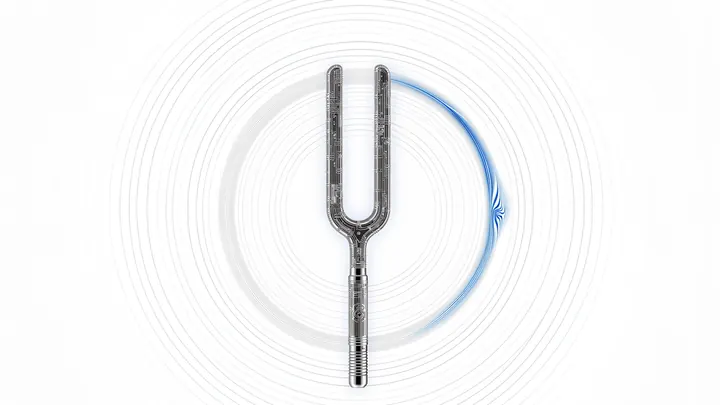
In a vast hall, a hundred tuning forks are set out. Each one is a pulsar — an ultra-dense stellar remnant spinning at a furious rate, sending out radio pulses more precisely than any clock. When a low-frequency sound wave sweeps through the hall, all the tuning forks start to go slightly out of tune at the same moment.
The trembling of space sounds like an orchestra. Gravitational waves caught by the LIGO and Virgo detectors tell of black hole collisions. Sometimes the music carries off-key notes — tiny deviations from Einstein's score. They might whisper of new physics or simply of dust on the bows.