Taming a Spinning Crystal express
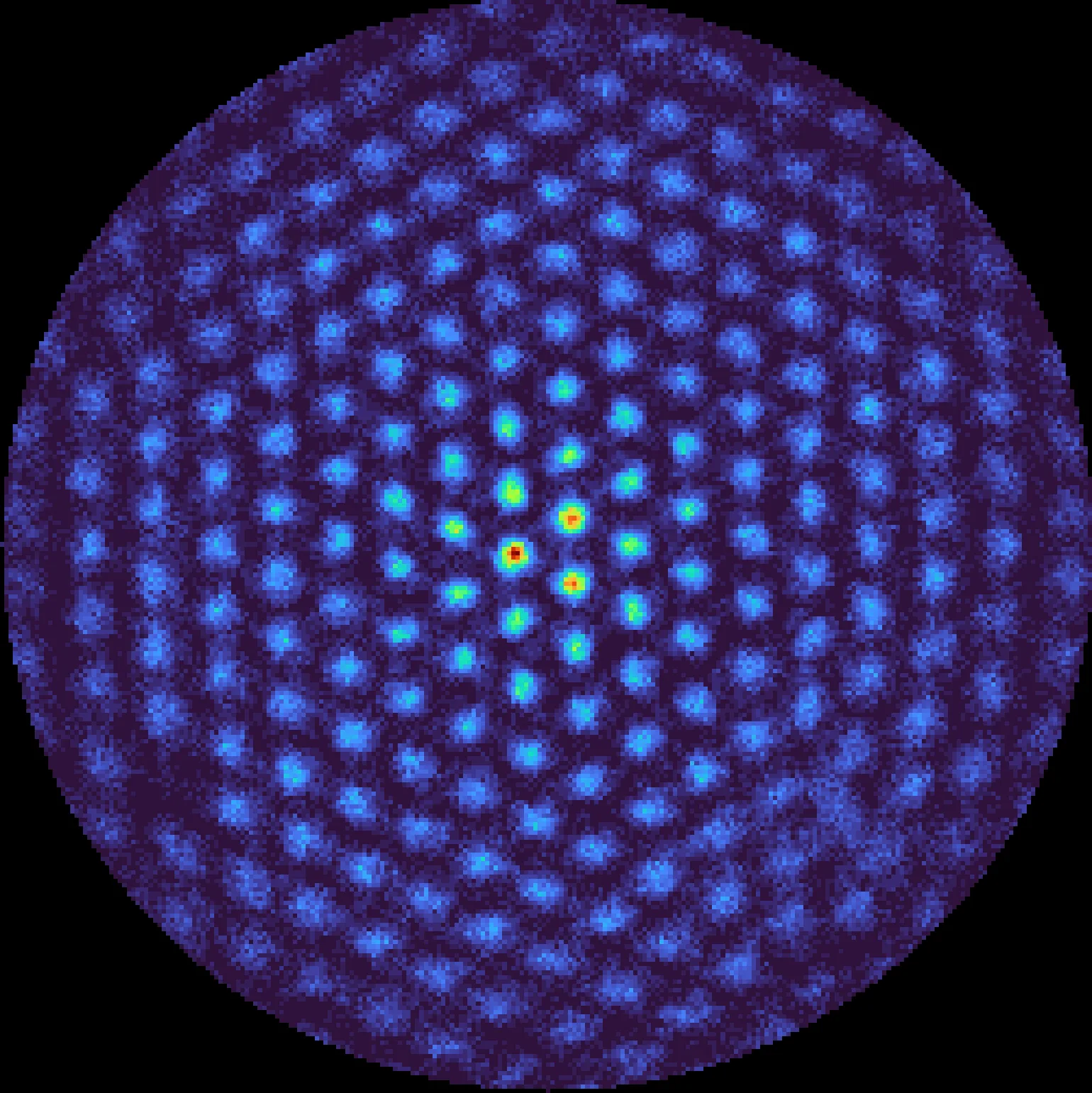
Hundreds of spinning tops sit on a carousel. Each one spins on its own, but the whole carousel also rotates. The challenge is to reach out and tilt the axis of any top as it whizzes by. In the quantum world, such a carousel is a crystal of charged atoms (ions) in a Penning trap — a device where electric and magnetic fields hold ions and make them rotate.
Previously, this collective rotation was a hindrance: a laser beam trying to control a single ion simply couldn't keep up. Now, a team from the National Institute of Standards and Technology (NIST) solved the problem by making the beam move in sync with the crystal, like a hand that precisely catches the right seat on a carousel. The beam doesn't just shine; it shifts the ion's energy levels (called the Stark shift), rotating its quantum spin, the analog of the top's axis, by a desired angle.
Tests showed that the accuracy of flipping the spin by 180 degrees reaches 95%, and the effect on neighboring ions is only 2%. That's enough to "paint" patterns of spins on the crystal. For example, the physicists created a texture called a "biskirmion"—two vortices of spins twisted in opposite directions, like a double whirlpool in a flat lake. And in bilayer crystals, they could address each layer separately without disturbing the other.
Now the carousel with tops has become controllable. You can not only set complex initial states but also measure the spin in two directions at once in a single experiment — thanks to the Ramsey method with double quadrature. One glance at the carousel reveals both the tilt angle of each top and its rotation speed.
The beryllium-9 ions in the experiment are cooled to near absolute zero, yet the entire crystal rotates at about 180,000 revolutions per second — faster than a race car engine.
In Greg Egan's novel "Permutation City," quantum states of particles are used to model consciousness — similar spin-control technologies bring us closer to creating programmable quantum matter.