A Lens the Size of a Nanoparticle
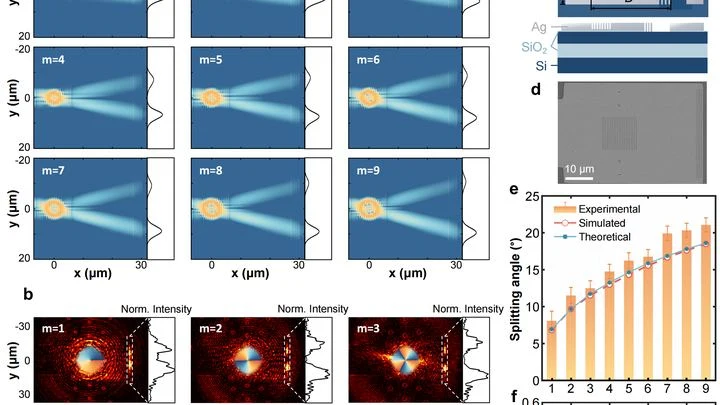
Light passing by a tiny structure changes direction. If the structure is smaller than the wavelength of the light, it acts like a lens and focuses the light into a spot smaller than the wave itself.
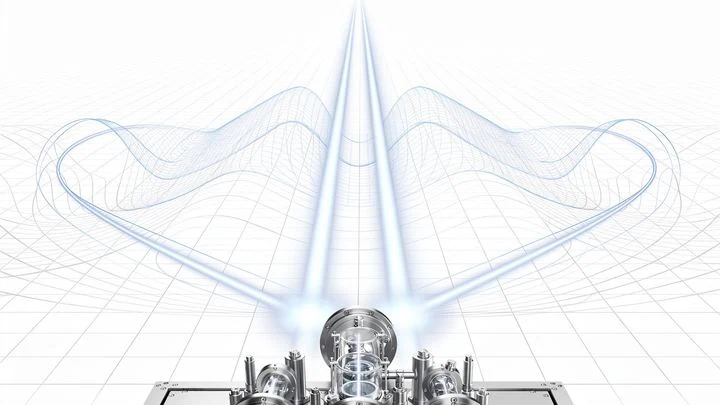
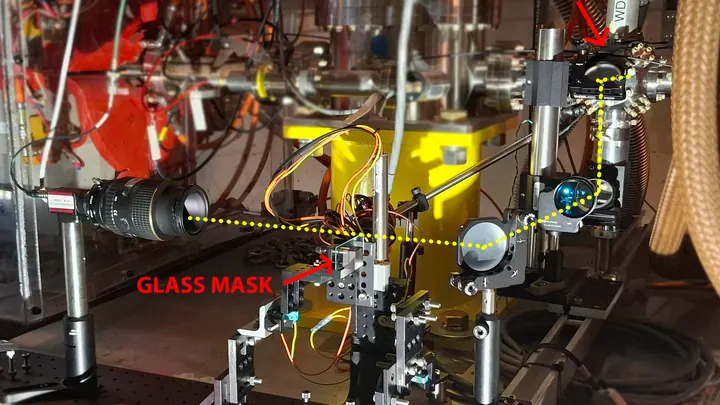
A concentrated beam of coherent light, used here to detect and amplify the nano-mirror's vibrations.A laser beam is a concentrated stream of light in which the waves are coherent — meaning they move in lockstep, with the same frequency and phase. This coherence is what makes laser light so different from ordinary light: it can stay narrow over long distances, focus to a tiny spot, and carry energy or information with remarkable precision. In the context of the research described, the laser beam is used to detect and amplify the vibrations of a nano-mirror, a tiny reflective structure that moves by minuscule amounts. By bouncing light off the mirror and measuring the changes in the reflected beam, scientists can sense vibrations far smaller than the wavelength of visible light.
The theoretical basis for the laser was laid by Albert Einstein in 1917 with his concept of stimulated emission, but the first working laser was built by Theodore Maiman in 1960 at Hughes Research Laboratories, using a ruby crystal. The term 'laser' (Light Amplification by Stimulated Emission of Radiation) was coined earlier, in 1957, by Gordon Gould.
A laser produces light through stimulated emission: atoms or molecules are excited to a higher energy state, and then a passing photon triggers them to emit identical photons, creating a cascade of coherent light. The beam is shaped and directed by mirrors and lenses. When it hits a moving mirror, the reflected light is Doppler-shifted — its frequency changes slightly depending on the mirror's velocity. By interfering the reflected beam with a reference beam (interferometry), these tiny frequency shifts become measurable as intensity variations, revealing the mirror's motion. This technique, often called laser vibrometry, can detect displacements on the order of picometers or less.
Laser beams are used in lidar systems to map terrain and detect atmospheric particles, in optical disc readers, in fiber-optic communications, and in precision measurement tools like laser interferometers for gravitational wave detection.
A laser beam can be so focused that it can cut through steel, yet a low-power laser is used in barcode scanners at every supermarket checkout.