Magnetic traps are a cornerstone technology for manipulating quantum systems, particularly neutral atoms and ions. By creating a spatially varying magnetic field, physicists can confine particles to a small region of space, isolating them from the environment. This isolation is essential for maintaining quantum coherence, the fragile state that enables superposition and entanglement. The technique is central to experiments in quantum computing, precision sensing, and fundamental tests of quantum mechanics.
History
The concept of magnetic trapping for neutral atoms was first demonstrated in the 1980s, with the first successful trap for sodium atoms achieved by the group of William Phillips and others in 1985. This built on earlier work on magnetic confinement in plasma physics.
How it works
The mechanism relies on the Zeeman effect: atoms with a magnetic moment experience a force in a magnetic field gradient. In a magnetic trap, the field is shaped to have a minimum (or maximum, for certain states) at the center, creating a potential well. Atoms in low-field-seeking states are pushed toward the minimum, where they remain confined. The trap is often combined with laser cooling to first slow the atoms, then the magnetic field takes over for long-term confinement.
The same principle is used to confine antimatter in experiments like ALPHA at CERN, where antihydrogen atoms are held in a magnetic trap to study their properties.
Imagine a ladder whose rungs are tiny magnets. If neighboring magnets point in opposite directions, the ladder is "calm." But if you make them all point the same way, the whole structure becomes magnetized and "stubborn."
Scientists built such a ladder from germanium atoms — a semiconductor used to make transistors.
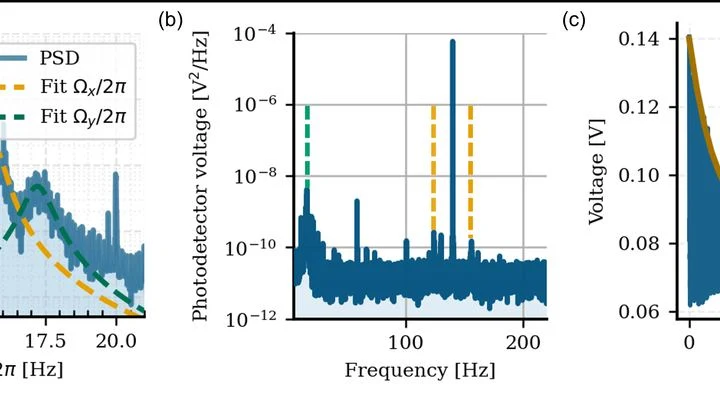
A magnetic top that doesn't fall. A tiny sphere of yttrium iron garnet hovers in midair, held by invisible forces. This isn't a magic trick but a Paul trap — an alternating magnetic field that rapidly changes direction and keeps the sphere from falling, like a juggler tossing balls.
The sphere trembles but doesn't fall.
A magnetic field holds a tiny particle in mid-air, like an invisible dance partner. A special tuning of the field creates a trap with two "positions." In the ordinary world, a dancer occupies only one, but in the quantum world — both at once. Physicists have learned to achieve this for dust grains weighing trillionths of a gram.
An ordinary magnet is like a compass: its needle points north. But a quantum compass can look in both directions at once. If a magnet floating in a vacuum is gently spun, its electron 'tops' synchronize so the whole piece of metal starts living by the rules of the microworld — freezes in a superposition, like a split pointer.
Hundreds of spinning tops sit on a carousel. Each one spins on its own, but the whole carousel also rotates. The challenge is to reach out and tilt the axis of any top as it whizzes by.
A tiny magnet levitates in a magnetic trap, like a weightless needle. Its magnetized axis is like a stubborn compass needle that is prevented from turning. An invisible wall rises before it. But in the quantum world, particles can seep through barriers — this trick is called tunneling.
A flashlight beam in a dark room can hold a dust mote almost still: that's how optical tweezers work. But light doesn't just push the particle; it also jostles it with random kicks. Each absorbed photon strikes it like an invisible hammer. The authors of the new study have devised a light trap of a special shape.
A typical atom trap works like a funnel: laser light and a magnetic field slow atoms down and gather them at the center. But the funnel has a limit: it only catches atoms moving within a certain speed range.
Ultracold molecules are a promising material for quantum computing, but assembling them into a neat array, like eggs in a carton, is no easy feat. A method has been proposed to load molecules one by one into optical tweezers or lattices directly from a gas. The molecules immediately end up in the calmest state of motion.
A single antiproton, trapped and cooled to near absolute zero, behaves like a tuning fork that needs a very precise strike to produce a clean note. Catching that 'note' directly is nearly impossible — the signal is too weak.
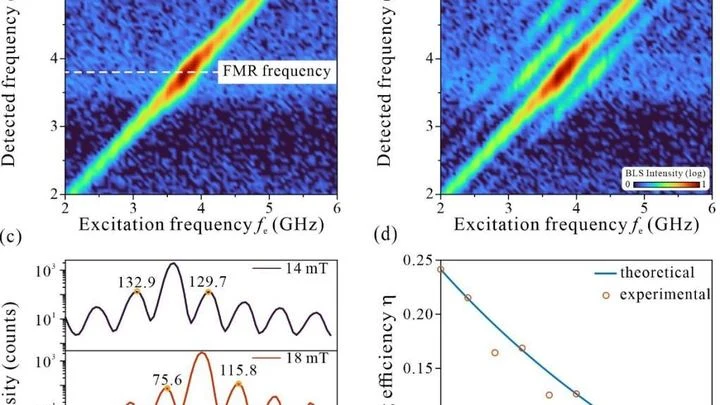
Waves in magnets resemble the vibrations of a string: if you pluck a string, it sounds a single note, but with a strong pluck, overtones appear — sounds at multiple frequencies.
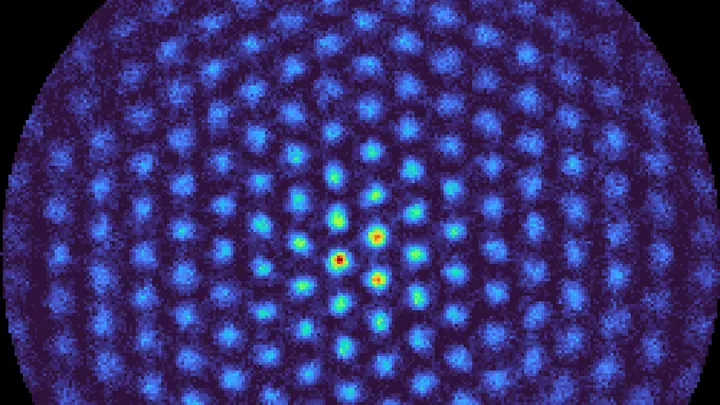
Five charged calcium atoms hover in a trap, held by electric fields. Laser cooling saps their excess energy, and they line up into a tiny pyramid with a square base. But this pyramid doesn't stay put: every now and then it flips over, as if someone tosses it into the air and catches it upside down.
In a narrow slit between two plates, ions don't behave like free particles but like a crowd in a packed bus: pressed tightly together, they form dense clusters. This very property, the ability of ions to bunch up in extremely confined spaces, underpins a new mechanism for controlling ion transport.
Researchers studied ion behavior in two-dimensional nanochannels just a few atoms wide.