Taming a Spinning Crystal
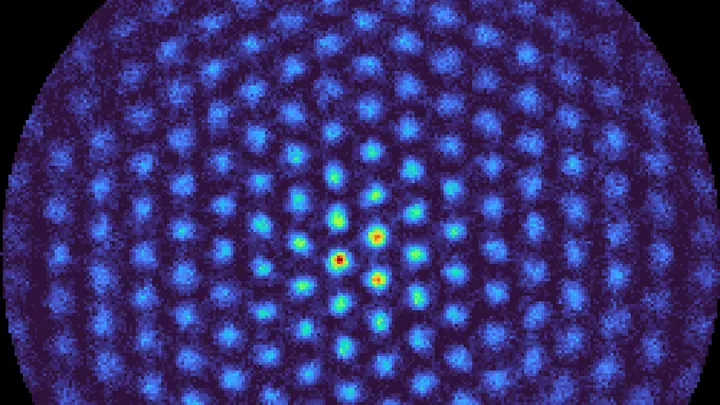
Hundreds of spinning tops sit on a carousel. Each one spins on its own, but the whole carousel also rotates. The challenge is to reach out and tilt the axis of any top as it whizzes by.
The space of adjustable variables that define the trap's configuration.Parameter space is the abstract, multi-dimensional space in which each point represents a specific combination of the adjustable variables that define a system's configuration. For a physical trap — such as an optical tweezers or a magnetic trap for atoms — these parameters might include laser power, beam alignment, field strength, and geometry. The concept is central to understanding how systems behave under different conditions and to optimizing their performance.
The term 'parameter space' emerged in the mid-20th century with the development of control theory and dynamical systems, though the underlying idea of varying parameters to explore system behavior is much older.
Each parameter is a coordinate axis in this space, and a particular setup corresponds to a single point. As parameters are varied, the system moves along a trajectory in parameter space. Regions of this space correspond to qualitatively different behaviors — stable trapping, instability, or chaotic motion. By mapping out these regions, researchers can identify the conditions needed for a desired outcome, such as a stable optical trap for a dust particle or a snapping mechanism that works reliably.
Parameter space is used in engineering to design robust systems, in physics to map phase diagrams, and in machine learning to tune model hyperparameters.
In cosmology, the 'parameter space' of the early universe is so vast that even tiny variations in a single parameter, like the density of matter, would have led to a universe completely different from ours.