A Trap for a Black Hole That Can't Be Overfed express
You toss pebbles into a whirlpool, trying to spin it faster and peer into its depths. A black hole is a cosmic whirlpool, where instead of water there is curved spacetime, and instead of a bottom there is a singularity — a point where the familiar laws of physics break down. But nature has set a firm barrier: no matter how hard you try, the 'bottom' will never be exposed.
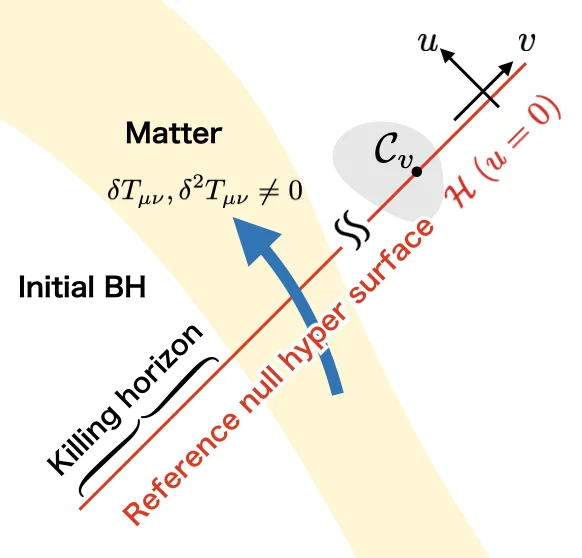
A group of physicists has formulated a rigorous geometric criterion that explains why this is so. They considered a thought experiment: into a nearly extremal black hole (spinning or charged), you add a bit more matter or charge. It would seem you could cross the critical threshold and turn it into a 'naked' singularity — an object without an event horizon, that invisible boundary from which nothing returns. But the infalling matter, layer by layer, forms a closed trapped surface — a region that collapses to a point faster than light can escape it.
And here is the key point: if the resulting trapped surface cannot 'fit' into the spacetime that would supposedly arise after the overload, then that spacetime simply cannot exist. Nature will not allow a naked singularity to appear. This criterion works without reference to charges at infinity or precise extremality conditions, making it universal.
So, no matter how hard you try, a black hole remains dressed in its horizon, and the singularity stays safely hidden from prying eyes. It's like a perfect safe: you can try to crack it by adding energy, but the locking mechanism engages before you get to the contents. Nature, once again, proves trickier than our wildest fantasies.
Original abstract
as written by the authors arXiv:2606.13592
We formulate a local geometric criterion for weak cosmic censorship in black hole overcharging and overspinning thought experiments. Under the null convergence and generic conditions, matter injection turns a horizon cross section into a closed trapped surface. Any final spacetime unable to accommodate this surface is ruled out. This trapped surface criterion excludes superextremal Reissner-Nordstr\"om, Reissner-Nordstr\"om-de Sitter, and Kerr-Newman final states, as well as Weyl-class naked singularities. Our criterion does not rely on asymptotic charges or on an extremal condition characterizing naked singularities.
The idea of a 'naked singularity' first appeared in the 1960s, and although such objects are mathematically possible, not a single one has been confirmed in reality, as if the universe imposes a strict ban on them.
In the movie 'Interstellar,' characters travel through a black hole to glimpse the singularity, but according to the new criterion, the event horizon would remain an insurmountable barrier for them.