The black hole horizon, or event horizon, is the boundary in spacetime around a black hole beyond which nothing—not even light—can escape. It is not a physical surface but a mathematical boundary defined by the escape velocity exceeding the speed of light. Once an object crosses this boundary, it is inevitably pulled toward the singularity, and all causal contact with the outside universe is lost. The horizon's size is proportional to the black hole's mass, and it is where many exotic gravitational effects become most pronounced.
History
The concept emerged from Karl Schwarzschild's 1916 solution to Einstein's field equations, though the term 'event horizon' was coined later. The idea that nothing can escape was solidified by Roger Penrose and Stephen Hawking in the 1960s-70s, who showed that horizons always grow and that they emit radiation (Hawking radiation) quantum mechanically.
How it works
The horizon is a one-way membrane in spacetime. For a non-rotating (Schwarzschild) black hole, it is a sphere at the Schwarzschild radius, r_s = 2GM/c². Inside this radius, the geometry of spacetime is such that all possible future paths lead inward; even light cones are tilted so that 'outward' directions point toward the singularity. For rotating (Kerr) black holes, the horizon is oblate and surrounded by an ergosphere where spacetime drags objects around. The horizon is not a physical barrier—an observer falling through it would notice nothing special locally—but it is a causal boundary that defines the black hole's 'point of no return'.
In practice
The horizon is central to astrophysical observations: the 'shadow' of a black hole imaged by the Event Horizon Telescope is the silhouette of the horizon's photon ring. It also governs accretion disk dynamics and gravitational wave signals from mergers.
Fun fact
If you were to fall into a black hole, an outside observer would see you slow down and redshift to invisibility as you approach the horizon, but you would cross it in finite proper time—experiencing nothing special at the moment of crossing.
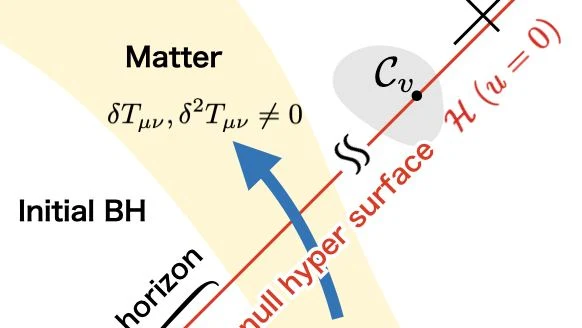
A black hole pulls in anything that gets too close. But if you toss in not one object but a pair, one of them can fly back out, carrying off some of the hole's rotational energy. This trick, devised by Roger Penrose in 1969, works only because a black hole has a horizon — a boundary beyond which nothing returns. Now it turns out the horizon isn't necessary.
A black hole is like a perfectly smooth sphere. It has no features — only mass, charge, and spin. This rule is called "no-hair." But nature loves to complicate things: sometimes a cloud of a scalar field (a special field described by a single number at each point) spontaneously appears around a black hole.
A climber on a ridge notices something strange: the horizon around them seems to freeze. No forward, no backward — only emptiness and silence. This is roughly the picture painted by new calculations for our Universe. At some point in its expansion, the invisible boundary, the future event horizon, stopped growing.
A black hole is not an eternal vacuum cleaner. Surround it with a non-ideal fluid (matter with internal friction), and the geometry starts to lead a life of its own. The authors of the paper showed that a special geometric flow, the almost η-Ricci–Yamabe soliton, acts like an invisible sculptor.
In quantum field theory, there is a strict law: a signal cannot outrun light. This is causality — the foundation on which the order of events rests. But near black holes, this foundation begins to crack, especially if the hole is not quite ordinary.
You toss pebbles into a whirlpool, trying to spin it faster and peer into its depths. A black hole is a cosmic whirlpool, where instead of water there is curved spacetime, and instead of a bottom there is a singularity — a point where the familiar laws of physics break down.
A spinning top whirling so fast that it forces light around it into spirals: that's a fitting image for what happens near a black hole's horizon. Hot plasma falls in and emits radio waves. Their polarization (the plane in which the wave oscillates) becomes an arrow pointing in the direction of energy flow.
Drop a handful of sand into calm water — the ripples spread and fade. Drop it into a running blender — the vortices mix everything in an instant. Physics has a similar rule: chaos cannot grow faster than a certain rate.
Normally, by rapidly oscillating a mirror in a vacuum, you can conjure real particles from nothing: this is the dynamical Casimir effect. But near a black hole, things are different. The spacetime curvature itself stifles any attempt to create something.
In causal set theory, spacetime is not a smooth sheet but a web of tiny points connected by arrows of cause and effect. A point is linked to another only if the first can influence the latter. In such a web, a black hole is described differently: its horizon, the boundary from which signals cannot return, must be redefined.
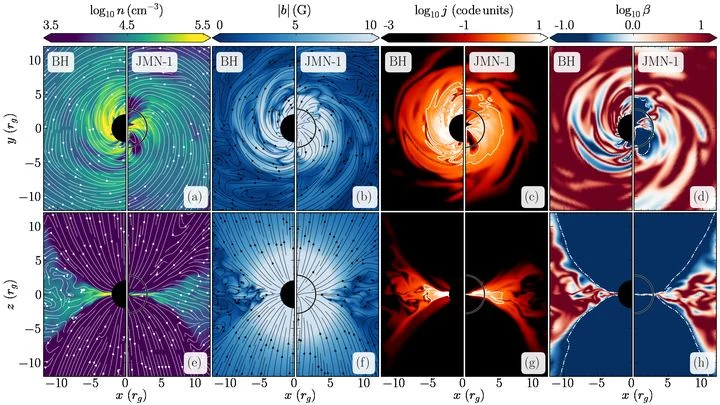
A bottomless well, but not quite. An ordinary black hole has a boundary, the event horizon, beyond which nothing returns. But what if you remove that boundary? That's exactly the kind of object, dubbed JMN-1, that astrophysicists modeled: a massive body born from stellar collapse, but without the impenetrable veil.
An ordinary door swings both ways, but the physicists rigged a one-way door for atoms — enter at will, but leaving is off-limits. The atoms were cooled nearly to absolute zero — in such deep cold, they merge into a single cloud. This cloud was placed in a neat lattice of laser beams, adding a tiny irregularity, like a step at the threshold.
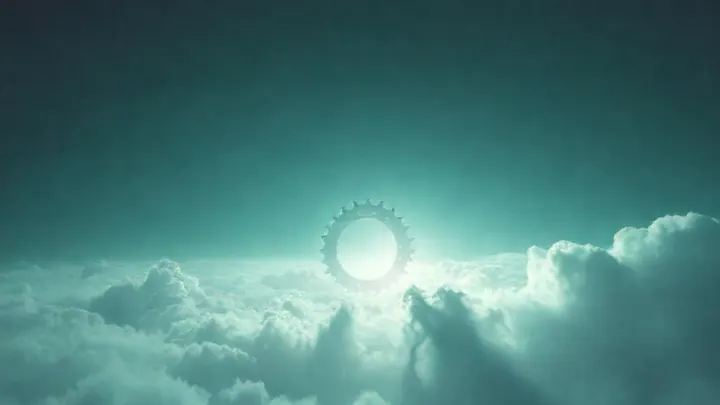
A wormhole is a tunnel through space, connecting distant regions of the Universe. Its shadow against a bright gas background was long thought to be as round as that of a black hole. But for a rotating wormhole (one you could actually traverse), the shape of the shadow might be surprising: the edge becomes jagged, like a gear.
A waterfall doesn't ask if you're ready to jump. Its flow accelerates, and at some point even light can't escape back. A McVittie black hole is such a waterfall, but not in an ordinary river; it's in an expanding universe: the water here is space itself, which continuously stretches, carrying galaxies apart from each other.
An ordinary black hole is the perfect devourer: everything that crosses its horizon disappears forever. But in recent decades, this picture has been cracking at the seams. The information paradox, singularities, firewalls: theorists are looking for a way out, and one candidate replacement is the black mirror.