A thought experiment is a mental exercise in which a scenario is imagined to explore the implications of a theory or to challenge a physical intuition. It is not performed in a laboratory but in the mind, yet it can be as rigorous as a mathematical proof. Thought experiments are used to clarify concepts, expose contradictions, and generate new hypotheses, often serving as a bridge between abstract mathematics and physical reality.
History
The term was popularized by Hans Christian Ørsted in the early 19th century, but the practice is older, with Galileo using such reasoning to refute Aristotle's physics. Einstein made it famous with his elevator and train scenarios for relativity.
How it works
The mechanism is purely logical: you set up a hypothetical situation, apply known physical laws or principles, and trace the consequences. The goal is to isolate a key feature of a theory and see what it predicts in a simplified or extreme case. This can reveal hidden assumptions or lead to a paradox that forces a revision of the theory.
In practice
Thought experiments are used in theoreticalphysics to test the consistency of new ideas, such as in quantum mechanics and cosmology, before any experimental setup is built.
Fun fact
Schrödinger's cat, a thought experiment, was originally devised to highlight the absurdity of quantum superposition, not to endorse it.
The meditating brain is an orchestra, and attention is the conductor. When you're focused on your breath, all instruments play in harmony. But suddenly, a thought-cello plays a false note: that's mind wandering. An experienced conductor doesn't panic: they instantly catch the dissonance and gently guide the orchestra back to the main melody — the breath.
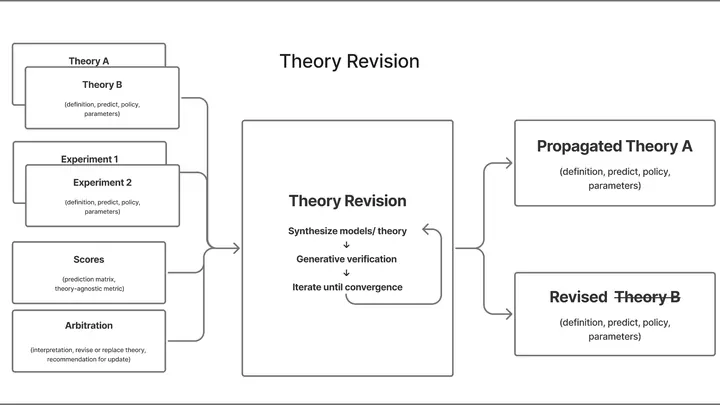
A closed loop: the machine proposes an idea, tests it on people, sees the failures, and spawns a new, more accurate guess. That's how AutoCog works — an automatic cognitive scientist. Previously, in the science of thinking (cognitive science), the hardest part, coming up with a theory, was done only by humans.
In the 1990s, philosopher John Searle devised a thought experiment: a person sits in a room and, without knowing Chinese, follows instructions to produce correct answers in Chinese. From the outside, it seems they understand the language, but inside, it's just mechanical rule-following.
Understanding the photoelectric effect — where light knocks electrons out of a material — is like learning to cook without a recipe. That’s where digital tools help: games provide intuition, and simulations provide precision.
Every time you mull over a risky move, whether to invest in stocks or hold off, an inner dialogue runs through your head. Usually, scientists try to reconstruct that dialogue from the final choice alone, as if a detective were reconstructing a conversation between two people from a photo of the meeting spot.
Two accomplices are interrogated separately: betray or stay silent? If neither knows what the other will do, their choice breaks the classical rule of probability. It’s like riding an old bicycle over bumps — the hard seat jolts you off. The textbook rule, the classical model, fails. The authors of a new study found a simple fix: the cyclist needs a soft saddle.
Science is like a city where residents pave the streets themselves. Where paths are already worn, new houses go up, while untouched vacant lots go unnoticed — not because building there is impossible, but because no one ever looks.
Light can draw patterns right inside your eye — no screen or glasses needed. When a specially shaped beam enters the pupil, it creates dark rays in your field of view, like the spokes of a spinning wheel. You see these rays because they are born in the retinal cells, not outside.
At night, the brain doesn't switch off. Instead, it sorts through the day's events like a librarian arranging books on shelves. But where do those strange, sometimes nonsensical dream images come from? Many have assumed they're just random noise with no meaning.
A new computer model shows that randomness doesn't hinder: it helps.
In 2022, physicists observed gravity shifting the phase of a single atom's wave, the gravitational analog of the Aharonov–Bohm effect. This experiment became part of a long-standing debate: whether gravity must be quantized or remains a classical background in the quantum world.