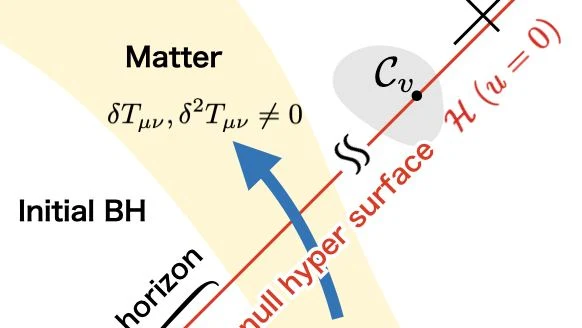
An apparent horizon is a boundary in a black hole spacetime that is defined locally, based on the behavior of outgoing light rays at a given moment. Unlike the event horizon, which is a global concept requiring knowledge of the entire future of the universe, the apparent horizon depends on the observer's choice of time slicing and can change in response to matter falling into the black hole. It is the outermost surface where all outgoing light rays are converging, meaning even light cannot escape outward.
History
The concept was introduced by Roger Penrose in 1965 as part of his work on gravitational collapse and singularity theorems. It was later refined by Stephen Hawking and George Ellis in their 1973 book 'The Large Scale Structure of Space-Time'.
How it works
The apparent horizon is defined using the concept of trapped surfaces: a surface where both ingoing and outgoing light rays are moving inward. The apparent horizon is the boundary of the region containing trapped surfaces. It can be computed from the local geometry of spacetime at a given time, making it useful for numerical simulations of black hole mergers, where the event horizon is difficult to track in real time.
In practice
Apparent horizons are routinely used in numerical relativity to locate black holes in simulations of mergers and to compute their masses and spins, as they can be found from the instantaneous data of the simulation.
Fun fact
In a dynamic black hole merger, the apparent horizon can appear and grow before the event horizon forms, and it is always located inside the event horizon, never outside.
Imagine an interferometer as a giant ear listening to the radio whisper of a distant galaxy. Three antennas spread across continents capture the signal, and the difference in their phases combines into a quantity that is immune to atmospheric jitter. This quantity is called the closure phase.
A network of radio telescopes scattered across the planet catches the whisper of a distant black hole. Each antenna records a signal, but how do you combine these recordings if the clocks at the stations tick at different rates and the atmosphere distorts incoming waves?
Stare long enough into the night sky, and sooner or later your gaze hits a blackness beyond which nothing is visible. This is not just a distant fence: it is the edge of the universe accessible to us, the cosmic horizon. Light from more distant stars simply hasn't had time to reach us.
A black hole's shadow isn't just a black circle. Usually, we see a dark void surrounded by a glowing ring of hot gas. But if a black hole wasn't born from a dying star but has existed forever, its shadow might hide a surprise.
An eternal black hole is a solution to Einstein's equations with no past and no collapse.
A cosmic object spins, but its shadow isn't round. Astrophysicists examined a black hole in an unusual version of gravity — the so-called brane world (where our universe is a three-dimensional surface in a space of higher dimensions).
Imagine a factory capable of producing a million parts per hour, yet it only makes a hundred. That's roughly how our Universe behaves when viewed through the lens of entropy — a measure of disorder that, according to physics, must only increase. The main "machines" of this factory are supermassive black holes.
A black hole devours everything, even light. Yet it obeys the laws of physics: it possesses entropy — a measure of the hidden information an object 'remembers.' In the 1970s, Jacob Bekenstein and Stephen Hawking discovered a strange pattern: a black hole's entropy grows not with its volume, but…
In a distant galaxy about 290 million light-years away, the object HLX-1 lies hidden. It once flared brighter than hundreds of billions of suns, but now it has quieted down. From 2018 to 2022, the Hubble, Chandra, and Swift space telescopes tracked its fading.
A black hole is a place from which nothing can escape. But some theories allow that deep inside, at the quantum level, it might bounce and turn into its opposite — a white hole, which only spews out matter and light.
A group of physicists built a computer model of such a transformation.
At the center of many galaxies lurks a black hole, wrapped in an invisible cloud — the halo of dark matter. This is not just a featureless mass: its density changes from the edge to the center, and the degree of this "compression" is called compactness.
In 2019, the world saw the first image of a black hole's shadow — an orange doughnut on a black background, becoming a symbol of scientific progress. But this image wasn't captured by a camera: it was born from mathematical alchemy, where data from eight radio telescopes, which gathered only crumbs of signal, merged into a single picture.
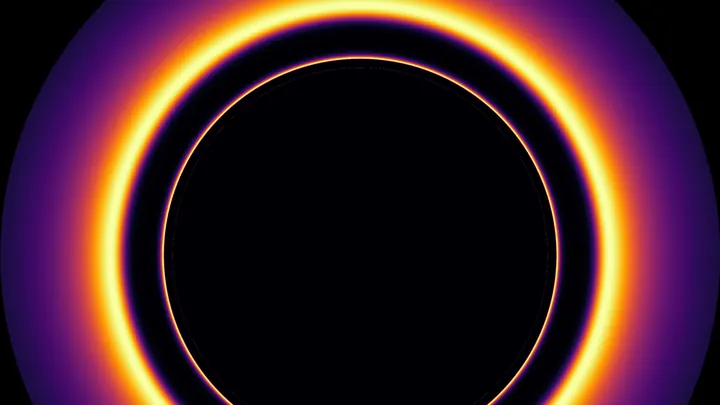
A black hole is not just a dark silhouette against the stars. Its shadow is surrounded by a thin glowing ring of photons that loop around the event horizon before escaping to an observer.
An ordinary black hole hides a singularity at its center — a point where density and curvature become infinite and the laws of physics break down. The authors of the new work built a model of a rotating black hole that, instead of a singularity, contains a calm "core" resembling ordinary flat space.
For decades astrophysicists painted a neat picture: a galaxy, like a giant carousel, spins in a unified rhythm, and the supermassive black hole at its center inherits that dance.
At the center of a black hole, classical theory paints a point where density and spacetime curvature shoot to infinity — like an infinitely sharp needle. But quantum corrections, tracing back to the work of Karl Schwarzschild, add a tiny “pillow”: space cannot collapse to zero.
In the first moments after the Big Bang, the universe inflated at an unimaginable rate. This inflation left behind ripples — tiny overdensities in the hot radiation and plasma.
At the center of galaxy M87, 55 million light-years away, lurks a black hole with a mass of 6.5 billion Suns. In 2019, the Event Horizon Telescope (EHT) gave us its first portrait: an orange donut with a dark core. But the donut is not the abyss itself.
A cosmic ray approaches a black hole almost tangentially. Instead of falling straight in, it lingers on an unstable orbit, like an acrobat balancing on a tightrope over an abyss. After a few loops, the light finally escapes toward a distant observer. Such rays produce multiple images of the same source, known as higher-order images.
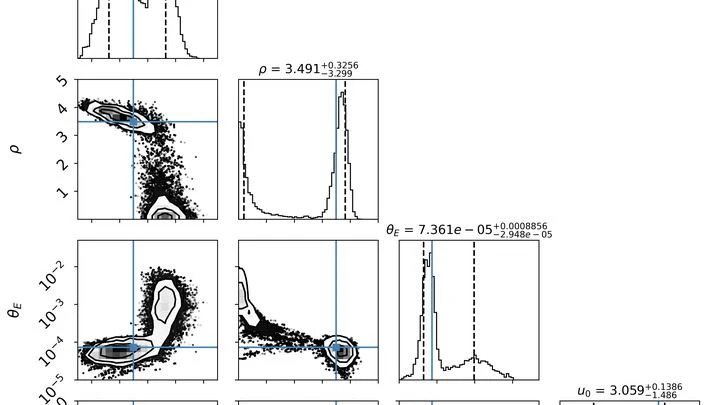
The light of a distant star briefly brightens when a massive invisible object passes between it and a telescope. This phenomenon, gravitational microlensing, acts as a natural telescope. Usually, the lens is a black hole, warping the spacetime around it.
A black hole is like a spinning drop of viscous liquid. Normally, such a drop tends to stay whole: splitting would reduce its surface area, which contradicts the law of non-decrease of entropy (a measure of disorder, like a broken cup doesn't glue itself back together).
It all began not with emptiness, but with a boiling ocean of plasma. In that primordial broth, sound waves raced through the fiery matter, colliding and compressing it. Sometimes a clump grew so dense that light could no longer escape, and right out of the scorching gas, a primordial black hole was born.
The Schwarzschild black hole is the simplest model in general relativity. But when you switch to teleparallel gravity (TEGR), where torsion replaces curvature, the horizon develops a problem. Some quantities built from torsion tend to infinity.
In quantum field theory, there is a strict law: a signal cannot outrun light. This is causality — the foundation on which the order of events rests. But near black holes, this foundation begins to crack, especially if the hole is not quite ordinary.
A black hole is like a perfect vacuum cleaner: anything that crosses its horizon vanishes without a trace. But this vacuum cleaner has a strange feature: its "dust bag" grows, and by the size of the bag you can tell how much has been sucked in. In black hole physics, this size is linked to entropy entropy — a measure of hidden information about what fell inside.
A black hole is not just a dark spot in the sky. Its shadow falls on the glowing backdrop of infalling matter and carries the imprint of spacetime geometry itself. If gravity works even slightly differently than we think, the shadow will give it away.
In a new study, physicists traced light rays around a rotating black hole in so-called Rastall gravity.
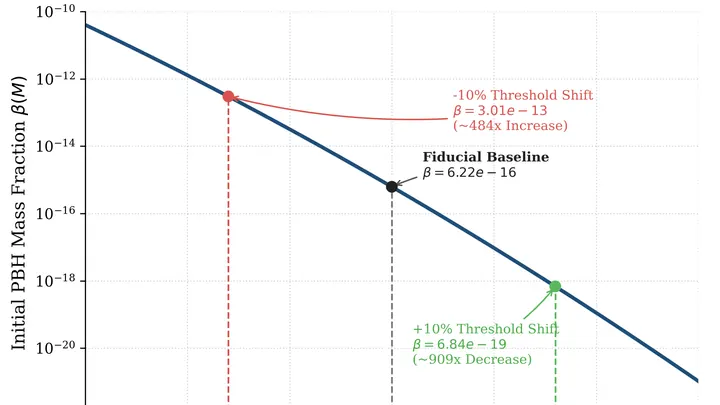
In the kitchen cupboard sits a jar of sugar. If you shake it, the grains will spread almost evenly — no need to place each one with tweezers. In much the same way, tiny black holes could have appeared in the first moments after the Big Bang. Their mass is like that of an asteroid, their size smaller than an atom.
You toss pebbles into a whirlpool, trying to spin it faster and peer into its depths. A black hole is a cosmic whirlpool, where instead of water there is curved spacetime, and instead of a bottom there is a singularity — a point where the familiar laws of physics break down.
Emptiness can surprise you. In general relativity, there is a solution where space itself gives birth to a black hole — literally from a point. It all starts at the moment when the event horizon (the surface from which not even light can escape) appears with zero radius and immediately begins to grow.
A black hole is not an eternal vacuum cleaner. Left alone in the void, it slowly disappears, radiating energy like a puddle drying on asphalt. This process, predicted by Stephen Hawking, is called evaporation.
In 2019, the image of the M87* shadow was a sensation: for the first time, humanity saw the outlines of a black hole, predicted by Schwarzschild and shrouded in myth. But what if that glowing crescent isn't a portrait of an absolute abyss, but of a cosmic portal?
A light ray skims along the horizon of a black hole: that invisible boundary from which nothing can escape. The closer the ray gets to the horizon, the slower its own 'time' stretches — a special measure of path called the affine parameter.
A black hole is like a whirlpool in the ocean: anything that falls in disappears forever. But if the whirlpool spins and carries a slight electric charge, and invisible axion particles (dark matter candidates) are buzzing around it, its surface stops being smooth.
The gravity of a black hole creates a curvature of spacetime, acting like a lens: light from a distant galaxy splits in two, stretching into arcs. Dark matter around the hole barely changes the picture, as if a transparent curtain was added to a window pane.
At the heart of our stellar metropolis — the Galaxy — lurks the supermassive black hole Sagittarius A*. Around it, star S2 whirls in a swift dance. But its movements reveal more than just the hole's pull: an invisible partner joins the dance — dark matter.
A tiny black hole, no larger than an atomic nucleus, hovers in a cloud of hydrogen. It doesn't swallow everything around it; instead, it slowly radiates away, losing mass with every moment.
A spotlight shines through a dark hall. Between the lamp and the wall, an invisible lens drifts by, and the spot of light briefly brightens and shifts. That is exactly what the DECam telescope, aimed at the Large Magellanic Cloud, a satellite galaxy of our Milky Way, was watching for five consecutive nights.
Two ocean liners sail at night without lights. One was built in a shipyard from steel plates, the other seems to have grown by itself from foam and waves. By ear they are almost indistinguishable, but an experienced hydroacoustician will catch the difference in the hum of the propellers and the contours of the hull.
The universe hums like an orchestra: its notes are gravitational waves — ripples in spacetime predicted by Albert Einstein. The LIGO observatories, made exquisitely sensitive thanks to Rainer Weiss, strive to catch these whispers.