A gravastar is a hypothetical alternative to a black hole, proposed as a way to avoid the singularities and event horizons that arise in general relativity. Instead of a point of infinite density, a gravastar consists of a core filled with dark energy — a substance exerting negative pressure — surrounded by a thin shell of ordinary matter. This structure is designed to mimic the gravitational effects of a black hole from the outside, so it would look nearly identical to a distant observer, but it lacks the defining features of a black hole: no event horizon and no singularity.
History
The gravastar concept was introduced in 2001 by physicists Pawel Mazur and Emil Mottola as a solution to the singularity problem in black hole physics.
How it works
The gravastar model replaces the collapse to a singularity with a phase transition. As a massive star collapses, the extreme conditions near the center are hypothesized to trigger a change in the vacuum state, creating a region of dark energy that halts further collapse. The outer shell, made of normal matter, is held up by the repulsive gravitational effect of the dark energy core. From the outside, the gravastar's gravitational field is essentially the same as that of a black hole of the same mass, so light and matter would follow similar trajectories, but there is no point of no return — an object could theoretically pass through the shell and interact with the core.
In practice
Gravastars are primarily a theoretical construct used to test the limits of general relativity and to explore possible observational signatures that could distinguish them from black holes, such as in gravitational wave signals or the shadow imaged by the Event Horizon Telescope.
Fun fact
If gravastars exist, they could be mistaken for black holes in all current observations, but they would lack the event horizon that makes black holes famous for trapping light forever.
A network of radio telescopes scattered across the planet catches the whisper of a distant black hole. Each antenna records a signal, but how do you combine these recordings if the clocks at the stations tick at different rates and the atmosphere distorts incoming waves?
A black hole pulls in anything that gets too close. But if you toss in not one object but a pair, one of them can fly back out, carrying off some of the hole's rotational energy. This trick, devised by Roger Penrose in 1969, works only because a black hole has a horizon — a boundary beyond which nothing returns. Now it turns out the horizon isn't necessary.
Somewhere in the center of a galaxy, a black hole is spinning. It doesn't hang in a void — around it swirls an invisible swarm of dark matter particles. Until now, this swarm was described for non-rotating holes, but in reality, holes always rotate.
A neutron star is the ultra-dense remnant of a supernova: the mass of the Sun packed into a sphere the size of a city. For billions of years, it travels through space, gathering around itself invisible matter, dark matter, which emits no light but pulls with gravity.
A black hole spun up almost to its limit is like an athlete balancing on the edge of a record. The most interesting action isn't inside the hole itself, but in the thinnest film of spacetime at its horizon. It's there that tiny corrections to Einstein's gravity can suddenly swell to gigantic proportions.
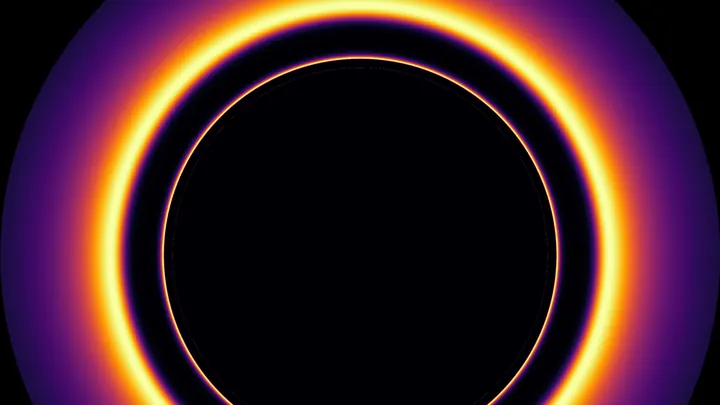
A black hole's shadow isn't just a black circle. Usually, we see a dark void surrounded by a glowing ring of hot gas. But if a black hole wasn't born from a dying star but has existed forever, its shadow might hide a surprise.
An eternal black hole is a solution to Einstein's equations with no past and no collapse.
Light freezes at the edge of the abyss: that's what the event horizon of an ordinary black hole looks like. But at the center of this abyss lurks a singularity, a point where the laws of physics break down. What if, instead of a point, there were a hard shell?
A gravastar is not a black hole.
A black hole is like a perfectly smooth sphere. It has no features — only mass, charge, and spin. This rule is called "no-hair." But nature loves to complicate things: sometimes a cloud of a scalar field (a special field described by a single number at each point) spontaneously appears around a black hole.
A black hole is not just an abyss. It is a seething cauldron whose temperature rises as it evaporates. The authors of the study found that when the heat reaches a critical threshold, the hole seems to boil. It emits superheavy particles — the very ones that exist on a scale where any theory of gravity collapses.
Two houses with identical facades. Windows, doors, wall color — everything matches. But inside, one is empty, while the other buzzes with life. How can you tell without stepping inside? In space, there's a similar puzzle: a black hole and a gravastar look the same from the outside, but they are built differently.
On November 23, 2023, LIGO detectors caught something strange. The gravitational wave signal from a black hole merger, designated GW231123, pointed to record masses—137 and 101 solar masses, and anomalously fast spin. That would be the most massive and fastest-spinning pair ever detected.
A campfire burns steadily and long. But when the wind blows, the flame flickers out, leaving only embers. A similar story plays out with the gravastar — a hypothetical object that was supposed to replace the black hole.
An ordinary black hole hides a singularity — a point where the laws of physics break down.
At the centers of many galaxies, not only supermassive black holes lurk, but also vast clouds of invisible matter. If this matter consists of ultralight particles, it can gather into dense clumps — a kind of 'star' made of dark matter.
Gravity is the invisible glue that holds stars and planets together. But what if this glue has a tiny mass? In massive gravity, the carrier particles (called gravitons) weigh a minuscule but nonzero amount. This changes the rules near black holes.
The authors of the new study built on a mathematical tool — eigenvalue decomposition.
A star runs out of fuel and rapidly collapses under its own gravity. According to classical ideas, it collapses into a point of infinite density — a singularity. But what if nature abhors infinities? In models of regular black holes, instead of a singularity, a dense core of unknown matter forms at the center.
Picture the early Universe as an unimaginably large bell. Inflation — the era of rapid expansion, dreamed up by Alan Guth, strikes it, sending a wave rippling across the fabric of spacetime.
An ordinary black hole hides a singularity at its center — a point where density and curvature become infinite and the laws of physics break down. The authors of the new work built a model of a rotating black hole that, instead of a singularity, contains a calm "core" resembling ordinary flat space.
At the center of a classical black hole lurks a singularity — a point where the density and curvature of spacetime become infinite. Physics goes silent there.
The LIGO detectors caught the signal GW250114—a gravitational wave from the merger of two black holes. After the main burst, a decaying 'tail' remained — direct waves from the newborn hole's horizon. It was expected that their damping would reveal the gravitational strength at the horizon's surface. But the measured value came out smaller.
The world around us is three-dimensional, but perhaps that's just an illusion. Some theories allow for extra dimensions of space, curled up or stretched in special ways. One such model depicts a five-dimensional universe with a "diluted" dimension (called a linear dilaton).
In classical theory, a black hole is where matter collapses to a point of infinite density. Such a 'singularity' looks like an error in the equations: nature hardly tolerates infinities. Many physicists seek ways to 'smooth out' this flaw, and one idea is to modify the theory of gravity itself at small distances.
In cricket, there's a special delivery — the googly. The ball spins in a way that deceives the batsman. Physics had its own googly: for nearly half a century, mathematicians couldn't make twistor theory work with real gravity. It described 'nice' fields perfectly, where everything twists in one direction. But as soon as an 'awkward' component appeared, the machinery broke down.
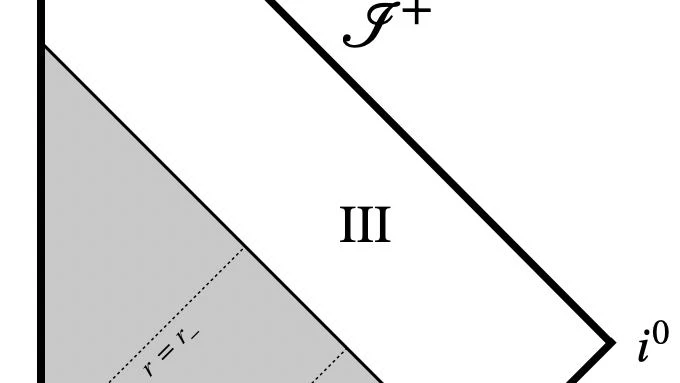
When a giant star runs out of fuel, it collapses into a black hole. Such a hole has an outer boundary — the event horizon, beyond which even light cannot escape. But many black holes also have an inner boundary — a second horizon that separates the outer layers from the singularity core.
A black hole's interior is layered like an onion. In the new model, instead of an infinite point at the center, there are three regions: a dense core, a transition layer, and a crust just below the horizon. All arise from a single field that interacts with itself.
The mystery of dark matter has puzzled physicists for nearly a century. Among the candidates for its role are primordial black holes (PBHs), born in the fiery embrace of the first moment after the Big Bang.
An ordinary black hole is surrounded by a thin photon sphere — a place where light can loop around before falling in or escaping. In the new work, this region has puffed up into a whole layer packed with massless particles that zip around at nearly the speed of light and don't press against the walls.
In the first moments after the Big Bang, the universe was filled with a hot, nearly uniform plasma. But in some places, the density could randomly be slightly higher. If such a clump gained critical mass, it collapsed into a black hole: this is how primordial black holes were born.
The light of a distant star briefly brightens when a massive invisible object passes between it and a telescope. This phenomenon, gravitational microlensing, acts as a natural telescope. Usually, the lens is a black hole, warping the spacetime around it.
At the centers of many galaxies lurk black holes — regions with gravity so strong that even light cannot escape. Stars often orbit them, and sometimes one of those stars is a pulsar, a cosmic lighthouse sending out strictly periodic radio pulses. When such a pulsar moves behind a black hole, its signals reach us with a delay.
The Schwarzschild black hole is the simplest model in general relativity. But when you switch to teleparallel gravity (TEGR), where torsion replaces curvature, the horizon develops a problem. Some quantities built from torsion tend to infinity.
The focus is on a black hole, but not an ordinary one. It carries a magnetic monopole and is surrounded by a dilaton — a field that blurs the familiar boundaries of space. The authors tested how stable such a system is to thermal jolts.
A magnetic monopole is a hypothetical particle with a single magnetic pole.
The black hole paradox has haunted physicists for decades. If a hole evaporates, where does its contents go? Discoveries by Stephen Hawking and Jacob Bekenstein showed that saving the laws of nature requires an unconventional move.
Imagine the universe as a woven blanket of invisible threads.
A tightrope walker spirals over an abyss, each loop drawing closer to the center. Their path is not a smooth glide but a series of sharp jerks and pauses. That is roughly how a tiny black hole behaves when it is pulled toward a supermassive neighbor.
Wormholes — tunnels through curved spacetime, allowed by general relativity. To be stable, they need repulsive energy — the kind that pushes apart rather than attracts.
A black hole is not just a dark spot in the sky. Its shadow falls on the glowing backdrop of infalling matter and carries the imprint of spacetime geometry itself. If gravity works even slightly differently than we think, the shadow will give it away.
In a new study, physicists traced light rays around a rotating black hole in so-called Rastall gravity.
In the kitchen cupboard sits a jar of sugar. If you shake it, the grains will spread almost evenly — no need to place each one with tweezers. In much the same way, tiny black holes could have appeared in the first moments after the Big Bang. Their mass is like that of an asteroid, their size smaller than an atom.
A giant cloud of invisible matter acts like a funhouse mirror — distorting the light from a distant galaxy. From these distortions, astronomers can weigh the cloud and peer into its depths.
You toss pebbles into a whirlpool, trying to spin it faster and peer into its depths. A black hole is a cosmic whirlpool, where instead of water there is curved spacetime, and instead of a bottom there is a singularity — a point where the familiar laws of physics break down.
A black hole is not an eternal vacuum cleaner. Left alone in the void, it slowly disappears, radiating energy like a puddle drying on asphalt. This process, predicted by Stephen Hawking, is called evaporation.
Cosmic black holes at the centers of galaxies are like giant banyan trees: their aerial root‑filaments stretch for kiloparsecs to harvest nourishing matter. For decades astronomers have debated: how does cooling gas from cluster atmospheres fall into the sphere of influence of a supermassive hole?