concept

non singular black hole

A theoretical black hole model that avoids a gravitational singularity at its center.
23 related articles

Description

A non-singular black hole is a theoretical construct where the gravitational collapse does not end in a point of infinite density, but instead the core is replaced by a finite, regular region. This idea emerges from attempts to combine general relativity with quantum mechanics, since the singularity at the center of a classical black hole is widely seen as a sign that the theory breaks down there. Various models propose different replacements: a 'Planck star' with quantum pressure, a 'fuzzball' made of strings, or a 'gravastar' with a vacuum-energy core.

History

The concept gained traction in the early 2000s with the gravastar proposal by Pawel Mazur and Emil Mottola in 2001, and later with the fuzzball program in string theory. The term 'Planck star' was coined by Carlo Rovelli and Francesca Vidotto in 2014.

How it works

In these models, quantum effects become significant near the would-be singularity, creating an effective repulsive force that halts collapse. The event horizon may still exist, but the interior is no longer a one-way street to destruction — in some versions, matter bounces and information can escape, potentially resolving the black hole information paradox. Observational signatures include modified gravitational wave echoes after a merger and different shadow shapes compared to classical black holes.

In practice

No direct technology, but these models guide the search for quantum gravity effects in gravitational wave data from LIGO and Virgo, and in future black hole imaging with the Event Horizon Telescope.

Fun fact

In some non-singular models, the interior of a black hole could be a gateway to a white hole — a region that spews matter out — making black holes potential portals to other universes.

Concept graph →

Related articles · 23

General Relativity2026-08-061 minarXiv:2608.05818express
Black Hole Without a Singularity Emerges from a Dust Cloud
A homogeneous, spherical cloud of cosmic dust begins to contract under its own gravity. At some point, by classical laws, it should collapse into a point of infinite density — a singularity.
General Relativity2026-08-032 minarXiv:2608.02481express
The Heart of a Black Hole: Why a Smooth Center Isn't Everything
An old house. The facade is freshly painted, the stairs don't creak. A pretty picture. But try to move in heavy furniture, and the floorboards give way. The beauty of the facade says nothing about the strength of the floors. It's much the same with black holes without singularities.
General Relativity2026-08-011 minarXiv:2608.00471express
Black Hole Without a Singularity: A Star Clad in a Shell
Light freezes at the edge of the abyss: that's what the event horizon of an ordinary black hole looks like. But at the center of this abyss lurks a singularity, a point where the laws of physics break down. What if, instead of a point, there were a hard shell? A gravastar is not a black hole.
General Relativity2026-07-211 minarXiv:2607.18764express
A Black Hole with No Bottom: Why Gravastars Can't Hold Up
A campfire burns steadily and long. But when the wind blows, the flame flickers out, leaving only embers. A similar story plays out with the gravastar — a hypothetical object that was supposed to replace the black hole. An ordinary black hole hides a singularity — a point where the laws of physics break down.
General Relativity2026-07-122 minarXiv:2607.10713express
Black Holes Without Singularities: Almost Indistinguishable
An ordinary black hole hides a singularity at its center — a point where density and curvature become infinite and the laws of physics break down. The authors of the new work built a model of a rotating black hole that, instead of a singularity, contains a calm "core" resembling ordinary flat space.
General Relativity2026-07-101 minarXiv:2607.09840express
General Relativity2026-07-082 minarXiv:2607.07790express
Black Holes Without Singularities: A New Approach
In classical theory, a black hole is where matter collapses to a point of infinite density. Such a 'singularity' looks like an error in the equations: nature hardly tolerates infinities. Many physicists seek ways to 'smooth out' this flaw, and one idea is to modify the theory of gravity itself at small distances.
General Relativity2026-07-082 minarXiv:2607.07955express
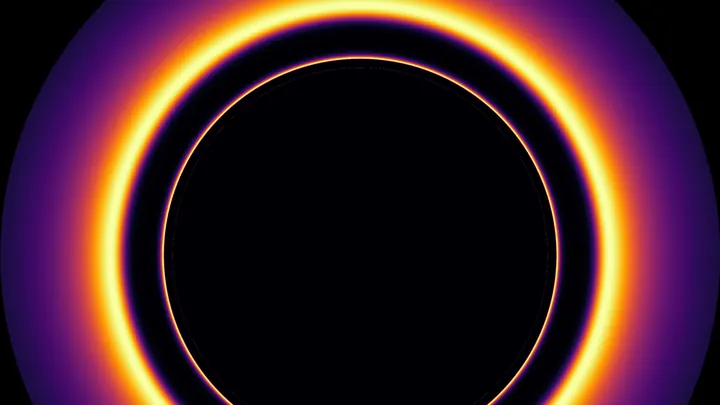
Cosmic Mirage: How Smearing Mass Changes a Black Hole's Shadow
At the center of an ordinary black hole, according to classical ideas, lurks a singularity — a point of infinite density where the laws of physics break down. But some theories, inspired by the duality idea from string theory, propose replacing the point with a tiny 'smudged' region.
General Relativity2026-07-042 minarXiv:2607.03916express
The Inner Horizon of a Black Hole: From Blast to Calm
When a giant star runs out of fuel, it collapses into a black hole. Such a hole has an outer boundary — the event horizon, beyond which even light cannot escape. But many black holes also have an inner boundary — a second horizon that separates the outer layers from the singularity core.
General Relativity2026-07-041 minarXiv:2607.03938express
A Black Hole as a Heat Engine
A black hole's interior is layered like an onion. In the new model, instead of an infinite point at the center, there are three regions: a dense core, a transition layer, and a crust just below the horizon. All arise from a single field that interacts with itself.
HEP Theory2026-06-192 minarXiv:2606.21537express
Black Holes with Throats: Where Causality Cracks
In quantum field theory, there is a strict law: a signal cannot outrun light. This is causality — the foundation on which the order of events rests. But near black holes, this foundation begins to crack, especially if the hole is not quite ordinary.
General Relativity2026-06-152 minarXiv:2606.17135express
A Quantum Cloak for the Naked Singularity
A star contracts under its own gravity, and at some point its fate hangs on a razor-thin balance. Classical physics paints a grim picture: if the mass and the force of compression are tuned with terrifying precision, what emerges is not a black hole but a 'naked' singularity.
General Relativity2026-06-131 minarXiv:2606.15423express
There Is No Singularity in Black Holes
Space is like a sheet of paper: gravity bends it, making lines converge toward the center. But if you bend too hard, the paper tears, just as space, under monstrous curvature, doesn't collapse into a point but forms a torn edge. That edge is the quantum boundary.
General Relativity2026-06-112 minarXiv:2606.13592express
A Trap for a Black Hole That Can't Be Overfed
You toss pebbles into a whirlpool, trying to spin it faster and peer into its depths. A black hole is a cosmic whirlpool, where instead of water there is curved spacetime, and instead of a bottom there is a singularity — a point where the familiar laws of physics break down.
General Relativity2026-05-191 minarXiv:2605.19731express
Neutron stars could be more compact than black holes
In the standard picture, black holes are the undisputed density champions: all their matter is squeezed into a single point. Imagine the entire mass of Mount Everest packed into a grain of salt. But physicists have found a theoretical trick.
Fuzzy-nova: A Quantum Wave Dissolving Black Holes
A dying star is not just fading away. In its final moments, the core, starved of fuel, collapses into itself at colossal speed. Classical gravity leaves no choice: if the mass is large enough, a black hole is born — a region from which not even light can escape.
Ashes of Inevitability: The Quantum Singularity of Evaporating Black Holes
In 1965, Penrose unleashed a mathematical thunderbolt on physics: any sufficiently massive star, shrinking under its own weight, inevitably collapses into a singularity — a region where spacetime curvature becomes infinite and the laws of physics break down.
Phantom Chords of Gravity: Boson Stars as Keepers of Quantum Memory
Every isolated quantum system inevitably moves toward thermal equilibrium — a state where all details of the past are erased. It’s like an orchestra: instead of a symphony, it starts playing white noise — random but statistically predictable notes.
General Relativity2026-05-032 minarXiv:2605.01808express
When a Black Hole Breaks the Void
A star that has exhausted its fuel falls into itself. Its outer layers fly apart, while the core compresses to unimaginable densities. It was once thought that this process ends in a point — a singularity where the laws of physics break down. New work shows that just before the very end, something strange happens inside the future black hole.
General Relativity2026-04-302 minarXiv:2604.27880express
Black Hole with a Fluffy Core
A pencil dropped on the floor hits with its entire surface at once. But if the floor were quantum, made of countless vibrating grains of sand, the pencil would never touch a single point.
HEP Phenomenology2026-04-292 minarXiv:2604.26191express
A Cosmic Bubble with a Monopole Inside
A magnet with only one pole (north, without a south) is not a fragment but a particle in its own right. Physicists call it a magnetic monopole (a carrier of a single magnetic charge). Such visitors could have been born in the early universe, when the forces were just separating.
General Relativity2026-01-161 minarXiv:2601.11101express
The Ringing of Black Holes That Remember the Past
Black holes ring like colossal bells. Colliding or devouring matter, they oscillate and send ripples through the cosmos — gravitational waves. These are tremors of the very fabric of spacetime, and their tone reveals the hole's inner structure.
Fluid Dynamics2025-11-071 minarXiv:2511.05351express
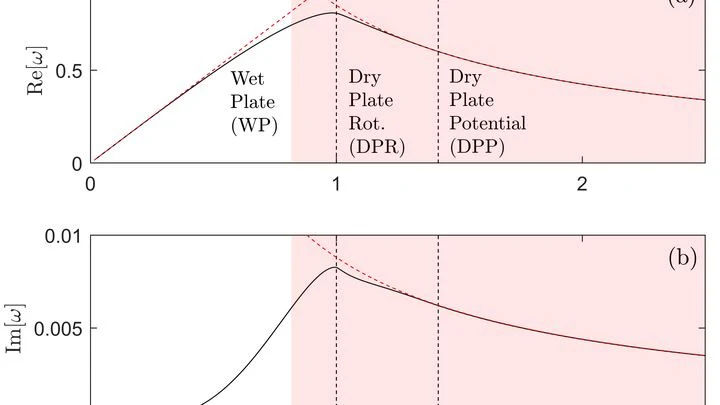
How a Whirlpool in a Cup Becomes a Black Hole Bomb
When liquid is swirled in a cup, a vortex with an empty center forms. In this empty core, waves find a trap: bouncing off the walls, they siphon energy from the vortex and grow like a flame along a fuse — each wave stronger than the last, until a surge breaks loose. Astrophysicists have described the same chain reaction around black holes.