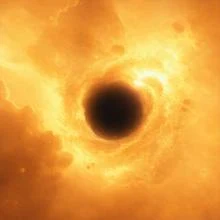
An extremal black hole is a black hole that spins at the maximum possible rate allowed by general relativity. At this limit, the event horizon's surface gravity becomes zero, meaning that a hypothetical observer hovering just outside the horizon would feel no gravitational pull. The entropy of an extremal black hole is maximal for its mass, and its temperature, as predicted by quantum field theory, drops to absolute zero. These properties make extremal black holes a fascinating theoretical laboratory for studying the intersection of gravity, quantum mechanics, and thermodynamics.
History
The Kerr solution was discovered by Roy Kerr in 1963. The concept of extremal black holes and their thermodynamic properties was developed in the 1970s by Stephen Hawking, Jacob Bekenstein, and others, as part of the formulation of black hole thermodynamics.
How it works
In general relativity, a rotating black hole is described by the Kerr solution, characterized by its mass and angular momentum. The angular momentum has an upper bound: for a given mass, the spin parameter must be less than or equal to 1 (in geometric units). When the spin parameter equals 1, the black hole is extremal. At this point, the inner and outer event horizons merge, and the geometry near the horizon becomes special — the gravitational field is so strong that the usual notion of time dilation breaks down in a particular way. The surface gravity, which is proportional to the temperature of the black hole, vanishes, so the black hole stops radiating Hawking radiation and becomes 'cold'.
In practice
Extremal black holes are primarily of theoretical interest, but they are used as testbeds for quantum gravity theories, such as string theory, where they help explain the microscopic origin of black hole entropy.
Fun fact
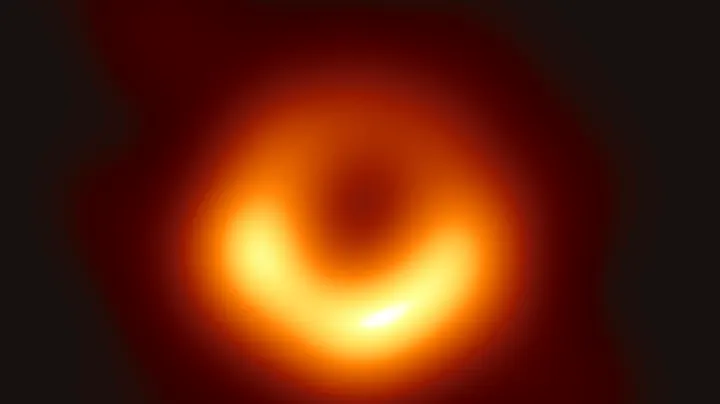
In 2019, the Event Horizon Telescope image of the supermassive black hole M87* showed a shadow consistent with a near-extremal spin, though the exact value remains uncertain.
A black hole spun up almost to its limit is like an athlete balancing on the edge of a record. The most interesting action isn't inside the hole itself, but in the thinnest film of spacetime at its horizon. It's there that tiny corrections to Einstein's gravity can suddenly swell to gigantic proportions.
A black hole is like a perfect safe: everything that falls in disappears without a trace. But quantum mechanics whispers that on the microscopic level, information is not lost but recorded on an invisible "surface." Understanding this record means unraveling the fabric of gravity.
Hot tea cools down, a pendulum comes to rest — nature loves equilibrium. But a charged black hole can reach a special, extreme state: the mass becomes minimal, and the temperature drops to zero.
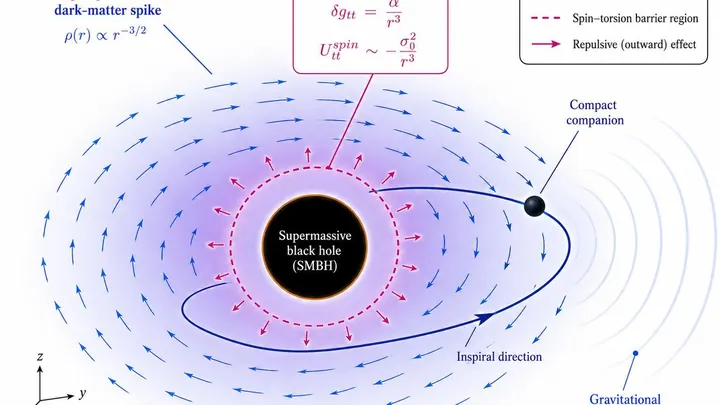
At the center of a galaxy, a huge black hole is shrouded in an invisible cloud — a swarm of ultralight particles that it itself spawned. Into this cloud dives another black hole, about the size of a star, and begins a long spiral dance. The approach takes millions of years, but the most dramatic events unfold right at the horizon.
A supermassive black hole drifts through a cloud of dark matter. In the usual picture, this invisible substance just adds mass and barely interacts with ordinary matter. But dark matter particles could have intrinsic rotation — spin.
A black hole is like a whirlpool in the ocean: anything that falls in disappears forever. But if the whirlpool spins and carries a slight electric charge, and invisible axion particles (dark matter candidates) are buzzing around it, its surface stops being smooth.
Scientists proposed a model in which the mysterious force (dark energy) possesses something like inertia: it needs time to respond, like a heavy pendulum. Because of this, the expansion of the Universe doesn’t accelerate forever, but instead decays, like a pendulum in thick honey.
In 2019, astronomers unveiled the first-ever image of a black hole's shadow — a dark void encircled by a lopsided orange ring. This is the supermassive black hole at the heart of galaxy M87, 55 million light-years away. The ring isn't just glowing: one side is noticeably brighter than the other, like a campfire burning unevenly, with flames leaping higher on one side.
A black hole in anti-de Sitter space is not a void but rather a pot of boiling liquid. This liquid has two phases: small and large black holes, like steam and water. At a certain pressure, they merge at a critical point, just as water at 374 °C and 218 atmospheres loses the distinction between liquid and gas.