The cosmic horizon is the maximum distance from which light has had time to reach us since the Big Bang. It is not a physical barrier in space, but rather a boundary in spacetime set by the finite speed of light and the finite age of the universe. Anything beyond this horizon is causally disconnected from us: no signal, information, or influence from there has ever reached Earth, and in an accelerating universe, light from beyond this boundary will never reach us in the future.
History
The concept of a cosmic horizon emerged from solutions to Einstein's field equations in the 1920s, particularly through the work of Alexander Friedmann and Georges Lemaître, who derived expanding universe models. The thermodynamic properties of horizons were later developed in the 1970s by Jacob Bekenstein and Stephen Hawking, who showed that event horizons have entropy and temperature.
How it works
The horizon exists because the universe is about 13.8 billion years old, so light can only have traveled a finite distance. However, because the universe has been expanding, the actual distance to the horizon is much larger than 13.8 billion light-years—about 46.5 billion light-years. The horizon is not a fixed surface; it is defined by the past light cone of an observer. Interestingly, the horizon itself has properties analogous to a black hole's event horizon: it radiates thermal energy (Hawking-like radiation) and possesses entropy proportional to its area, a fact that connects cosmology with thermodynamics and quantum gravity.
In practice
The cosmic horizon is central to observational cosmology: it defines the observable universe, sets the scale for the cosmic microwave background, and is used to test models of cosmic inflation and dark energy.
Fun fact
Because of the accelerating expansion of the universe, galaxies that are currently visible at the edge of the cosmic horizon are already receding faster than light, and over time, they will fade from view entirely, leaving future astronomers with a much emptier sky.
A river drawn on a map is always a single line. But stand on the bank, and you will see that within the channel there are faster currents, eddies, and branches that merge and split. The cosmic web is like that river, but made of dark matter, and until recently astronomers drew it as a single line.
The Andromeda galaxy is our nearest large neighbor, and like the Milky Way, it has an invisible gaseous shroud. This shroud of extremely hot, rarefied gas extends for hundreds of thousands of light-years. Seeing it directly is nearly impossible — the gas is too faint.
Stare long enough into the night sky, and sooner or later your gaze hits a blackness beyond which nothing is visible. This is not just a distant fence: it is the edge of the universe accessible to us, the cosmic horizon. Light from more distant stars simply hasn't had time to reach us.
A spotlight beam fades into the darkness, but if you trace it backward, you hit the lamp. The history of the universe might be the same: tracing its expansion backward, we run into a beginning.
Physicists took the simplest model — a universe that stretches equally in all directions, like a cube with all sides growing.
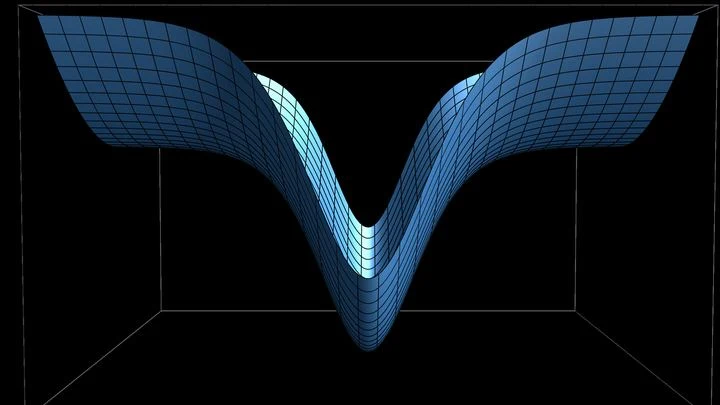
A climber on a ridge notices something strange: the horizon around them seems to freeze. No forward, no backward — only emptiness and silence. This is roughly the picture painted by new calculations for our Universe. At some point in its expansion, the invisible boundary, the future event horizon, stopped growing.
General relativity, which describes the structure of the universe, does not forbid closed timelike curves. But Stephen Hawking put forward the 'chronology protection' conjecture: quantum effects should destroy such curves, making time travel to the past impossible.
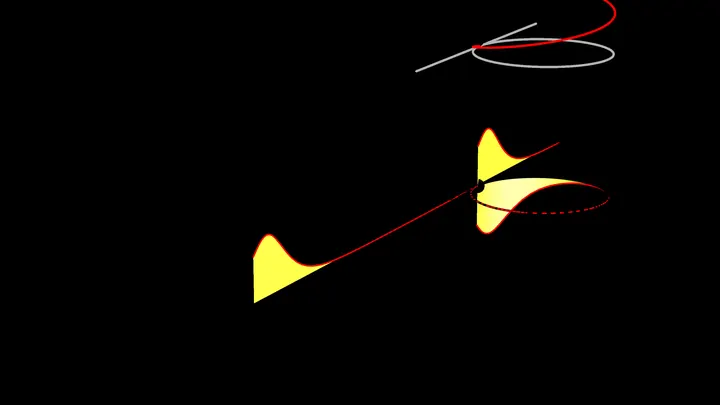
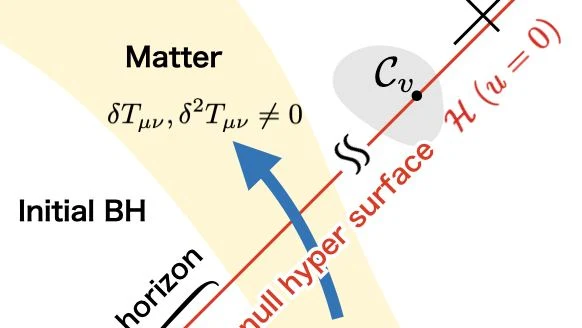
A light ray skimming along a black hole horizon doesn't just move: it carries heat and information. Physicists have long suspected that the geometry of such rays obeys strict rules, but the details remained blurry. The new work turns these rules into a sharp inequality.
The first three minutes after the birth of the world are a cosmic kitchen where nature cooked the lightest atomic nuclei. The recipe is set by gravity: it controls the cooling rate of the hot 'broth' of particles. If gravity worked differently than we are used to, the dish would have turned out different — with different amounts of helium and deuterium.
In the ocean, a whirlpool pulls everything into a closed loop, just as a gravitational wave in empty space twists time into a loop. Gravitational wave — a ripple in the fabric of spacetime, and its special shape can turn the usual flow of events into a closed cycle. In such a zone, an object can return to its own past without violating the laws of physics.
You toss pebbles into a whirlpool, trying to spin it faster and peer into its depths. A black hole is a cosmic whirlpool, where instead of water there is curved spacetime, and instead of a bottom there is a singularity — a point where the familiar laws of physics break down.
Our Solar System isn't an island in the void: it's a sensitive web stretched in a dark cosmic corner. Planets circle their orbits like dewdrops on threads, and we are the spider sensing the faintest tremor. That tremor betrays the approach of the catastrophe astronomers call the Big Rip.
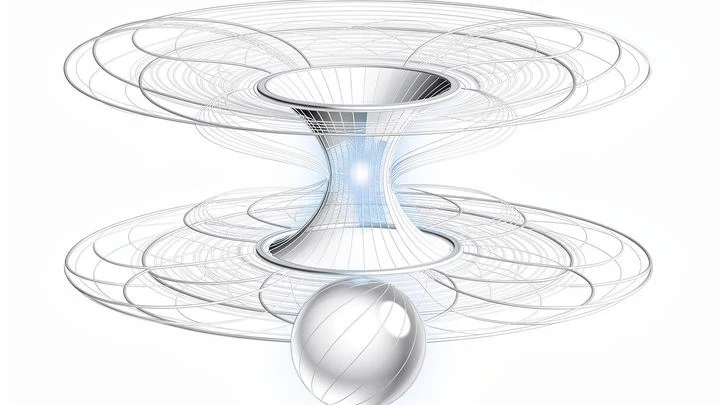
First thing that comes to mind when thinking about the birth of the Universe is an explosion. But modern cosmology paints a more refined picture: birth through the neck of a wine glass. This geometry is not a sommelier's fantasy, but a rigorous form of Euclidean wormhole that connects two anti-de Sitter worlds.
A pot of boiling soup that suddenly starts cooling at a breakneck pace: that's roughly what the universe looked like a few minutes after the Big Bang. As the temperature dropped, the first nuclei began to stick together from protons and neutrons: hydrogen, helium, deuterium, and lithium.
In a vast dark hall, someone invisible plucks the strings. The cosmic gas, the tenuous hydrogen that filled the young universe, resembles stretched strings that can resonate at a radio wavelength of 21 centimeters. This is hydrogen whispering about its temperature.
When a heavy nucleus slams into interstellar gas at enormous speed, it shatters into pieces. Those pieces (lithium, beryllium, boron) then fly onward, and their abundance in the cosmic-ray flux depends on how the breakup unfolded. Conventionally, one expected the proportions to shift smoothly with energy, like the taste of soup when you keep adding water.
Traditional cosmology begins with the Big Bang — the idea of Georges Lemaître. However, a new approach, inspired by the work of Stephen Hawking, bypasses the mystery of the initial moment.
The universe is expanding, but at what rate is a question that has been troubling astronomers for decades. Two methods of measurement give different answers, and this discrepancy is called the Hubble tension. Some look at the early universe through the cosmic microwave background, others at nearby supernovae and Cepheid variables.