Vacuum cracks not with a bubble but with a pair of rings express
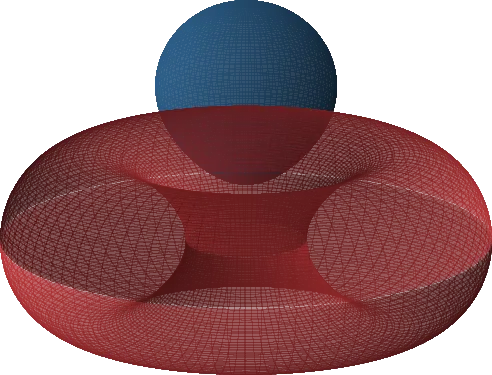
An empty glass on the table seems reliable. But if there's a microcrack in the bottom, one day it will break — not with a crash, but quietly, spreading in a web of lines. So too with the vacuum: it may not be the true vacuum but a false one — temporarily stable, yet ready to transition to a deeper, real state.
For a long time, it was thought that such a transition looks like an inflating soap bubble — perfectly round, symmetric. This solution was found by Sidney Coleman in 1977. But mathematicians knew that other shapes, breaking the symmetry, might exist. Only no one could construct them explicitly — until now.
These rings are not just a mathematical curiosity. They set initial conditions for real time: one can trace how the vacuum will start spreading through space. The solution has an odd number of unstable modes — tiny perturbations that drive its evolution. This is like a pencil balanced on its tip. A single puff of air and it falls, triggering a chain of events.
Why does this matter? The false vacuum is not an abstraction. If our world is stuck in such a state, its decay could rewrite the laws of physics. Now we know that the catastrophe might begin not with a sphere but with a pair of intertwined rings. A quiet crack in the bottom of reality.
Original abstract
as written by the authors arXiv:2606.16024
False vacuum decay in field theory is thought to be dominated by Coleman's O(4)-symmetric bounce, the minimum action nontrivial solution of the imaginary time equations of motion. Beyond the bounce, non-constructive existence proofs of O(4)-breaking solutions are available in the mathematics literature, but the solutions themselves, and their physics, have remained unknown. Considering the simple, bounded-below, scalar field potential $$V(\phi)=\frac{m^2}{2}\phi^2-\frac{\lambda}{4}\phi^4+\frac{g}{6}\phi^6$$, we construct a nonradial solution explicitly: two bubble-tubes of opposite sign wrapping orthogonal rings, invariant under $${\rm O}(2)\times{\rm O}(2)$$ rotations combined with a parity that exchanges the rings. The solution admits valid Cauchy data for real time evolution from a $$t=0$$ slice, and supports an odd number of unstable deformation modes.
The field potential in this work resembles a Mexican hat with an extra dimple at the center, a particle can roll into it, triggering vacuum decay.
In Isaac Asimov's novel 'The End of Eternity,' a tiny change in the past can reshape reality — here, the trigger role is played by a pair of rings.