The cosmological constant problem is one of the deepest unsolved puzzles in physics: the enormous discrepancy between the theoretically predicted value of the vacuum energy density (the energy of empty space) and the value observed from cosmological measurements. Quantum field theory predicts that the vacuum is filled with zero-point fluctuations, contributing an energy density that is roughly 10^120 times larger than the observed value of the cosmological constant, which drives the accelerated expansion of the universe. This mismatch, spanning over 120 orders of magnitude, is considered the worst prediction in theoretical physics.
History
The problem was first articulated in the late 1960s by Ya. B. Zel'dovich and others, but it gained prominence in the 1970s when Steven Weinberg and others highlighted the discrepancy. The discovery of cosmic acceleration in 1998 (by two independent teams) turned the problem from a theoretical curiosity into an observational crisis.
How it works
In quantum field theory, every field contributes a zero-point energy to the vacuum. Summing over all known particles and fields gives a huge energy density, which would act like a cosmological constant in Einstein's equations. However, astronomical observations (from supernovae, cosmic microwave background, and baryon acoustic oscillations) show that the actual cosmological constant is tiny but nonzero, about 10^-26 kg/m^3. The problem is that no known mechanism cancels the huge quantum contributions down to the observed value without extreme fine-tuning. Some proposals invoke supersymmetry (which would cancel contributions but is broken at low energies), anthropic reasoning, or modifications of gravity, but none is fully satisfactory.
In practice
While the cosmological constant problem has no direct technological application, it drives research in quantum gravity, string theory, and cosmology, and it influences the interpretation of dark energy, which constitutes about 68% of the universe's energy budget.
Fun fact
If the vacuum energy were as large as naively predicted, the universe would have expanded so rapidly that stars, galaxies, and even atoms would never have formed — so the fact that we exist implies the cosmological constant is extraordinarily fine-tuned, a puzzle known as the 'why now?' problem.
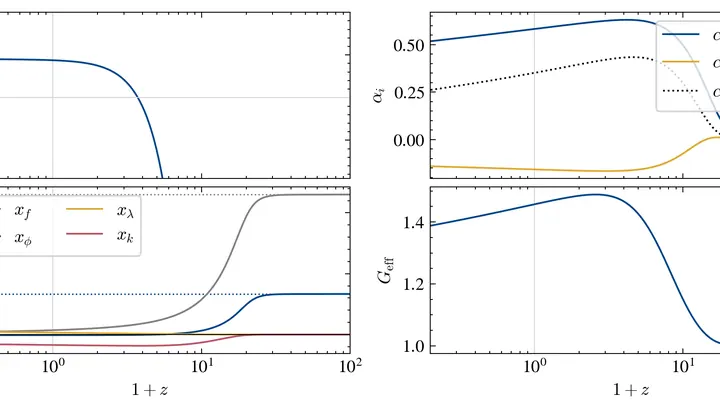
Space is expanding, and that expansion is accelerating. But what if, in the first instants after the Big Bang, gravity behaved differently? The authors of a new study added an invisible field to Einstein's equations that siphons energy from ordinary matter and radiation.
The cosmological standard model is like a recipe for a cake where everything is strictly measured: dark matter is like flour without a single lump (zero pressure), and dark energy is like the perfect leavening agent (equation of state exactly minus one). But what if the flour is a bit damp and the leavening agent has lost its oomph?
A cold, black mirror — that's what the sea of dark energy, the invisible substance driving the expansion of the universe, looked like for billions of years. But the DESI spectrograph has caught a faint ripple.
10⁻¹²⁰. That's not just a small number: it's a chasm. That's the ratio of dark energy density to the Planck density, the natural scale of quantum gravity. The colossal difference of 120 orders of magnitude has long seemed an unsolvable puzzle. But the answer might lie in a drama played out at the dawn of time.
Quantum chromodynamics is the theory that describes how quarks and gluons assemble into protons and neutrons. In its equations, there is a strange angle, the parameter θ (theta).
The quantum world is often compared to a musical instrument. Each system, whether an atom or a chain of particles, sounds at its own frequencies, which physicists call energy levels. In chaotic systems, like an orchestra without a conductor, these frequencies usually fill the entire available range without gaps.
When the cooling cosmos, in the aftermath of the Big Bang, lost its primordial symmetry, tensions arose in the fields, like microcracks forming in solidifying glass. Global monopoles, predicted by Gerard 't Hooft and Polyakov, became such “scars” on the fabric of the universe. Each monopole is a tiny but incredibly massive knot of field.
In the ordinary world without dark energy, the mass of any object is always positive. That seems obvious: positive mass attracts, creating gravity. But the real universe has dark energy — a mysterious force making the cosmos expand faster and faster.
The quantum vacuum is not a dead void but a boiling cauldron of probabilities. In some theories, our Universe is frozen in a metastable state: like superheated water, it's ready to explode into steam at the slightest nudge.
The Universe is an orchestra playing the symphony of the Big Bang. For a long time, the conductor was thought to be dark energy — an unwavering metronome setting the pace of expansion.
The explosion of a distant supernova told us something hard to believe: the universe is expanding faster and faster. The engine of this acceleration is dark energy — nearly 70% of everything that exists.
After the Big Bang, the universe may have been stuck in a false vacuum — a temporary state like a soap bubble ready to pop. A rare true vacuum bubble could then erupt, stretching space in the blink of an eye.
The universe is expanding at an accelerating rate, like dough that keeps rising faster even though the yeast ran out long ago. For twenty years, astronomers have been searching for the cause and call it dark energy. But what it is remains a mystery.
New work proposes an unexpected source: the vacuum inside the atomic nucleus.
The Universe behaves like a soap bubble swelling in a multidimensional foam. The dark bubble model explains why it's expanding ever faster: the spacetime bubble grows, and its membrane gains a tiny thickness — about a micron, like a bacterium. At such distances, gravity 'blurs' across this thickness and weakens.
An empty glass on the table seems reliable. But if there's a microcrack in the bottom, one day it will break — not with a crash, but quietly, spreading in a web of lines. So too with the vacuum: it may not be the true vacuum but a false one — temporarily stable, yet ready to transition to a deeper, real state.
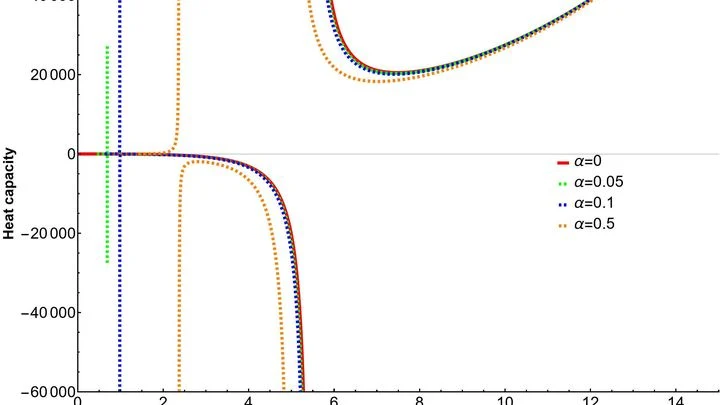
An ordinary black hole is like a stove that heats up more as its mass shrinks. A tiny hole should glow at unimaginable temperatures and evaporate in an instant. But that scenario ignores quantum corrections — what happens when the very fabric of spacetime begins to tremble.
The cosmic vacuum is not emptiness but a living ocean: its energy swells and subsides, echoing the expansion. Like a lunar tide, vacuum density sensitively responds to Hubble’s tempo — the conductor’s baton of the universe.
A compressed spring can sit for years without moving. It seems frozen forever, but inside the metal, atoms slowly rearrange, and one day the spring clicks, settling into a new, more relaxed position.
An inflating balloon starts out slowly, then suddenly expands faster and faster, as if someone is pumping it up from inside. That's roughly how our universe behaves: galaxies are receding with acceleration. The culprit behind this acceleration is called dark energy.
The universe is not a solid monolith, but a canvas of countless quantum threads. Spacetime doesn't flow like water, but vibrates like a tapestry in the wind. For a long time, physicists only saw the overall pattern, neglecting the tremor of individual threads.
Right after the Big Bang, space swelled at an unimaginable speed — that's inflation. Now expansion has slowed, but galaxies are moving apart faster and faster. The culprit behind the acceleration has been named dark energy.
For a long time, dark energy, the mysterious force prodding the expansion of the Universe, was considered eternal and unchanging, like yeast that never loses its activity. But explaining such constancy through the laws of the microcosm proved impossible, and scientists began to suspect that the “leaven” might be going flat.
Imagine inflating a balloon. It expands quickly at first, then slows down, and then suddenly speeds up again, as if someone gave the pump another squeeze. That's what seems to be happening to our universe.
Spacetime sometimes resembles a sheet of paper in which you can punch a hole and connect the edges with a short tube: you get a wormhole. In the simplest mathematical models of such wormholes, massless scalar fields appear — something like an invisible fog filling everything around.
The mystery of dark energy is a chasm. Quantum field theory predicts a density 10¹²⁰ times larger than observed. In the string landscape, this abyss takes shape — myriads of vacua with different energies, and we are nestled in one of them.
The Universe is like an inflating balloon. Quantum mechanics forbids measuring exactly how big it is and how fast it's inflating at the same time. This principle permeates the cosmos: a new equation states that the Universe's expansion and its size are linked by a fundamental uncertainty.
An invisible film, a quantum field, is stretched over a rubber bagel. While the bagel is small, the film stays taut and doesn't sag anywhere: the vacuum remains empty. But once you stretch the bagel to a certain size, a dent spontaneously appears in the film — the field starts to be felt at every point.
This dent is not random.
Toss a handful of glitter into a river, and some flakes will drift straight while others spin in tiny eddies. Galaxies in the universe do something similar: they don't just recede due to cosmic expansion: they also swirl in giant currents, like wood chips caught in invisible whirlpools.
Two galaxy clusters collided like two swarms of bees flying through each other. One of them is the famous "Bullet." After the collision, the hot gas, which makes up most of the ordinary matter, slowed down and stayed in the center, while the galaxies, like small dense pebbles, flew on.
Cosmologists have measured how fast distant galaxies are receding in different parts of the sky. To do this, they used two kinds of "cosmic rulers": galaxy clusters and a certain type of supernova explosion. Both methods showed the same thing: in one direction, the Universe is expanding slightly faster than in the opposite direction.
Two astronomers look at the same universe but see it differently. One measures the expansion rate using ancient light that has been traveling toward us for nearly 14 billion years. The other uses recent stellar explosions in nearby galaxies. The first gets 67 kilometers per second per megaparsec, the second gets 73.
An attempt to suppress room background noise by adding anti-sound turns into speaker howl if the circuit has an error. A similar glitch occurred with a theory that set out to remove the main cosmic hum — the inexplicably weak dark energy.
The universe is expanding, but at what rate is a question that has been troubling astronomers for decades. Two methods of measurement give different answers, and this discrepancy is called the Hubble tension. Some look at the early universe through the cosmic microwave background, others at nearby supernovae and Cepheid variables.
Galaxies are flying apart, but the expansion rate measured from the afterglow of the Big Bang and from supernova explosions doesn't match: this problem has been called the Hubble tension. It's like two dancers losing their rhythm because they can't feel each other.
The universe is expanding faster and faster, like yeast dough in the kitchen. This expansion is helped by dark energy — the cosmic sugar. Ever since astronomers like Adam Riess noticed the acceleration in the late 1990s, they've been searching for the cause.
Light from distant galaxies, passing through clusters of matter, gets distorted — much like the bottom of a pool breaks up into ripples of water. Astronomers measure these barely perceptible bends in shape and create a map of gravitational ‘ripples.’ This is weak lensing — a natural detector of invisible matter.
In the thirties, Pauli realized: without tiny ghost-like particles, the energy of stars doesn't add up. Thus neutrinos were born — intangible wanderers that permeate everything.