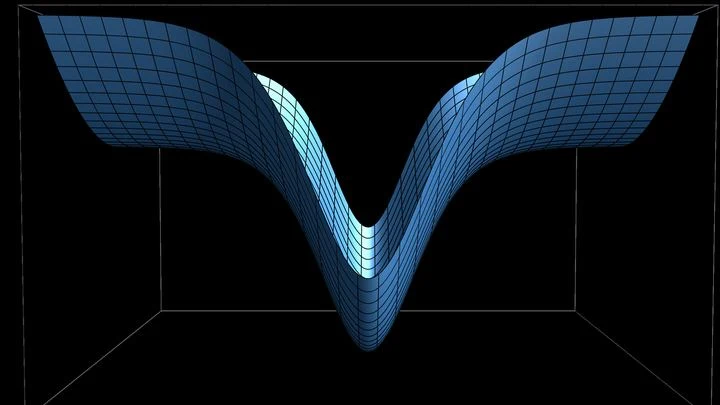
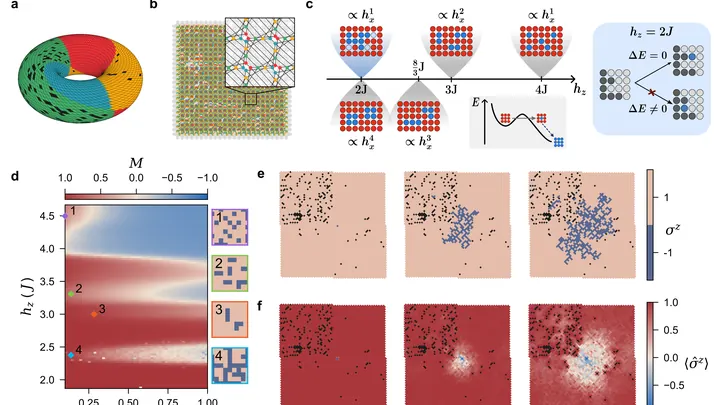
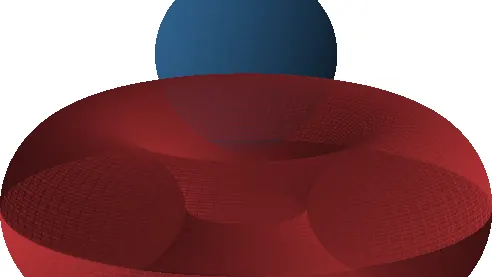
The false vacuum is a hypothetical state of the universe that is locally stable but not globally minimal in energy. Think of a ball resting in a small dip on a hillside: it sits there indefinitely, but a nudge could send it rolling down to a much lower valley. In cosmology, the universe's vacuum state determines fundamental constants like particle masses and forces. If our universe is in a false vacuum, it could decay into a true vacuum, releasing enormous energy and altering physics as we know it.
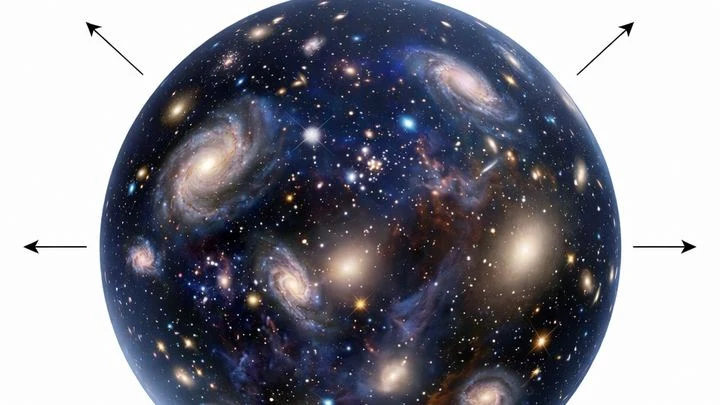
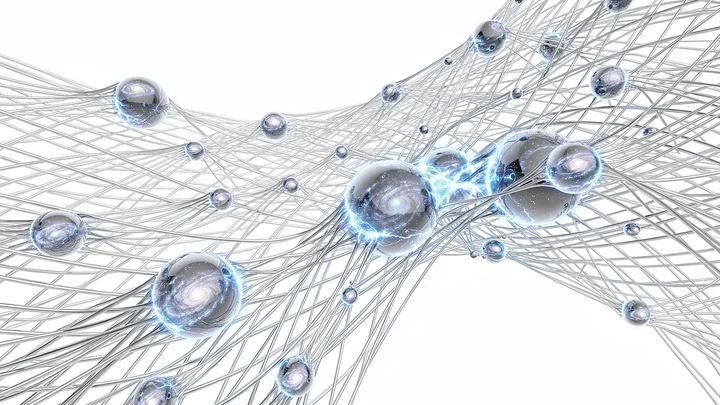
Quantum field theory allows for multiple vacuumstates, each with different energy densities. A false vacuum is a metastable minimum in the potentialenergy landscape. Quantum tunneling can nucleate bubbles of true vacuum within the false vacuum. These bubbles expand at nearly the speed of light, converting the surrounding space to the new vacuum state. The process is analogous to boiling water, where vapor bubbles form and grow.
In practice
It is a key idea in inflationary cosmology, where the early universe may have started in a false vacuumstate, and in speculative models of dark energy as a slowly decaying vacuum.
Fun fact
If our universe is in a false vacuum, the decay could be happening right now, but the bubble would travel at light speed, so we wouldn't see it coming.
In a pot of water carefully heated above its boiling point, the liquid remains calm. But the slightest disturbance, and it violently turns to steam. Physicists call this a metastable state: it seems stable, but in reality it's ready to break apart at the slightest nudge.
In the quantum world, a fact becomes objective when its value is imprinted on many independent fragments of the environment, like a notice posted on hundreds of bulletin boards across the city. Each copy alone adds no new information, but it changes the rules of the game for anyone trying to erase that information.
A homogeneous, spherical cloud of cosmic dust begins to contract under its own gravity. At some point, by classical laws, it should collapse into a point of infinite density — a singularity.
A honeycomb made not of wax but of atoms is graphene — a flat crystal just one atom thick. Electrons in it are like runners at an intersection: they speed up here, slow down there, but never get stuck at the edge. Physicists call such a sheet "topologically trivial," meaning its edges are perfectly ordinary, with no special properties.
Now, let's knock out a single atom from the honeycomb.
A false vacuum is not just a supercooled liquid, but a quantum hologram, ready to spring to life under the right projection. Its decay is described by the tunneling of a quantum field from a metastable minimum, and the classic calculation via Euclidean instantons is as elegant as a still life under spotlights.
In the ordinary world without dark energy, the mass of any object is always positive. That seems obvious: positive mass attracts, creating gravity. But the real universe has dark energy — a mysterious force making the cosmos expand faster and faster.
A runner on the middle of a track suddenly switches to a walk — not speeding up or slowing down, but maintaining a constant pace. Something similar may have happened to the universe itself shortly after the Big Bang.
The quantum vacuum is not a dead void but a boiling cauldron of probabilities. In some theories, our Universe is frozen in a metastable state: like superheated water, it's ready to explode into steam at the slightest nudge.
In the ocean, a whirlpool pulls everything into a closed loop, just as a gravitational wave in empty space twists time into a loop. Gravitational wave — a ripple in the fabric of spacetime, and its special shape can turn the usual flow of events into a closed cycle. In such a zone, an object can return to its own past without violating the laws of physics.
The cosmological principle – the notion that the Universe is homogeneous and isotropic on large scales – has guarded our understanding of the world since the time of Edwin Hubble and Georges Lemaître, whose ideas formed the basis of the Big Bang model.
The explosion of a distant supernova told us something hard to believe: the universe is expanding faster and faster. The engine of this acceleration is dark energy — nearly 70% of everything that exists.
A ball sits in a pit. It won't roll out on its own: it needs a push. But in the quantum world, a particle can leak through a barrier without extra energy. This trick is called tunneling.
After the Big Bang, the universe may have been stuck in a false vacuum — a temporary state like a soap bubble ready to pop. A rare true vacuum bubble could then erupt, stretching space in the blink of an eye.
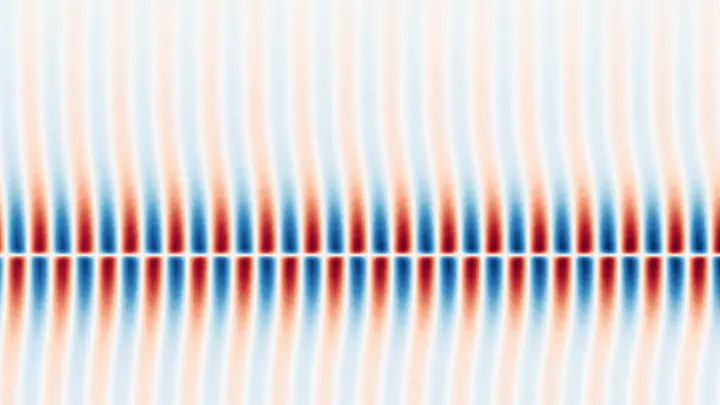
A lone fold runs across a taut sheet — a sharp drop in height that doesn't spread out but moves as a whole. Physicists call such a fold a 'kink'. If you give the sheet a sharp tug in one spot, ripples will travel across it. But in some media, these ripples don't disperse; instead, they gather into a clump and tremble in place for dozens or hundreds of cycles. Such a clump is an oscillon.
The Universe behaves like a soap bubble swelling in a multidimensional foam. The dark bubble model explains why it's expanding ever faster: the spacetime bubble grows, and its membrane gains a tiny thickness — about a micron, like a bacterium. At such distances, gravity 'blurs' across this thickness and weakens.
An empty glass on the table seems reliable. But if there's a microcrack in the bottom, one day it will break — not with a crash, but quietly, spreading in a web of lines. So too with the vacuum: it may not be the true vacuum but a false one — temporarily stable, yet ready to transition to a deeper, real state.
A translator hears not just words, but intonation, pauses, the tremor in a voice. Ordinary entropy analysis of cosmic perturbations is like meeting minutes: it records facts but loses the nuances. Pseudoentropy entropy is a new tool that captures the hidden "music" of the early universe.
Imagine a slide with three dips: the deepest one is a stable position for a ball, the middle one is precarious. A slight push and the ball rolls down. Yet, constant vibration of the right strength can hold it in the middle hollow for a long time.
In the 1950s, physicists Lee and Yang discovered that all states of matter are separated by invisible points in the world of imaginary numbers.
The cosmic vacuum is not emptiness but a living ocean: its energy swells and subsides, echoing the expansion. Like a lunar tide, vacuum density sensitively responds to Hubble’s tempo — the conductor’s baton of the universe.
Immediately after the Big Bang, in the seething cauldron of the cooling Universe, much like in unevenly hardening glass, stresses appeared — hairline cracks in reality, cosmic strings. Picture a tightrope walker balancing on an invisible cable stretched across the abyss of warped spacetime.
A child on a swing: too strong a push and they fly off. Roughly this is how powerful light tears electrons out of an atom. It would seem that the stronger the push, the more certain the destruction. But in the quantum world it is different: when the field strength crosses a certain threshold, the atom suddenly freezes.
A compressed spring can sit for years without moving. It seems frozen forever, but inside the metal, atoms slowly rearrange, and one day the spring clicks, settling into a new, more relaxed position.
An eternal Universe where the measure of disorder (энтропия) grows is, for most of its time, a homogeneous void. In it, complex structures occasionally assemble by chance, such as fleeting consciousnesses — ‘мозги Больцмана’.
In an orchestra, one musician plays so quietly that their sound is almost inaudible in the overall chorus. In the quantum world, such 'quiet' states are called dark: their energy barely escapes, like light in a darkened room. But if there are many musicians, their mutual influence can unexpectedly awaken even the most silent one.
Cosmology is going through strange times. On one hand, the standard model with dark matter and dark energy beautifully describes the large-scale structure. On the other, it's cracking at the seams.
Picture the Universe as a book with a finite number of pages. Its accelerated expansion, driven by dark energy, a mysterious substance pushing space apart, acts like an invisible binding: distant pages are forever glued together, becoming inaccessible chapters.
Back in the 1930s, Fritz Zwicky noticed that the speeds of galaxies in clusters were too high for the visible mass. Later, Vera Rubin confirmed this for individual galaxies.
A ball on a slope with two pits usually rolls into the nearest one and comes to rest. But if the slope is slightly deformed and 'remembers' recent nudges, the ball can hang around halfway for a long time — in a narrow spot it doesn't want to leave. That's exactly the trick physicists played with light.
For a long time, dark energy, the mysterious force prodding the expansion of the Universe, was considered eternal and unchanging, like yeast that never loses its activity. But explaining such constancy through the laws of the microcosm proved impossible, and scientists began to suspect that the “leaven” might be going flat.
Imagine inflating a balloon. It expands quickly at first, then slows down, and then suddenly speeds up again, as if someone gave the pump another squeeze. That's what seems to be happening to our universe.
Spacetime sometimes resembles a sheet of paper in which you can punch a hole and connect the edges with a short tube: you get a wormhole. In the simplest mathematical models of such wormholes, massless scalar fields appear — something like an invisible fog filling everything around.
A boiling cauldron with the occasional bubble of steam popping: that's what the early universe resembled. All of space was filled with a field in a false vacuum state, like water superheated above its boiling point.
You are pacing a huge hall in complete darkness. You walk from wall to wall, counting your steps, and suddenly realize that the distances don't add up as they should. It seems as if the floor is not flat but bulging like a hump or hollowed like a bowl. That's roughly what astronomers found when studying distant galaxies and sound waves frozen in the early Universe.
A spring compressed to the limit breaks. Likewise, classical gravity theory leads to a singularity — a point where all laws break down. Quantum mechanics turns this end into an elastic bounce.
An attempt to suppress room background noise by adding anti-sound turns into speaker howl if the circuit has an error. A similar glitch occurred with a theory that set out to remove the main cosmic hum — the inexplicably weak dark energy.
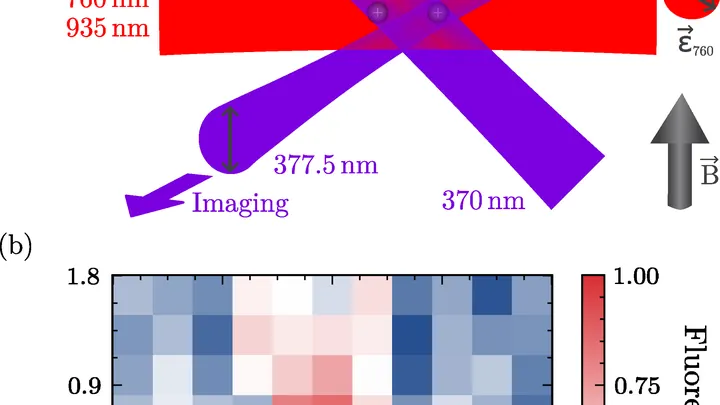
A glowing dot in a vacuum chamber refuses to go out, even though the light source has long been switched off. A single ytterbium ion, held by electric fields, is stuck in an excited state, as if the electron inside it has forgotten how to return to its usual place.
Our Universe may have arisen from a highly unstable state that physicists call the false vacuum. Imagine a glass of water cooled below its freezing point: the liquid remains liquid only until the first jolt, which instantly triggers crystallization into ice.
The early universe was an extremely hot and dense medium. In this medium, like bubbles of steam in boiling water, bubbles of a new state of space spontaneously emerged — regions where physical properties changed abruptly.
The idea of quantum teleportation was proposed by Charles Bennett and realized by Anton Zeilinger. It uses entanglement — when two particles are in sync, like two sheets of paper that instantly copy the same drawing. But earlier, the "ink" would blur, ruining the blueprint.