How a Pair of Black Holes Creates Particles from the Void express
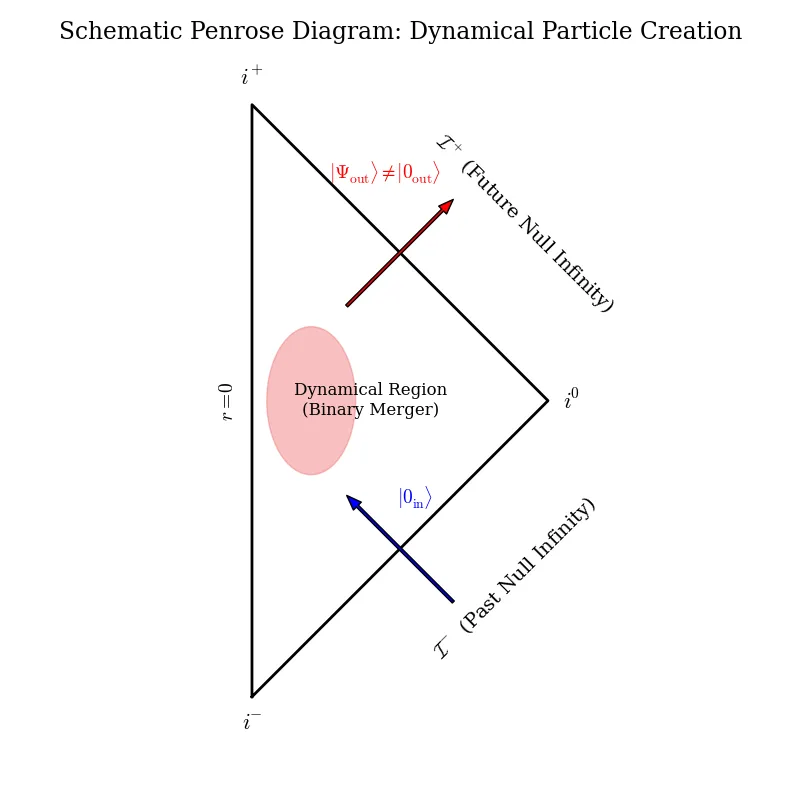
Two black holes circle in a slow dance, gradually drawing closer. Their motion perturbs spacetime itself, like two heavy balls rolling on a stretched sheet, making it tremble. These tremors are what we call gravitational waves. But there is a subtler effect: the oscillating fabric of spacetime can give birth to particles right out of the vacuum.
In quantum physics, the void is not truly empty — pairs of particles and antiparticles constantly pop into existence and annihilate. Usually they annihilate immediately, but strong spacetime curvature can separate them, turning them into real, observable particles. That is exactly how Hawking radiation works for a single black hole. The authors of the new study applied this idea to a system of two black holes in the early inspiral stage — when they are still far apart and gravity is not too strong.
The result was unexpected: the spectrum of produced particles is not thermal, as in Hawking radiation, but a power law. The energy carried away by the particles grows with the gravitational wave frequency as ~$ω^{16}$/3. In other words, the faster the holes spin, the more powerful the particle flux. For now, the calculation covers only the calm inspiral phase, leaving the violent merger for the future. But it is already clear: dancing black holes make the void glow.
The effect of particle creation by gravitational fields was theoretically predicted back in the 1970s, but for binary black holes it has been calculated for the first time only now.
In Poul Anderson's novel "Tau Zero," the crew of a starship observes that under strong acceleration, the vacuum begins to emit particles — an echo of those very quantum effects in curved spacetime.