Pair production is the process where energy is converted directly into matter, creating a particle and its corresponding antiparticle. This is one of the most direct demonstrations of Einstein's mass-energy equivalence (E=mc²). In a vacuum, this process is forbidden by energy and momentum conservation for a single photon, but it becomes possible in the presence of a strong electromagnetic field, such as near an atomic nucleus or in an intense laser field. The concept is central to quantum electrodynamics and explains phenomena from cosmic ray showers to the behavior of matter in extreme astrophysical environments.
History
The concept was first proposed by Paul Dirac in 1928 with his relativistic equation of the electron, which predicted the existence of positrons. The process was experimentally confirmed by Carl Anderson in 1932, who discovered the positron in cosmic ray tracks. The theoretical framework for pair production in strong fields was developed by Julian Schwinger in 1951.
How it works
A photon with energy greater than twice the rest mass energy of an electron (1.022 MeV) can, when passing near a nucleus, spontaneously transform into an electron and a positron. The nucleus absorbs the excess momentum, allowing energy and momentum conservation to be satisfied. The process is reversible: when a particle and its antiparticle meet, they annihilate, releasing energy as photons. In strong fields, such as those in heavy-ion collisions or intense lasers, the vacuum itself can become 'polarized,' and pairs can be created from the field energy alone, a phenomenon known as the Schwinger mechanism.
In practice
Pair production is used in positronemission tomography (PET) scans, where positrons from radioactivedecay annihilate with electrons, producing gamma rays that are detected to create 3D images of metabolic processes in the body.
Fun fact
The energy of a single photon can be converted into matter, but the process requires a 'witness' — a nearby nucleus or another photon — to conserve momentum, so a lone photon in empty space can never spontaneously create a pair.
Imagine a green beam that, passing through an ingenious optical setup, twists into a three-dimensional funnel of light — an optical vortex. At its heart, like in the eye of a hurricane, the intensity drops to zero. It is there that photons disappear.
Since Saul Perlmutter and his colleagues discovered the accelerated expansion of the universe, physicists have been scratching their heads over the nature of dark energy.
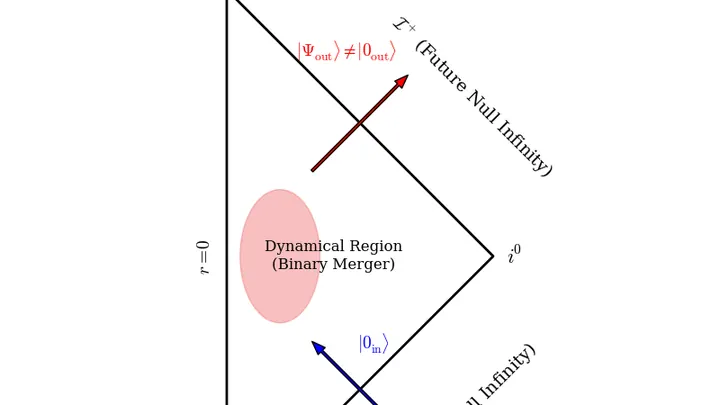
Two black holes circle in a slow dance, gradually drawing closer. Their motion perturbs spacetime itself, like two heavy balls rolling on a stretched sheet, making it tremble. These tremors are what we call gravitational waves.
In the first moments after the Big Bang, matter and antimatter should have been created in equal amounts. But today we see only matter — stars, planets, ourselves. Where did the antimatter go? One clue hides in nearly elusive particles: right-handed neutrinos. The usual story is that their decays create a slight bias in favor of matter.
Many black holes are surrounded by magnetic fields. As it spins, the black hole drags curved spacetime along with it, like a machine's flywheel, and sets the cosmic factory in motion.
In the Standard Model, our most complete description of the subatomic world, electric charge is always a multiple of the electron's charge: nature works in whole units, like a builder using bricks of a strictly defined size. Yet the equations allow for particles with double charge — bileptons.
If you squeeze a handful of sand in your fist, it first compacts, but then starts to resist — the grains have nowhere left to go. In the depths of a neutron star, something similar happens, except instead of sand grains, you have elementary particles, and instead of your hand, you have monstrous gravity.
Inside a neutron star, the density doesn't change smoothly but drops abruptly at sharp cliffs — density staircases. At these steps, the void suddenly births pairs: neutrinos and antineutrinos.
Light from a bulb or even a regular laser resembles a crowd at a subway exit: people move haphazardly, sometimes dense, sometimes sparse. Physicists call this behavior shot noise — random fluctuations in the number of particles arriving per second.
The void can produce particles if a strong enough field is applied. Physicists call this the Dirac–Klein paradox. Previously, explaining it required the most complex calculations of quantum field theory. But we can make do with a visual image: a tightly stretched rubber band with a knot. The knot is a particle.
A laser strikes a strontium atom, and two electrons fly out at once. Previously, it was thought that in such double ionization each electron acts on its own: one is knocked out first, the second later, randomly.
A semiconductor diode normally conducts current in only one direction, like a spring-loaded door: it opens easily one way but pushes back the other. But if you dope the crystal heavily, the door starts behaving strangely: under reverse bias, the current doesn't just flow: it shoots up.
Sunlight is a turbulent stream carrying inseparable pairs of droplets. That’s what quantum entanglement looks like: two particles are so connected that a fluctuation in one instantly resonates in the other. In the past, creating such pairs required a 'calm pool' — a perfectly tuned laser beam.
At the Large Hadron Collider, physicists accelerate protons to nearly the speed of light and smash them together. Usually, the protons themselves take part in such collisions, but sometimes they pass close by without touching, and it is their electric fields that interact.
A single calcium ion hovers in a vacuum trap, held by electric fields like a pea in an invisible bowl. Around it are two mirrors forming an optical cavity: light bounces between them, amplifying the interaction with the ion.
Light from an ordinary lamp is chaos: photons scatter in all directions with no order. But if you make many atoms emit light simultaneously and in sync, you get a short, powerful flash, like applause that turns individual claps into a single burst. Such coordinated emission is called superradiance.
Run a current through a wire, and the wire heats up. Anyone who has ever touched a phone charger knows this. Physicists call this heating Joule heating, after James Joule, who in the mid-19th century measured how much heat electricity produces. Since then, the formula has been simple: the greater the resistance and the current, the hotter the wire.
An ordinary laser emits photons one by one, like a faucet dripping water. But what if you need several particles of light born at the same instant? Physicists have made a cloud of cold rubidium atoms emit quadruples of photons — as if the faucet suddenly released four drops at once, each falling into its own test tube.
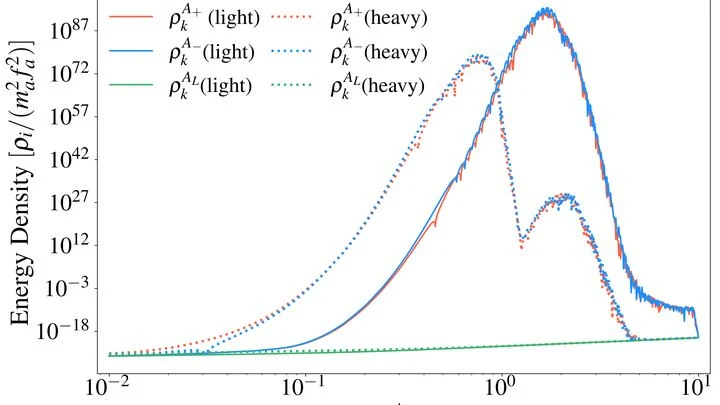
Supermassive black holes at the centers of galaxies appeared so quickly after the Big Bang that astronomers are scratching their heads. The solution lies in the trembling of an invisible axion field.
The expansion of the universe is like a dance floor stretching wider. For decades, physicists assumed that more stretching would spawn more particles, like the floor spontaneously generating new dancers. But those models ignored an obvious fact: dancers sometimes link arms. When particles interact, new simulations reveal, they actually suppress creation.
In 1989, John Wheeler proposed a bold idea: "it from bit," meaning everything that exists arises from information. For a long time, this remained a beautiful metaphor, but now physicists have found a concrete mechanism that turns bits into particles.
Spontaneous emission, the very process that lights up lamps and stars, has long been considered a pesky noise in quantum physics. This cacophony of random photons ruthlessly destroys fragile quantum entanglement, like radio static drowning out a distant melody.