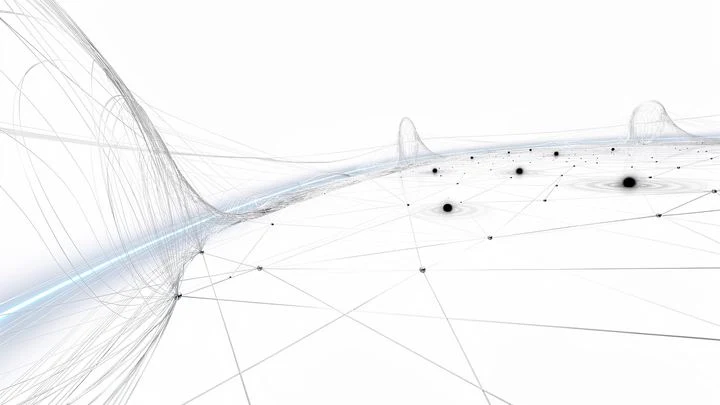
Scalar perturbations are small disturbances in a scalar field—a field that has a single value at every point in space and time, like temperature or pressure—propagating through the curved spacetime around a black hole. When a black hole is disturbed, whether by infalling matter, a passing gravitational wave, or a subtle change in its environment, it responds by 'ringing' in characteristic oscillation modes. Scalar perturbations provide a clean, mathematically tractable way to study this response, acting as a test probe of the black hole's geometry and its stability.
History
The systematic study of perturbations around black holes began in the late 1950s with the work of Regge and Wheeler on gravitational waves, and was extended to scalar fields shortly after. The concept of quasinormal modes was formalized in the 1970s by Chandrasekhar and Detweiler.
How it works
In practice, one solves the wave equation for a massless scalar field in the black hole's background metric. The field's behavior is governed by a potential barrier that depends on the black hole's properties—mass, spin, and charge. Perturbations that hit this barrier are partially reflected and partially transmitted; the trapped part oscillates at discrete complex frequencies called quasinormal modes. The real part of the frequency sets the oscillation rate, while the imaginary part sets the damping time. By analyzing these modes, physicists can infer the black hole's parameters and test whether its exterior geometry matches general relativity's predictions.
In practice
Scalar perturbation theory underpins the analysis of gravitational wave signals from black hole mergers, where the 'ringdown' phase is modeled as a superposition of quasinormal modes. It is also used to test the no-hair theorem and to probe alternative theories of gravity.
Fun fact
The quasinormal mode frequencies of a black hole depend only on its mass, charge, and angular momentum—not on what initially disturbed it—a property known as 'black hole spectroscopy.'
A black hole is a maze with no way out. But what happens to the information inside? To test this, physicists didn't fly to the nearest hole; instead, they built a tiny replica on a quantum processor. The maze was played by a chain of 32 superconducting qubits, where each step leads only forward, like a one-way corridor.
Drop a pebble into a pond, and ripples spread across the water. Something similar happens when a black hole merges with another: it emits gravitational waves that resemble the fading ring of a bell.
When two heavy balls merge into one, ripples spread across the water's surface for a long time. A black hole behaves similarly: after a merger, it 'rings' for a while, emitting special gravitational oscillations — quasinormal modes. Usually, this ring fades quickly, like an echo dying out in an empty hall.
A dance floor where couples whirl. At the center, an invisible master of ceremonies sets the rhythm. This is the supermassive black hole at the heart of the Milky Way, and the couples are stars whose orbits astronomers have tracked for years. But what if the master himself is wrapped in a fluffy fur coat of tenuous matter?
When you blow up a balloon too quickly, its surface starts to quiver. Something similar happened to space in the first moments after the Big Bang: the universe expanded rapidly, and the very fabric of space began to ripple.
A black hole spun up almost to its limit is like an athlete balancing on the edge of a record. The most interesting action isn't inside the hole itself, but in the thinnest film of spacetime at its horizon. It's there that tiny corrections to Einstein's gravity can suddenly swell to gigantic proportions.
A classical black hole is a bottomless well: everything that falls past the horizon disappears into a point of infinite density. But in loop quantum gravity (one approach to quantum gravity), that point is replaced by a quantum 'bounce'—a sphere of finite size where spacetime doesn't tear but rearranges itself.
In a binary star system, one star pulls matter from its companion. Over centuries, this material settles onto the surface of a neutron star — the ultra-dense remnant of a dead star. This process, called accretion, usually proceeds smoothly. Gravity behaves as general relativity predicts, without surprises.
You could send a short radio pulse toward a black hole and wait for the reflected echo. Intuitively, the shorter the signal, the better it would probe the finest details of spacetime right at the horizon: that region from which even light cannot return.
A black hole is not just an abyss. It is a seething cauldron whose temperature rises as it evaporates. The authors of the study found that when the heat reaches a critical threshold, the hole seems to boil. It emits superheavy particles — the very ones that exist on a scale where any theory of gravity collapses.
Light from the very beginning of the cosmos has been traveling toward us for 13.8 billion years. During that time, its polarization, the direction of its oscillations, might have been twisted, like a compass needle that someone quietly nudged. Physicists call this phenomenon cosmic birefringence.
A cloud of waves collapses under its own gravity. While it's loose, everything goes by the book: the field oscillates gently in nearly flat space, and approximate formulas work perfectly. But add just a bit more energy, and the picture changes.
Physicists used a numerical model to catch the moment when simple calculations stop describing reality.
A stone falls into still water — ripples spread across the surface. A black hole behaves similarly when something falls into it or when it merges with another black hole. The hole begins to oscillate, and these oscillations propagate through space as gravitational waves.
In the first 10⁻³⁵ seconds after the big bang, the most rapid part unfolded. Space expanded faster than light — that's expansion of the universe (inflation). Almost the entire score was performed by a single field, the inflaton, conducting the tempo and key.
After a hit, a black hole rings like a bell. But instead of sound, it emits gravitational waves whose frequency rapidly decays: these are called quasinormal modes. From such a 'ring,' you can infer the hole's mass, spin, and other properties.
A black hole sitting on a thin cosmic membrane (brane) resembles a heavy ball stretching an elastic sheet. In classical physics, it is bald — only mass, charge, and rotation. But add a scalar field (an invisible substance like temperature), and the hole can spontaneously grow 'fur' from this field.
The spiral of water draining into a sink spins faster and faster toward the center. In an ordinary black hole, that funnel ends in an infinitely sharp point — a singularity where the laws of physics break down. But this new work considers a different picture: the funnel doesn't taper to a needle but ends in a smooth, swelling bubble.
A swarm of tiny invisible particles, like a cloud of pollen, drifts through space. A black hole sits in its path. Some particles fall in and vanish forever; others swing around the trap and fly away. The physicists built a map showing exactly how much matter gets swallowed and how much survives.
2.1 × 10⁻⁹ — that's the temperature variation across the sky, about the same as measuring ripples a fraction of a millimeter high on the ocean surface. This microscopic non-uniformity is imprinted in the cosmic microwave background and tells the story of the very beginning of time.
The event horizon's edge is never calm. Quantum vacuum boils there, and particles sometimes burst out of this foam: that is how Stephen Hawking in 1974 discovered black hole radiation, forever linking gravity with quantum field theory.
Gravity is the invisible glue that holds stars and planets together. But what if this glue has a tiny mass? In massive gravity, the carrier particles (called gravitons) weigh a minuscule but nonzero amount. This changes the rules near black holes.
The authors of the new study built on a mathematical tool — eigenvalue decomposition.
At the center of many galaxies lurks a black hole, wrapped in an invisible cloud — the halo of dark matter. This is not just a featureless mass: its density changes from the edge to the center, and the degree of this "compression" is called compactness.
At the hearts of many galaxies, cosmic tops of incredible power spin — supermassive black holes. Their nature was first described by Schwarzschild right after Einstein gifted the world with general relativity.
At the center of attention is a black hole of unusual shape. Its geometry resembles a spindle: a slight elongation is added to the usual rotation. The parameter B measures this deformation.
The spindle deformation is not just a mathematical toy.
Picture the early Universe as an unimaginably large bell. Inflation — the era of rapid expansion, dreamed up by Alan Guth, strikes it, sending a wave rippling across the fabric of spacetime.
An ordinary black hole hides a singularity at its center — a point where density and curvature become infinite and the laws of physics break down. The authors of the new work built a model of a rotating black hole that, instead of a singularity, contains a calm "core" resembling ordinary flat space.
A black hole merger is not a silent impact. The newborn hole quivers and decays, emitting gravitational waves — ripples in space itself. This signal is called the 'ringdown,' and it resembles the fading chime of a bell: it has a fundamental tone and several overtones.
A black hole is not just a dark spot. It rotates, drags space along with it, and can carry imprints of the quantum world. To describe such a hole, one must solve gravitational field equations.
The mystery of dark matter has puzzled physicists for nearly a century. Among the candidates for its role are primordial black holes (PBHs), born in the fiery embrace of the first moment after the Big Bang.
At the center of a black hole, classical theory paints a point where density and spacetime curvature shoot to infinity — like an infinitely sharp needle. But quantum corrections, tracing back to the work of Karl Schwarzschild, add a tiny “pillow”: space cannot collapse to zero.
Two black holes race past each other like Formula 1 cars on opposite lanes. In standard general relativity, they remain 'bald'—no extra fields appear around them. But if you add a scalar field to the equations (something like an invisible fog permeating space), the rules change.
Observations by James Webb showed: already 500 million years after the Big Bang (at redshifts z~10), the Universe was aglow with black holes with masses of billions of solar masses. This baffles theories of gradual growth: matter would not have time to 'feed' the seeds at the required rate.
Imagine a river at a rapid: the current accelerates until no wave can go against the flow. So it is with gas near a black hole: reaching the speed of sound, it locks itself in — an acoustic black hole is born, a twin of the gravitational abyss. Here the event horizon is woven from a flow faster than its own sound.
A black hole horizon is like a soap film stretched over an abyss. From a distance it looks perfectly smooth, but up close it trembles. This ripple arises from quantum fluctuations — the continuous birth and death of particles in the vacuum.
A tiny star spirals around a giant rotating black hole. Slowly, it moves closer in a spiral, and this dance lasts thousands of years. All the while, waves ripple through space, like ripples on water, but these are gravitational waves. They can be "heard" with special detectors.
At the centers of many galaxies lurk black holes — regions with gravity so strong that even light cannot escape. Stars often orbit them, and sometimes one of those stars is a pulsar, a cosmic lighthouse sending out strictly periodic radio pulses. When such a pulsar moves behind a black hole, its signals reach us with a delay.
A black hole is like a spinning drop of viscous liquid. Normally, such a drop tends to stay whole: splitting would reduce its surface area, which contradicts the law of non-decrease of entropy (a measure of disorder, like a broken cup doesn't glue itself back together).
The focus is on a black hole, but not an ordinary one. It carries a magnetic monopole and is surrounded by a dilaton — a field that blurs the familiar boundaries of space. The authors tested how stable such a system is to thermal jolts.
A magnetic monopole is a hypothetical particle with a single magnetic pole.