Gravitational wave astronomy is the observation and analysis of ripples in spacetime, known as gravitational waves, to study cosmic events that do not emit light. These waves are produced by massive accelerating objects, such as merging black holes or neutron stars, and carry information about their origins that electromagnetic observations cannot provide. This field has opened a new window on the universe, allowing scientists to probe the most violent and extreme phenomena, including black hole mergers, supernovae, and potentially the early universe.
History
The first direct detection of gravitational waves was announced in 2016 by the LIGO and Virgo collaborations, confirming a prediction made by Albert Einstein in 1916. This detection, of a binary black hole merger, marked the beginning of gravitational wave astronomy as a practical field.
How it works
Gravitational waves are detected using highly sensitive interferometers, such as LIGO and Virgo, which measure tiny changes in the distance between mirrors caused by passing waves. When a wave passes, it stretches and squeezes spacetime, altering the interference pattern of laser light in the detector. By analyzing these patterns, scientists can infer the masses, spins, and distances of the sources, as well as test predictions of general relativity.
In practice
Gravitational wave astronomy is used to study black hole and neutron star populations, measure the expansion rate of the universe, and test fundamental physics under extreme conditions.
Fun fact
The first detected gravitational wave signal, GW150914, was produced by the merger of two black holes about 1.3 billion light-years away, and the energy released in that fraction of a second was more than the combined light of all stars in the observable universe.
In 2034, a rocket leaves a spaceport with an unusual payload: two spheres the size of a large globe, each weighing nearly a ton. No engines, no electronics. Just a mirrored surface of hundreds of corner-cube reflectors — tiny prisms that return light exactly to where it came from. This is the future space tuning fork.
A black hole is not just a vacuum cleaner. It glows faintly, emitting particles — this idea was proposed by Jacob Bekenstein, who connected the hole's temperature to its degree of disorder. Detecting such radiation in space is incredibly difficult.
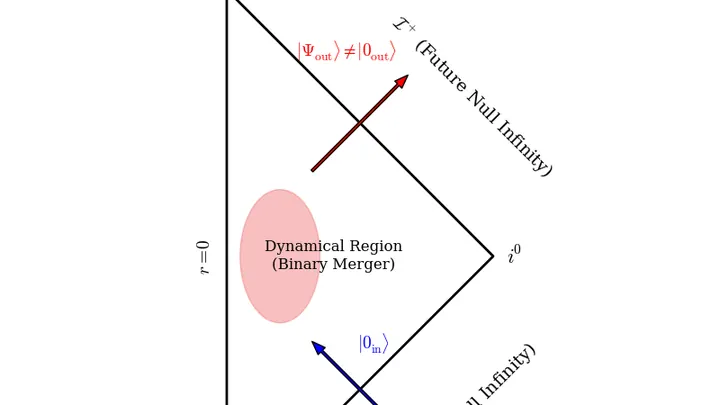
Two black holes circle in a slow dance, gradually drawing closer. Their motion perturbs spacetime itself, like two heavy balls rolling on a stretched sheet, making it tremble. These tremors are what we call gravitational waves.
The universe sometimes resembles a pot of boiling water. With enough heat, liquid turns to vapor: that's a phase transition. Something similar could have happened in the early universe: a field filling space suddenly changed its state, like water becoming gas.
The fabric of space bends under weight, like a stretched trampoline. Gravitational waves — ripples spreading from cosmic cataclysms, such as merging black holes. If such a ripple encounters a massive galaxy or invisible dark matter, they act like a magnifying glass: bending and amplifying the signal.
Black holes are rarely alone in the cosmos. They are often shrouded in invisible clouds of hypothetical dark matter particles — so light that they feel only gravity, barely interacting with each other or ordinary matter.
A guitar string after being plucked produces not only the fundamental note, but also quiet overtones. A similar phenomenon appeared in the gravitational waves from the merger of two black holes (event GW250114).