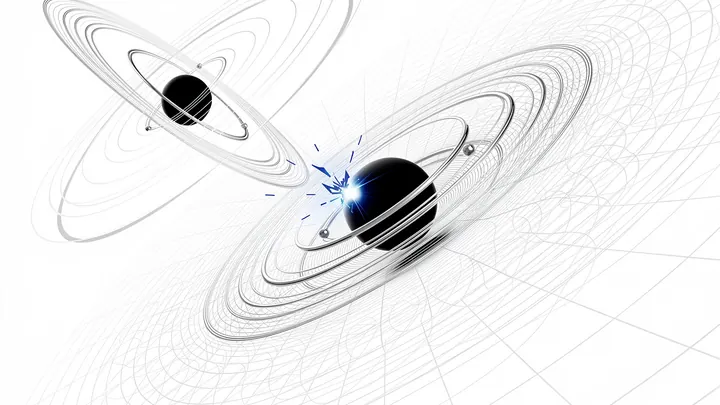
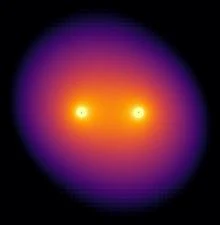
Black hole binary interaction refers to the gravitational and dynamical processes that occur when two black holes orbit each other and eventually merge. These interactions are a key source of gravitational waves, which were first directly detected in 2015. The dynamics of black hole binaries are governed by general relativity, and their evolution involves the emission of gravitational radiation, which carries away energy and angular momentum, causing the orbit to shrink over time.
History
The existence of gravitational waves was predicted by Albert Einstein in 1916, but the first direct detection of a black hole binary merger was made by the LIGO and Virgo collaborations in 2015 (event GW150914).
How it works
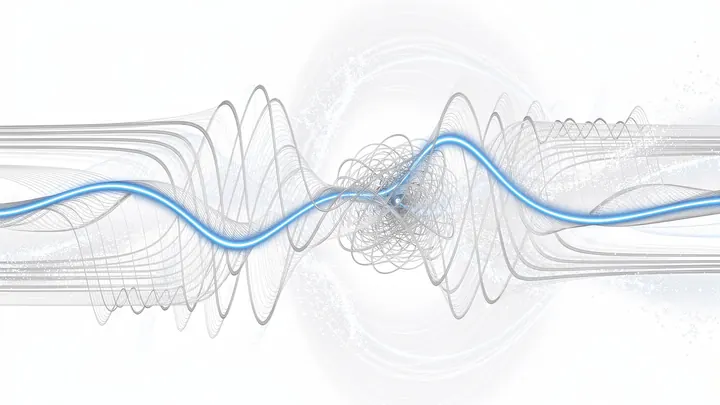
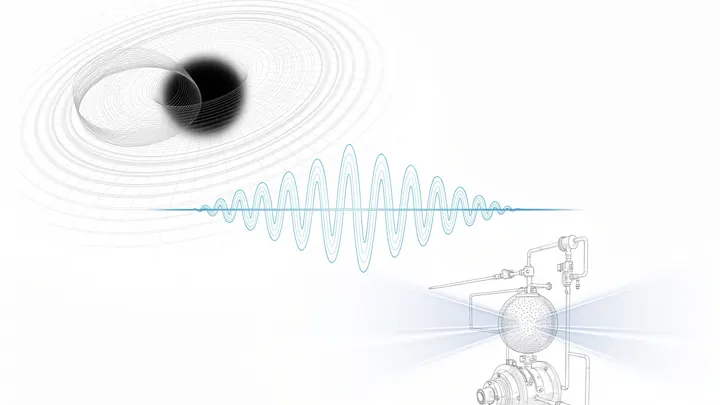
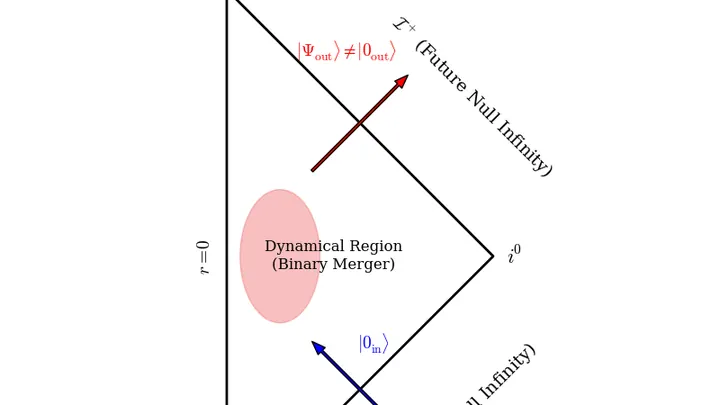
As two black holes orbit each other, they emit gravitational waves—ripples in spacetime that propagate outward. This emission drains energy from the orbit, causing the black holes to spiral closer together. The process accelerates as they approach, leading to a final plunge and merger, which releases a burst of gravitational waves. The resulting single black hole then rings down, emitting damped oscillations. The details of this process depend on the masses, spins, and eccentricity of the binary, and can be modeled using numerical relativity.
In practice
Observations of black hole binaries are used to test general relativity, measure the properties of black holes, and probe the population of black holes in the universe.
Fun fact
The first detected gravitational wave signal, GW150914, came from the merger of two black holes about 1.3 billion light-years away, and the energy released in that merger was more than the combined energy of all stars in the observable universe for that instant.
In 2015, the LIGO detectors caught the first ripple of spacetime from a black hole merger. Since then, hundreds of such events have piled up, each carrying the imprint of its ancestry: whether the holes were born together from a single pair of stars or met by chance in a dense cluster. The difference shows in the direction of their spin axes.
Two black holes circle in a cosmic dance, spiraling closer together. In the end, they merge into one, and that moment unleashes a powerful burst of gravitational waves, ripples in spacetime itself. But what remains after the merger?
The first moments after the big bang: space expands rapidly — physicists call this period inflation. Inside this swelling fabric, like soap bubbles in a stream of air, regions of new vacuum begin to form — a first-order phase transition. Most bubbles pop or merge as soon as they appear.
Three milliseconds before the merger. A gargantuan black hole spinning at breakneck speed drags in a neutron star — a ball the size of a city but with 1.5 times the Sun's mass. Tidal forces stretch the star into a thread as thin as a needle and fling its matter outward.
The universe rewrites its history again and again. Where ordinary astronomy sees only a point, a black hole, gravitational waves peel back thin layers of the past, like an ancient palimpsest. The idea that black holes can grow by devouring each other, and their offspring can enter new unions, has been discussed by astrophysicists for half a century.
In the ocean of space, every storm of birth or merger of supermassive black holes generates ripples — gravitational waves traveling at the speed of light. Over billions of years, these waves superimpose, merging into a low-frequency hum, like a distant surf.
At the heart of almost every galaxy slumbers a supermassive black hole — the invisible conductor of a stellar orchestra. When galaxies collide, their central monsters draw closer, entwining in a gravitational dance. Sometimes a third partner joins the duo, and then a triple waltz begins, its outcome unpredictable.
The mergers of black holes, first predicted by Karl Schwarzschild, are the main source of gravitational waves picked up by LIGO detectors. Over the years, 259 events have accumulated, each one an encrypted birth story of a pair. But is there a hidden system in this data?
A figure skater spins on the ice, gradually spiraling inward. Similarly, a small star or black hole orbiting a massive black hole loses energy. It emits gravitational waves — ripples in spacetime that detectors on Earth pick up.
But the dance of this pair is more intricate than it seems. The small companion isn't just a point.
Gravitational-wave detectors picked up a strange burst — the signal GW241011. Two black holes merged, but the pair looked unusual: one hole was about three times lighter than the other, and the system as a whole was spinning rapidly. Such a combination is a rare guest in the catalogs.
A black hole, like a spinning wheel, twists a cloud of light particles, axions, around itself. These particles are the leading candidates for dark matter. The cloud follows the laws of quantum mechanics, resembling a giant atom: there are levels, and there are transitions between them.
A hum resonates across the universe. It is not sound, but a trembling of space itself — the gravitational wave background. It is produced by pairs of supermassive black holes circling each other at the centers of distant galaxies. Each pair is like a bass instrument in a vast orchestra.
Two black holes circle in a slow dance, gradually drawing closer. Their motion perturbs spacetime itself, like two heavy balls rolling on a stretched sheet, making it tremble. These tremors are what we call gravitational waves.
Waves sort pebbles on a sandy beach. Small stones lie close together, nearly identical in size. Farther from shore, there's a scatter of larger and more varied ones. And right at the waterline, where the surf is strongest, the biggest and most rounded fragments pile up. Nature sorts black holes by mass in much the same way when they merge in pairs.
In the dense core of a star cluster, three black holes converge in a dangerous dance. The motion is chaotic — trajectories tangle like balls of yarn. Then one hole is ejected, while the other two remain on an elongated orbit. Such a pair continues to spiral inward and eventually merges, producing a burst of gravitational waves.
Drop a pebble into a pond — ripples spread across the water. In much the same way, a massive body circling a black hole perturbs the fabric of spacetime, generating gravitational waves. But what if the pond itself isn't flat, but has hidden folds — extra dimensions invisible to the eye?
On May 14, 2019, LIGO detectors registered a gravitational burst that didn't fit the usual mold. Event GW190521 appeared as a collision of two black holes weighing 85 and 66 solar masses. The resulting hole of 142 solar masses landed right in the "forbidden" range — where stellar collapses leave almost no trace.
Two figure skaters glide on the ice. One is light and cautious, barely rotating. The other is massive and fast, spinning with all its might, and in different directions at that. That's roughly the picture painted by gravitational waves from black hole mergers.
Usually, black holes inch closer gradually, circling in a tightening spiral. This dance births a long ripple of gravitational waves — a tremor in the very fabric of spacetime. Detectors LIGO and Virgo routinely catch such mergers.
But GW190521 is the exception.
Two electrically charged spheres attract each other with a certain force. If you replace their charges with magnetic poles, a spring scale shows exactly the same force. Black holes, it turns out, behave the same way — except instead of springs, the fabric of spacetime itself does the work.
Two heavy spheres circle not in a neat circle but in a highly flattened oval — now approaching, now flying apart. That's roughly how pairs of black holes on elongated orbits behave. Unlike calm pairs that gradually spiral together and merge, these dancers retain a memory of their turbulent youth: of being kicked out of star clusters or made to whirl by close neighbors.
When the universe was a couple of hundred million years old, it resembled a giant kitchen where the first galaxies were being shaped from primordial 'dough'—hydrogen and helium. At their centers, black holes ignited like ovens of varying power, from light 'camp stoves' to heavy 'hearths.' But how quickly did they gain mass by swallowing surrounding gas?
The merger of two black holes is like a dance that ends in a powerful burst — a gravitational wave. This wave carries the imprint of how spacetime is curved around the objects. If the geometry differed from what we're used to, as if a ball rolled not on a flat floor but on wavy linoleum, the signal would be different.
When two black holes spiral around each other and merge, they send ripples across the universe — gravitational waves. These waves carry the imprint of exactly how the objects moved before the collision. From the shape of this 'dance,' you can tell how closely the objects resemble perfect black holes.
When two heavy bodies collide, they don't always stay put. Merging black holes get a powerful kick, like the recoil of a gun, but instead of gunpowder, it's the curvature of spacetime doing the work. This kick can send the new hole flying out of a galaxy's center or even beyond its outskirts.
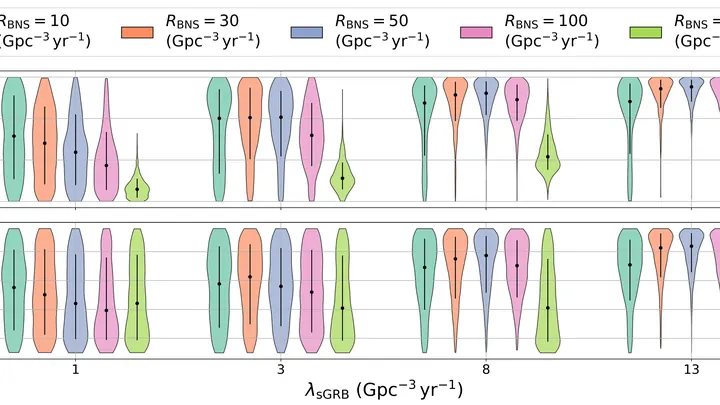
Two neutron stars collide, and the space around them ripples like the surface of a pond after a stone is thrown. Huge gravitational wave detectors catch these ripples. If the collision also launches a narrow beam of gamma rays, space telescopes see it as a short gamma-ray burst.
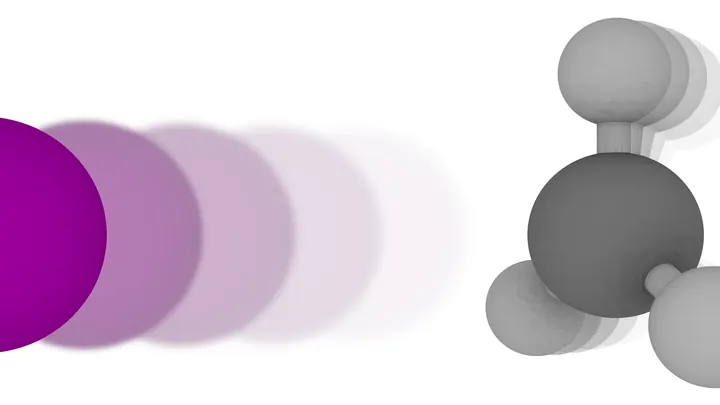
A chemical bond is like a stretched spring between atoms. When it's snapped, the molecular fragments fly apart, but they don't freeze: they keep vibrating, like a plucked string. That's exactly the vibration a team of researchers caught when they broke a methyl iodide molecule with an ultraviolet laser.
Two black holes circle each other, and their dance isn't always a smooth waltz. If the holes spin on their own axes, their orbit can start to tumble, like a top that's been pushed and wobbles on its side while still spinning.
Two black holes circle in a tight dance, and around them something remarkable is born: a gravitational molecule. A cloud of ultralight bosons, particles with masses below an electronvolt, envelops the pair like the electron cloud in an H2+ ion.
In April 2023, the LIGO, Virgo, and KAGRA detectors caught a gravitational wave from the merger of two black holes. With masses of 137 and 103 solar masses, GW231123 became the most massive event ever observed.