The Iron Planet Isn't So Iron After All express
A cosmic sprinter on a short track: that's how you might describe planet GJ 367 b. It whips around its star in just 7.7 hours. This world is slightly smaller than Earth but has a personality: it was once thought to be nearly a solid ball of iron.
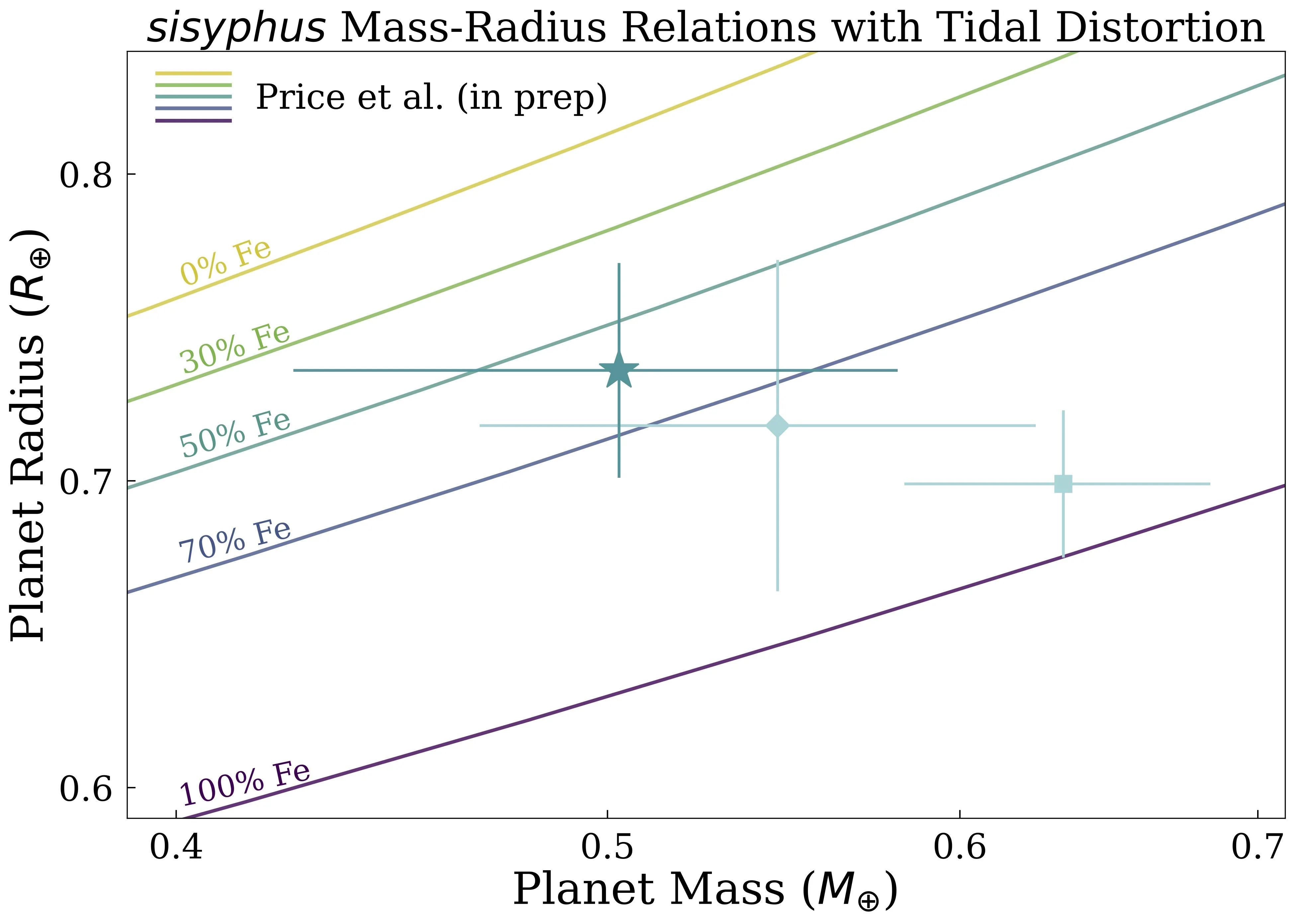
New observations from the TESS telescope and the ESPRESSO instrument on the Very Large Telescope (VLT) have refined the planet's portrait. It turns out its radius is 0.736 times that of Earth, and its mass is 0.503 times Earth's. That gives a density of 6.9 grams per cubic centimeter. For comparison, Earth's density is 5.5, and pure iron is about 7.9. The planet isn't an iron record-holder; it's more of an average Joe.
Scientists built a model of its internal structure, accounting for tidal distortions. They found that the planet's iron fraction is between 50 and 70%. That's close to Mercury, whose huge core makes up about 60% of its mass. The mystery of the "iron planet" is solved: it doesn't violate the laws of planet formation; it's just similar to a neighbor in our solar system.
Original abstract
as written by the authors arXiv:2606.18355
We report revised mass and radius measurements for GJ 367 b, an ultra-short-period (7.7 hr) sub-Earth in a multi-planet system orbiting a nearby (~9 pc) M dwarf host. Previous mass and radius measurements have suggested GJ 367 b has an anomalously high bulk density, close to that of solid iron. The existence of such an iron-rich planet is in tension with established planet formation scenarios. We utilized newly available TESS short-cadence photometry to constrain the radius of GJ 367 b to 0.736 +/- 0.035 R_Earth. We consider observational and modeling effects such as photometric dilution, stellar activity, and tidal distortion to account for possible inaccuracies in the star and planet radius measurements. From our radial velocity (RV) analysis using VLT/ESPRESSO data covering nearly the full orbit in a single night, we find a mass of 0.503 +/- 0.078 M_Earth, corresponding to a bulk density of 6.9 +1.6/-1.4 g cm-1. We present a new tidal distortion and interior composition modeling framework to assess the iron mass fraction of GJ 367 b. Considering several different interior composition assumptions and radial aspect ratios, we find an iron fraction of ~50-70%, which is broadly consistent with that of Mercury and not as iron rich as previously suggested.
A year on GJ 367 b lasts less than a workday: while you sleep, the planet manages a full orbit around its star.