Daniel Huber

5 articles · 30 co-authors · latest: 2026-09-14
18 citations · h-index 2 · 9 papersData: Semantic Scholar

We have retold 5 papers by this author. 1 of them with a full read. most often about: stellar evolution, pulsar, brown dwarf. 30 co-authors across our retellings.

Links in the knowledge graph
Stellar2026-04-012 minarXiv:2604.00498express
The Pulse of Red Giants: 19,000 Stars Speak Up
The night sky looks still, but many stars tremble like a drum after a strike. For seven straight years, the TESS satellite stared at the same patches of sky and caught this trembling in 19,151 red giants — old, bloated stars. Previously, far fewer of these 'singing' giants were known, and now the list has grown by 80%.
Stellar2026-04-022 minarXiv:2604.01847express
The Silent Music of Red Giants
A red giant is a star that has swelled up, cooled on the outside, and become hundreds of times larger than the Sun. Inside, it's far from calm: layers of gas oscillate like a giant bell, causing its brightness to flicker slightly. Astronomers pick up these oscillations to probe what's happening deep within.
Exoplanets2026-06-161 minarXiv:2606.18355express
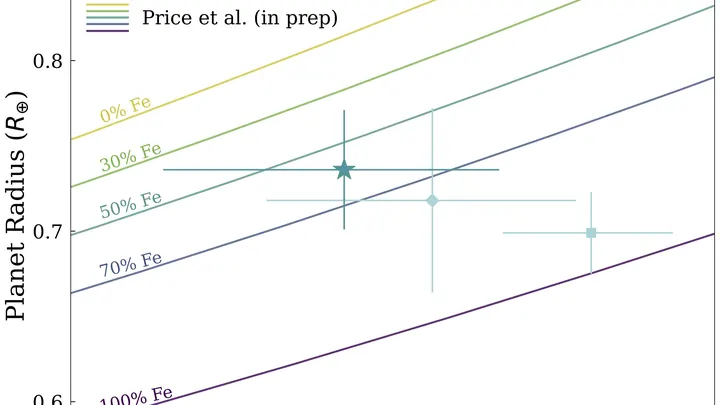
The Iron Planet Isn't So Iron After All
A cosmic sprinter on a short track: that's how you might describe planet GJ 367 b. It whips around its star in just 7.7 hours. This world is slightly smaller than Earth but has a personality: it was once thought to be nearly a solid ball of iron.
Exoplanets2026-06-222 minarXiv:2606.23899express
The Glow of an Escaping Atmosphere
A world where a year lasts just one and a half Earth days, and the star in its sky is hundreds of times larger than our Sun. This is KELT-9 b — a gas giant heated to temperatures at which iron vaporizes. Its atmosphere is not just hot; it is literally boiling away into space, like steam rising from a giant cauldron.
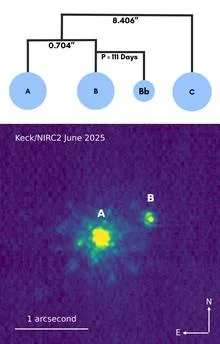
Rescued from a False Alarm: A Giant Planet in the Triple System KOI-1623
Every night the Kepler telescope stared at the same patch of sky, catching tiny dips in the light of distant stars. If a star blinked with clockwork precision, that could mean a planet was passing in front of it. But sometimes the blinking turned out to be a trick: light from two stars got mixed together, and astronomers filed the signal away in the false-alarm archive.