The Delay That Ignites the Rhythm express
A neuron sends a signal to its neighbor. The neighbor doesn't respond immediately — the impulse travels along the process at a finite speed, like a letter delayed in transit. Usually, such a delay is considered a nuisance, but in this new work, it becomes the conductor.
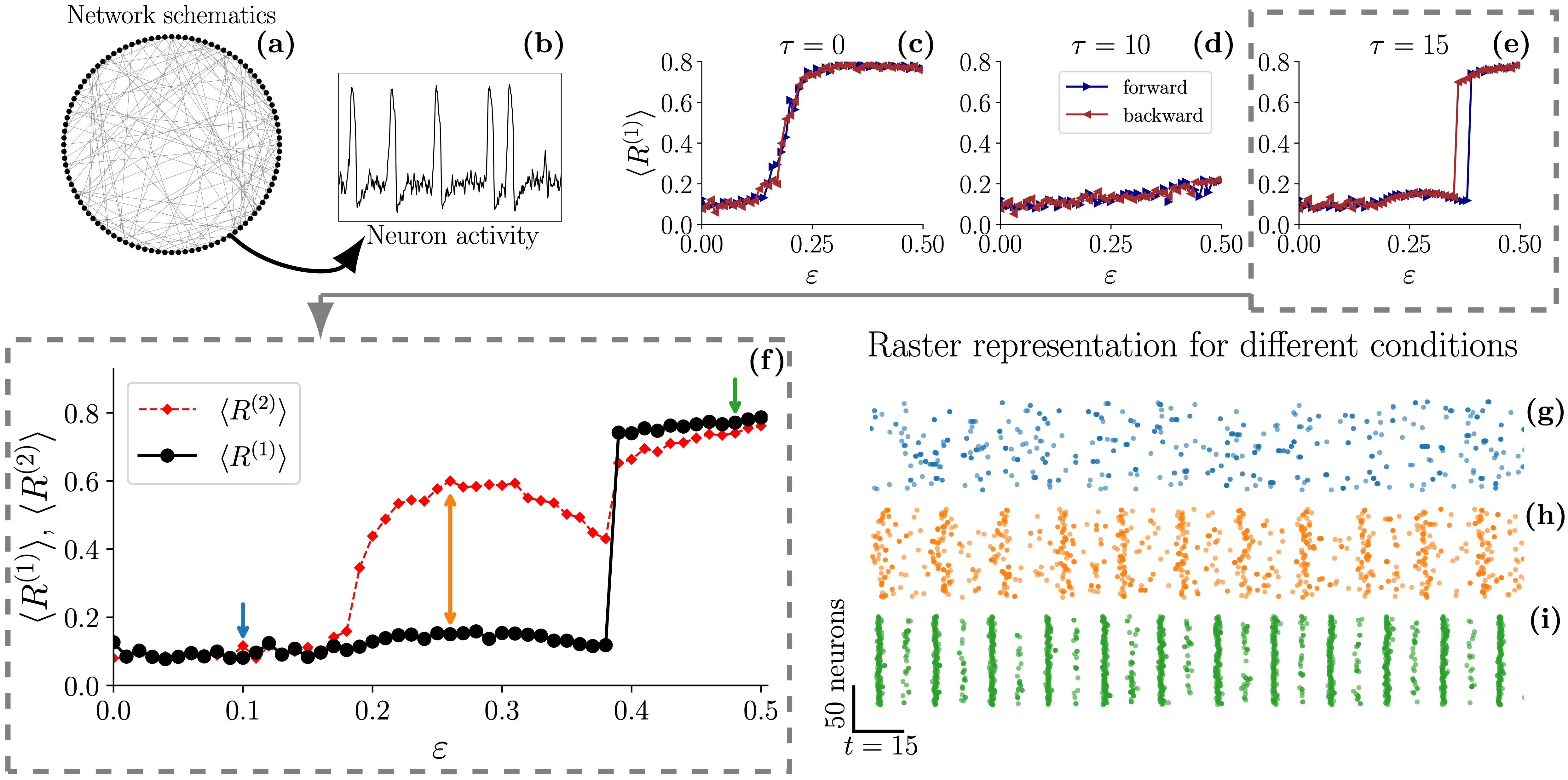
When two excitable neurons are connected with a delay, a rhythm spontaneously emerges between them. The cells begin to pulse together — either strictly in time or in anti-phase, like pendulums swinging in opposite directions. The most striking part: the transition from silence to a synchronized chorus doesn't happen gradually but in a jump. Slightly strengthen the connection or shift the delay, and the network bursts into coordinated activity.
The authors tested the mechanism across different models of neural network oscillations — with and without noise, with and without excitation. Everywhere, the picture is the same: delay and excitability give rise to oscillations, which then lead to abrupt synchronization. It's like an orchestra where musicians don't hear each other instantly, but it's precisely the echo in the hall that makes them play in harmony.
Original abstract
as written by the authors arXiv:2606.21703
Neuronal communication is inherently time-delayed, due to the finite speed of signal propagation. Although often considered challenging or disruptive, such time delays can also endow neural circuits with useful capabilities. Here, we show that delays in excitatory connections between excitable neurons coordinate their synchronization patterns by creating self-sustained oscillations that may be out-of-phase or in-phase. The emergence of these oscillations leads to an abrupt, explosive, transition to in-phase synchronized regimes due to small changes in connection strength or time-delay. We describe the mechanism underlying these phenomena as an interaction between the neuron's excitable dynamics and the delay in signal transmission, explaining many aspects of how the oscillations emerge. We show this phenomenon in different network connectivities, neuronal models, with and without excitation, with and without noise, highlighting the generality of the mechanism.
In the brain, a signal travels along an axon at speeds from 0.5 to 120 meters per second, like a leisurely stroll or a race car. Differences in delays between different pathways can reach tens of milliseconds, and it's precisely these differences that help tune rhythms.
In Peter Watts's novel 'Blindsight,' an alien intelligence uses a distributed nervous system without a center, where signal delays are the basis of thought.