Ion channel dynamics is the study of how membrane-spanning proteins open and close to control the flow of ions into and out of cells. These channels are the electrical switches of biology: they generate the action potentials that let neurons communicate, set the resting potential of every cell, and regulate muscle contraction, hormone secretion, and sensory perception. The dynamics involve not just the simple open/closed states, but also voltage sensitivity, ligand binding, inactivation, and the collective behavior of many channels in a membrane patch.
History
The existence of ion channels was established by Alan Hodgkin and Andrew Huxley in the 1950s through their voltage-clamp experiments on squid giant axons, for which they received the 1963 Nobel Prize in Physiology or Medicine. The first single-channel recordings were made by Erwin Neher and Bert Sakmann in the 1970s using the patch-clamp technique, earning them the 1991 Nobel Prize.
How it works
Ion channels are proteins with a central pore that can be open or closed. The transition between states is governed by conformational changes triggered by stimuli like voltage changes across the membrane, binding of signaling molecules, or mechanical stretch. Once open, ions flow passively down their electrochemical gradient, with selectivity filters in the pore allowing only specific ion species to pass. The kinetics of these transitions — how fast channels open, how long they stay open, and how they inactivate — determine the overall electrical behavior of the cell.
In practice
Ion channel dynamics are central to drug development for cardiac arrhythmias, epilepsy, and chronic pain, as well as to the design of biosensors and artificial membranes for water purification and energy conversion.
Fun fact
A single ion channel can conduct up to 100 million ions per second, making it one of the fastest molecular machines in biology.
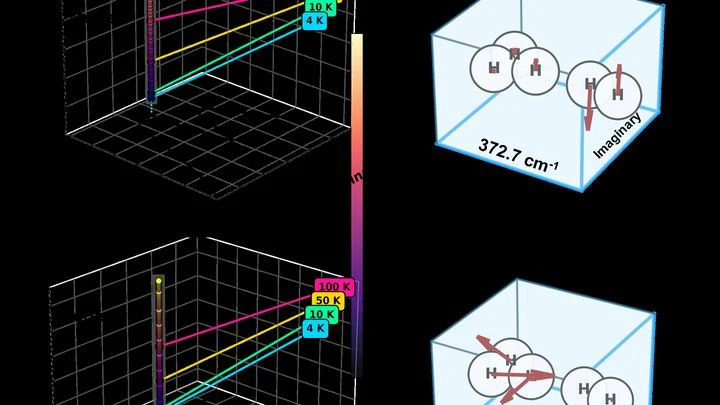
In a molecule, hydrogen sometimes resembles not a ball but a wave that can leak through an energy barrier, like a ghost through a wall. Chemists call this tunneling, and it underlies many processes, from enzyme function to charge transfer in materials. But how exactly does a molecule find its path for such a transition?
In an aquarium the size of a dining table, two schools of black neon tetras swim in adjacent compartments separated by a transparent wall. They cannot touch each other, but they see every movement. And here's the surprising part: when one school decides to turn left, the other does the same a moment later. It's like two pendulums hanging behind glass, starting to swing in rhythm.
Imagine a large orchestra without a conductor. Each musician hears everyone else and adjusts to the collective hum. If every instrument amplifies its neighbors, the sound builds to a screech; if some occasionally dampen it, the orchestra may fall into silence or break into cacophony.
Picture a long thread trapped inside a sphere with charged walls. The thread is the virus's RNA; the sphere is its protein shell. The thread tries to settle so that its charges sit as close as possible to opposite charges on the wall.
A superconducting detector usually works like an honest ruler: absorb a photon, get a pulse whose amplitude is strictly proportional to the energy. This mode is convenient, but it has a ceiling: a weak signal easily gets lost in the amplifier noise.
Now imagine a swing.
Epithelium lines our organs like tiles on a floor. At rest, cells cling to each other, and the tissue is elastic. But during embryonic development, wound healing, or tumor growth, this layer begins to flow like thick honey. What exactly triggers such softening?
A protein is like a tiny machine that switches on and off on command. The command arrives when another molecule sticks to it, like a key in a lock. The protein then changes shape and passes the signal along. But exactly how the signal travels inside the protein has long been a mystery.
Toss a handful of sand onto a table — the grains scatter equally in all directions. But if a magnet is hidden under the table and the sand is iron, the trajectories get trickier: an invisible structure overlays the chaos. That's roughly how molecular motion works inside a living cell.
Inside every cell, things are constantly meeting and parting. Some pairs hold tight, like Velcro, while others barely touch, like pollen on the wind. These fleeting touches, where the binding strength is comparable to a grain of salt dissolving in a glass of water, govern many of the cell's signals and decisions.
A neuron transmitting a signal is like a tiny battery that quickly discharges and recharges. For nearly 70 years, it was believed that a special "potassium valve," opening with a delay, was responsible for the recharge phase. New work claims this current is a ghost.
Ion current through a membrane is like a queue at a turnstile. Sometimes the turnstile is free — ions pass through quickly. Sometimes it gets stuck — the flow drops. A weak magnetic field, it turns out, doesn't push ions from behind; it simply changes the number of open turnstiles.
A person in a boat turns by shifting their body weight. An unmanned vessel uses the same trick: a sliding weight inside the hull does the steering. Its movement is controlled by a neural network, anticipating the chaos of waves and gusts of wind. The propeller pushes the boat forward, while the weight shifts balance — like moving from one foot to the other.
In the vast clouds of rarefied gas that fill the space between stars, something is always churning. Supernova explosions, colliding streams — all of it shakes the plasma. And in this rippling, as it turns out, hides the mechanism that gives birth to magnetic fields.
Plasma is a gas in which electrons are stripped from atoms.
An ionic conductor resembles a crowded bus where passengers (ions) try to squeeze toward the exit. Previously, it was thought that fast exit could be achieved either by a gently swaying bus (soft lattice) or by passengers standing in chaotic order (geometric disorder). The new work shows these are not two different tricks but the same one.
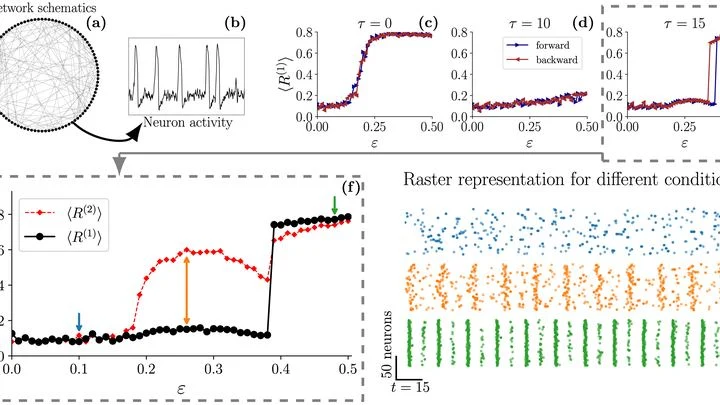
A neuron sends a signal to its neighbor. The neighbor doesn't respond immediately — the impulse travels along the process at a finite speed, like a letter delayed in transit. Usually, such a delay is considered a nuisance, but in this new work, it becomes the conductor.
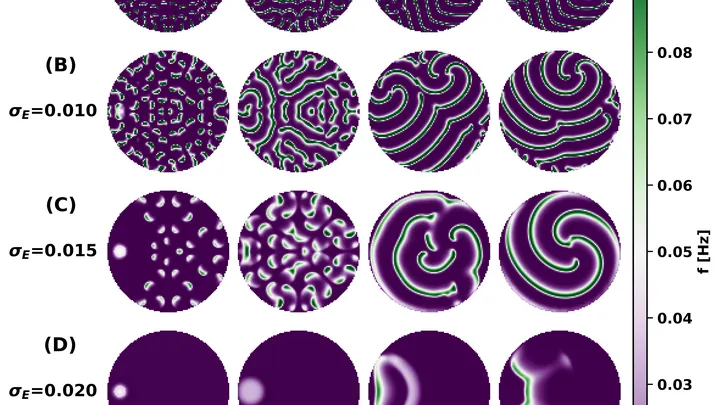
When two excitable neurons are connected with a delay, a rhythm spontaneously emerges between them.
Inside every cell, construction never stops: molecules constantly cluster together and drift apart. Sometimes they form dense droplets, like oil in water, but without a membrane. These droplets act as temporary storage: they hold proteins, gene copies, or DNA repair tools.
A neuron resembles an electrical circuit with batteries and variable resistors. The resistors are played by ion channels — protein pores in the membrane that open and close, letting charged particles through. Whether a nerve impulse fires depends on how fast and at what voltage these pores operate.
Inside every cell, a complex network of genes determines what it will become — a nerve cell, a muscle cell, or part of the skin. This choice often resembles flipping a toggle switch: two stable positions, and the cell decides which way to tip. But cells have a feature rarely considered in such models: they divide.
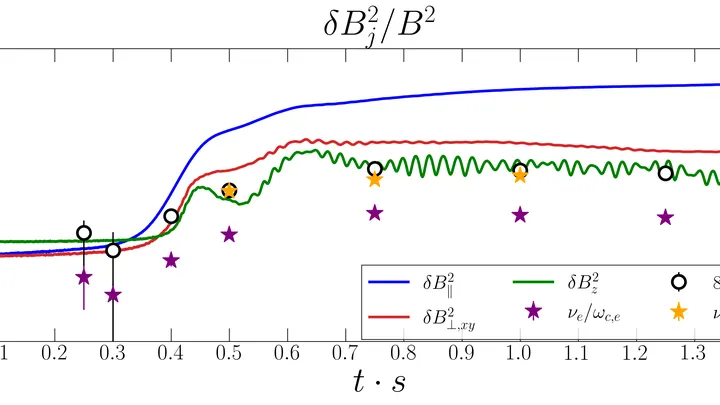
A crowd is trapped in a narrow corridor between two rows of mirrors. Every now and then, someone shoves the wall hard, and a rumble rolls down the corridor — similarly, in the plasma of galaxy clusters, whistler waves and ion-cyclotron waves appear.
Millions of cilia, thin hairs, work inside the tiny ducts of our bodies. They beat in synchrony, like the oars of a galley, pushing viscous mucus or fluid along. The authors of a new study propose viewing the ciliary carpet as an active porous medium — something like a sponge that squeezes and releases itself, driving water through.
A lump of plasticine, when kneaded, behaves like an amorphous solid — not a crystal, but not a liquid either. Inside such a material, avalanches can occur: one tiny rearrangement triggers neighboring ones, and a wave sweeps through the entire sample.
The microbial community in the gut is like an orchestra: what matters is not only the musicians but how they play together. When disease strikes, it's not just the lineup of microbes that changes: their interconnections shift too. Researchers built interaction networks of microbial genes in healthy and sick individuals.
A chemical reaction resembles passing through a turnstile: a crowd creates chaos and gets stuck, while an orderly line moves. In the quantum world, however, when the jostling subsides, the barrier can become ghostly — a particle passes through it as if the turnstile has vanished.
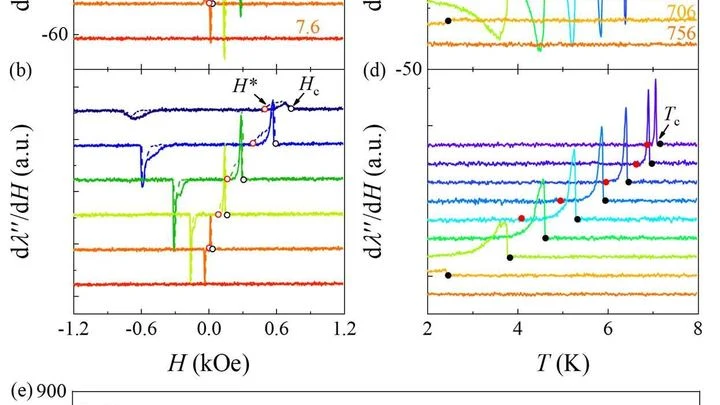
Ordinary magnetic measurements only see the surface of a superconductor, where barriers and viscous flows of magnetic field get in the way. Inside, in the so-called intermediate state, superconducting and normal domains coexist, separated by thin walls. These walls can oscillate, but hearing them directly has been difficult.
A neuron that has just calmed down is like a pianist lifting their hands from the keys. But inside, silent work continues: tiny pumps push chloride ions outward, returning the instrument to a state of readiness. If the pumps fall behind, chloride builds up, and then an inhibitory signal meant to quiet the cell suddenly starts exciting it.
Inside a cell, there are tiny liquid droplets, like oil droplets in water. They form from proteins and RNA and serve all sorts of purposes, from storing molecules to speeding up reactions. But if droplets start merging with each other, you'd end up with one big puddle, which would wreck the cell's organization.
The cell membrane isn't just a wall; it's a turnstile gate. Embedded within it are protein channels that let ions in and out, creating an electric charge, like a battery that powers nerves and muscles.
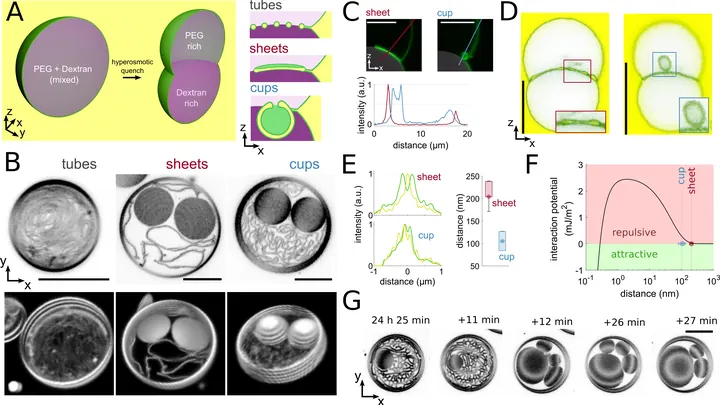
Inside a living cell, droplets float that don't mix with the surrounding fluid, like oil in water. These droplets aren't just passive clumps; they actively press on membranes and make them bend. Scientists observed this process in living plant cells, reproduced it in a test tube, and simulated it on a computer.
A membrane for water electrolysis is like a sponge soaked with water. Inside it, hydroxide ions, particles that carry electric charge, must move freely. But exactly how they move has long been a mystery: tracking each ion in an experiment is too difficult.
An ion channel in a cell membrane is a gate just a few atoms wide. Every second, millions of charged particles, sodium and potassium ions, pass through it. Classical physics said that to get through, an ion must jump over an energy barrier, like a traveler crossing a high mountain pass.
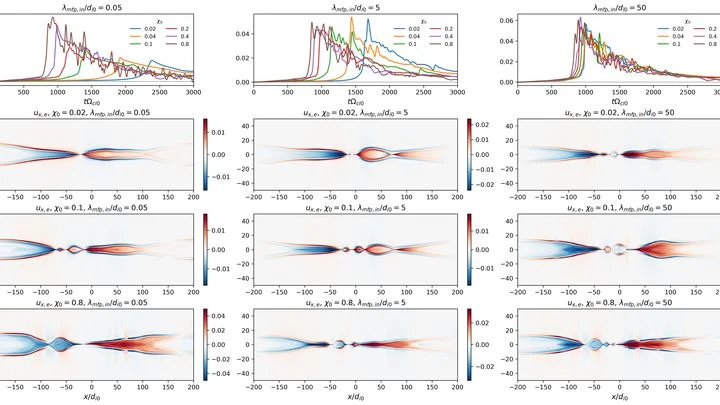
In plasma where some atoms remain neutral, magnetic field lines can rearrange at different speeds. This is like two rubber bands that are initially stuck together, then suddenly snap apart and contract, releasing energy.
Inside every cell, there is a scaffold of filaments, like construction scaffolding that gives the cell its shape and allows it to move. These filaments are connected by crosslinking proteins: some simply hold them together like ropes, while others act as tiny motors that crawl along the filaments and pull them toward each other.
Over the course of a day, the brain accumulates impressions the way a room accumulates stuff. At night, during deep sleep, it doesn't just rest: it tidies up: it sorts through the day's events and decides what to keep and what to toss. Scientists built a computer model of the brain that learns from a few examples during the day and 'replays' them at night, as if dreaming.
The scorching gas streaming from the Sun is not a continuous flow but rather a soup of charged particles. In this soup, waves constantly boil up: electric fields flare and fade like ripples on water from a tossed stone. One such wave is the ion-ion acoustic wave.