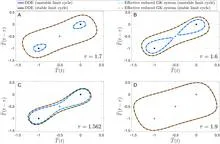
The theory is not a single equation but a family of models, each emphasizing different delayed processes. Common ingredients include a positive feedback that amplifies an initial warm anomaly (e.g., weaker trade winds reduce upwelling of cold water, further warming the surface) and a negative feedback that only acts after a delay (e.g., the slow propagation of oceanic Kelvin waves that eventually cool the eastern Pacific). The delay arises because these waves travel at finite speed across the basin, taking weeks to months to cross.
History
The concept was developed in the late 1980s, with key contributions from Mark Cane, Stephen Zebiak, and others who formulated mathematical models showing how delayed negative feedback could produce ENSO-like cycles. It built on earlier ideas about ocean–atmosphere coupling from the 1960s and 1970s.
How it works
Imagine pushing a swing: the push (positive feedback) makes it go higher, but gravity (negative feedback) always pulls it back, and the swing's natural period determines when it returns. In the ocean, the 'push' is the Bjerknes feedback—warm water in the east weakens the east-west temperature gradient, which weakens the trade winds, which reduces upwelling of cold water, warming the east further. The 'gravity' is the delayed arrival of cold subsurface water, carried by waves that were generated by the wind changes. Because those waves travel slowly, the cooling arrives months after the peak warmth, creating the oscillation.
In practice
The theory underpins many operational ENSO prediction models, such as the Cane–Zebiak model, which was among the first to forecast El Niño events months in advance using observed ocean temperatures and winds.
Fun fact
The delayed oscillator theory was inspired by similar mathematical models used to describe predator–prey cycles in ecology, where a delay between a predator's growth and its effect on prey populations creates oscillations.
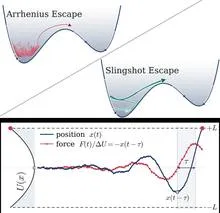
A particle sits in an energy pit like a pea in a dimple. To get out, it needs to go over the barrier, and usually this is rare: the higher the barrier, the longer the wait. The Arrhenius law says the waiting time grows exponentially, meaning doubling the barrier height increases the time by hundreds of times.
Every year, as December approaches, the water off the coast of Peru becomes anomalously warm or anomalously cold. This is El Niño and La Niña, two phases of the same climate pendulum that swings in the equatorial Pacific. The pendulum is not a simple one: it remembers what happened to it several months earlier, and this memory determines which way it will swing next.
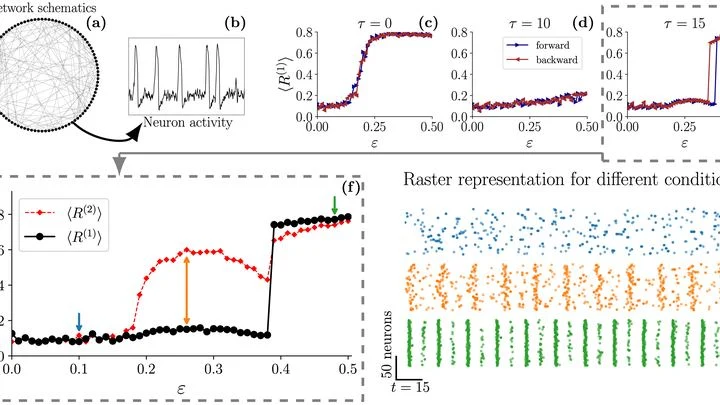
A neuron sends a signal to its neighbor. The neighbor doesn't respond immediately — the impulse travels along the process at a finite speed, like a letter delayed in transit. Usually, such a delay is considered a nuisance, but in this new work, it becomes the conductor.
When two excitable neurons are connected with a delay, a rhythm spontaneously emerges between them.
In 2017, the IceCube detector caught a neutrino from the distant galaxy TXS 0506+056. It was like hearing a phone ring from across the ocean: the signal came from where the most energetic particles in the Universe are born. At the same time as the neutrino, astronomers spotted a gamma-ray flare, and two to three years later, radio waves. Why was the radio late?
Over the warm waters of the Indian Ocean, every six to eight weeks, a vast wave of moist air gathers. It moves eastward at a pedestrian pace—about five meters per second—and takes forty to ninety days to circle half the planet.
A tiny particle floats in a laser beam like a speck of dust in a flashlight's glow. Water molecules constantly jostle it — randomly, from all sides. Usually these bumps are a nuisance: the particle twitches, and precise measurements turn into a lottery. But physicists have figured out how to turn the interference into an advantage.
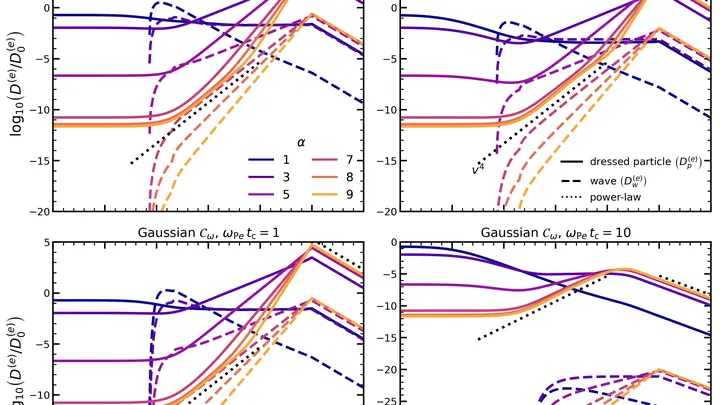
In a hot gas of charged particles — plasma — chaotic electric fields work like a sieve. A slow particle gets surrounded by a cloud of opposite charges, which cancels the external field. A fast one sheds this armor and gets accelerated.
Imagine an interpreter in a negotiation room who hears the tropics whisper and repeats it too loudly. That is how the neural-network climate model DLESyM behaves when forced with real Pacific sea surface temperatures. The ocean whispers "El Niño," and the atmosphere shouts back as if being shaken by the shoulders.
Imagine a pendulum that is pushed in time with the seasons: harder in winter, softer in summer. But this pendulum has a quirk: a switch that operates with a delay. When the pendulum passes through zero, the switch clicks and changes the direction of the push. That is exactly how the simplified El Niño model built by mathematicians works.
Picture a pendulum hanging in a room with drafts. Sometimes a gust pushes it harder, sometimes softer. If the pendulum barely loses energy, it will swing long and steady. But if friction is strong, each push quickly fades, and the motion becomes jerky: a sharp swing, then a long sway. That's exactly how the tropical Pacific behaves when the heat of El Niño gives way to the cold of La Niña.
A warm patch off the coast of Peru does not appear every year, but when it does, deserts are drenched with rain and Australia is plagued by wildfires. This is El Niño, a phenomenon that climate models struggle to reproduce. Simple models do well at estimating how often it occurs but lose spatial details.
The Pacific Ocean remembers. Water warmed off the coast of Peru drifts slowly westward, and six months later its heat returns to South America. Scientists call this six-month journey the delay. It turns a simple climate model into a maze where the route depends not only on your current position but also on where you were half a year ago.
A translator in a large hall hears both a whisper right next to their ear and a conversation at the far end. The same mind picks up local nuances while keeping track of the overall discussion. That is how ResoNet works: a neural network that predicts El Niño.
El Niño is a warm current in the equatorial Pacific that, every few years, alters weather across all continents.
The ocean off Peru is not just warm: it pulses. Every few years, the winds die down, warm water creeps eastward, and fishermen are left empty-handed. This is El Niño, and its arrivals do not follow a simple schedule. Some researchers blamed random weather gusts, others sought chaos in the climate system itself.
The ocean remembers its past. Heat given to the water off the coast of Norway does not vanish without a trace: it embarks on a long journey across the Atlantic, only to return decades later and alter the temperature at those same shores once again.
A wave travels westward, reflects off the coast, and returns six months later to alter temperatures along the eastern Pacific. This journey of Rossby and Kelvin waves Mori-Zwanzig formalism turns into an equation with memory. Previously, climatologists added delays to El Niño models by intuition, relying on physical insight.
The conductor of an orchestra gradually loses control of the tempo. First, the second violins fall slightly behind, then the cellos speed up, and soon every musician is playing in their own rhythm, even though a minute ago they all followed the same melody.
Two pendulums hang side by side, connected by a spring. Give one a push, and through the spring the other starts to swing. That's how the two regions of the equatorial Pacific are arranged, where sea-surface temperature rises and falls in the rhythm of El Niño.
The Pacific Ocean does not breathe evenly but in bursts. Every few years, its warm waters stir, and then Australia suffocates from drought while Peru is flooded with rain. This phenomenon is called El Niño, and it resembles a traveler wandering along an invisible road map.