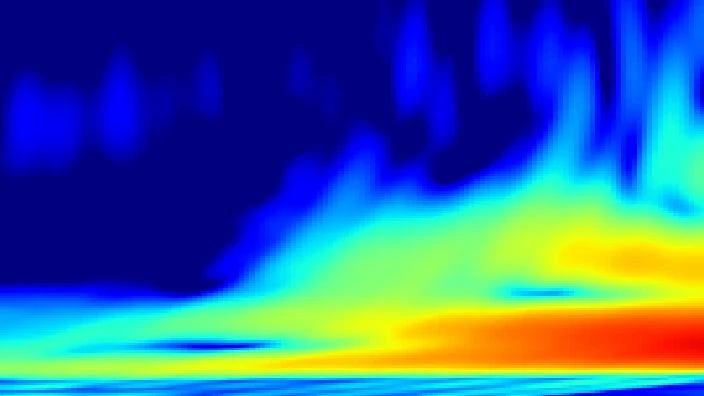
Signal delay in astrophysics refers to the time lag a radio signal experiences as it travels through ionized gas, such as the interstellar or intergalactic medium. This delay occurs because free electrons in the plasma interact with the radio waves, slowing their propagation compared to a vacuum. The effect is frequency-dependent: lower-frequency signals are delayed more than higher-frequency ones, a property that astronomers exploit to study the gas itself and the sources behind it.
History
The effect was first recognized in the context of pulsar observations in the late 1960s, when astronomers noticed that pulses arrived later at lower frequencies. The dispersion measure became a standard tool shortly thereafter.
How it works
When a radio wave passes through ionized gas, the electrons are set into oscillation by the wave's electric field. This interaction effectively reduces the wave's group velocity. The delay is proportional to the column density of free electrons along the line of sight and inversely proportional to the square of the frequency. By measuring the arrival times of pulses at multiple frequencies, astronomers can calculate the total electron content and infer properties of the intervening medium.
In practice
Signal delay is used to map the electron distribution in the Milky Way and to locate fast radio bursts and pulsars by their dispersion measures.
Fun fact
The delay can be so large that a single burst of radio waves from a distant source arrives spread out over several seconds, with lower frequencies trailing behind like a rainbow stretched in time.
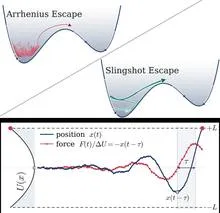
A particle sits in an energy pit like a pea in a dimple. To get out, it needs to go over the barrier, and usually this is rare: the higher the barrier, the longer the wait. The Arrhenius law says the waiting time grows exponentially, meaning doubling the barrier height increases the time by hundreds of times.
Somewhere in the depths of the Milky Way, radio pulses flare up from time to time — rare, steady, like the ticks of a distant metronome. These long-period radio transients were discovered only recently, and they immediately puzzled astronomers.
Gravitational waves from merging black holes sound like bass chords, pulsars tap out a rhythm, and the cosmic microwave background carries echoes of the Big Bang. But there is a silent player — dark matter, whose presence is betrayed only by gravitational effects.
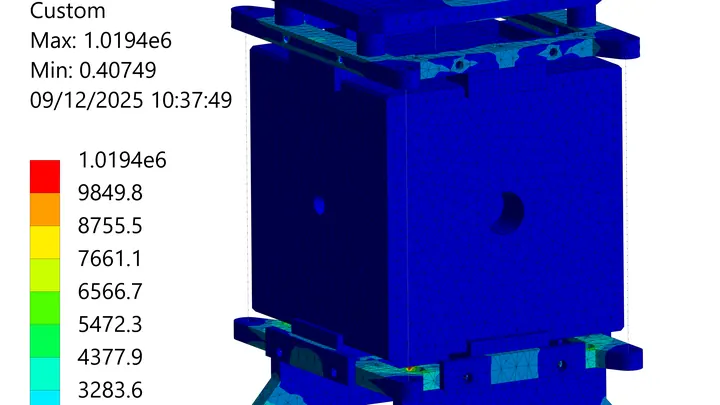
In absolute silence, you need to hear a feather drop. But someone keeps rustling a plastic bag. For the space-based LISA observatory, that 'rustling' will come from charged particles in space.
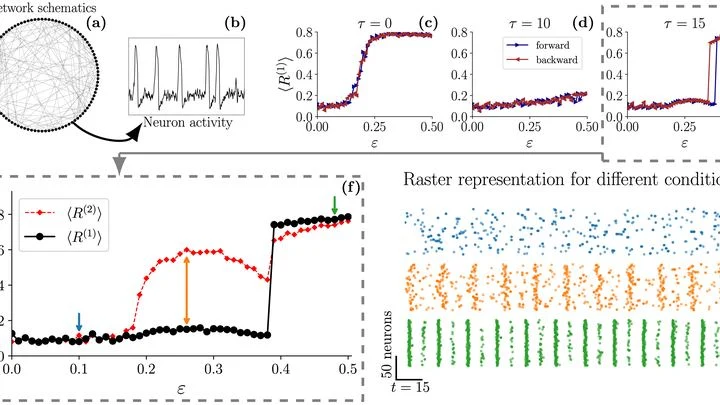
A neuron sends a signal to its neighbor. The neighbor doesn't respond immediately — the impulse travels along the process at a finite speed, like a letter delayed in transit. Usually, such a delay is considered a nuisance, but in this new work, it becomes the conductor.
When two excitable neurons are connected with a delay, a rhythm spontaneously emerges between them.
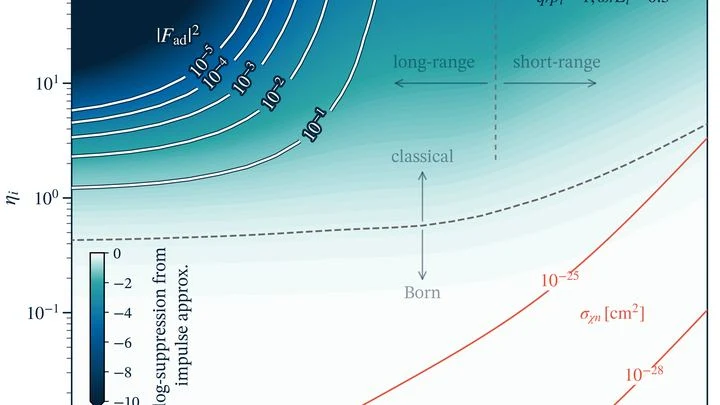
A billiard ball slams into another. Impact, and the balls scatter. But if the push is not sharp but very gentle, the balls just roll together without bouncing. An atom behaves much the same way when hit by a dark matter particle.
The Universe is pervaded by an invisible substance — ultralight dark matter, which doesn't collide with ordinary matter but can tremble like a taut string. Its oscillations alter the world's most fundamental properties: the electron charge, the speed of light — as if the tuning of a single cosmic note slightly drifts.
A black hole rips apart a star, and we see a dazzling flare. Then, a couple of years later, when everyone has forgotten about it, radio telescopes suddenly pick up a new signal, like an echo from the past.
Gravitational wave detectors are microphones listening to the trembling of space. But their own noise drowns out weak signals. To hear more, physicists add special "squeezed" light to the instrument: it reduces quantum noise, like noise cancellation in headphones.
In 2017, the IceCube detector caught a neutrino from the distant galaxy TXS 0506+056. It was like hearing a phone ring from across the ocean: the signal came from where the most energetic particles in the Universe are born. At the same time as the neutrino, astronomers spotted a gamma-ray flare, and two to three years later, radio waves. Why was the radio late?
If a supermassive black hole lives at the center of a galaxy, it heats the infalling gas to incredible temperatures. That gas glows, and we see it as a quasar — the brightest beacon in the universe. But how do you measure the size of the light source itself?
A radio telescope picks up a signal from the Crab Nebula, and instead of a smooth line, the screen shows bright and dark bands, like on a zebra's hide. This is the emission from the pulsar, a rapidly spinning neutron star left over from a supernova explosion.
A crowd of people in a subway station moves slower than individuals: everyone gets in everyone else's way. A similar picture emerges in a dense cloud of magnetic atoms exchanging energy. Previously, it was thought that the transfer rate depended only on the atoms' own properties.
The night sky glows not only with stars. Between them lies a faint microwave radiance that astronomers have noticed for three decades but couldn't explain. One idea: the culprits are polycyclic aromatic hydrocarbons — molecules like tiny soot flakes that spin in space and, like miniature antennas, emit radio waves.
In the stream of charged particles that constantly blows from the Sun, radio bursts sometimes occur — short, powerful signals at frequencies you can pick up on an ordinary radio. Until now, it was unclear how exactly these signals are born in that stream.
A quasar is a supermassive black hole at the center of a galaxy that devours matter and shines brighter than all the stars around it. Some of that energy goes into radio emission, which, it was thought, could heat or expel cold gas — the raw material for new stars.
The scorching gas streaming from the Sun is not a continuous flow but rather a soup of charged particles. In this soup, waves constantly boil up: electric fields flare and fade like ripples on water from a tossed stone. One such wave is the ion-ion acoustic wave.