A Quiet Error in Planet Hunting express
In a quiet observatory, a spectrograph catches the light of a distant star. The instrument spreads it into a rainbow — the spectrum. Lines in the spectrum shift slightly back and forth: an invisible planet is tugging the star. To spot this shift, astronomers compare the spectrum with a reference — a "portrait" of the star assembled from many observations.
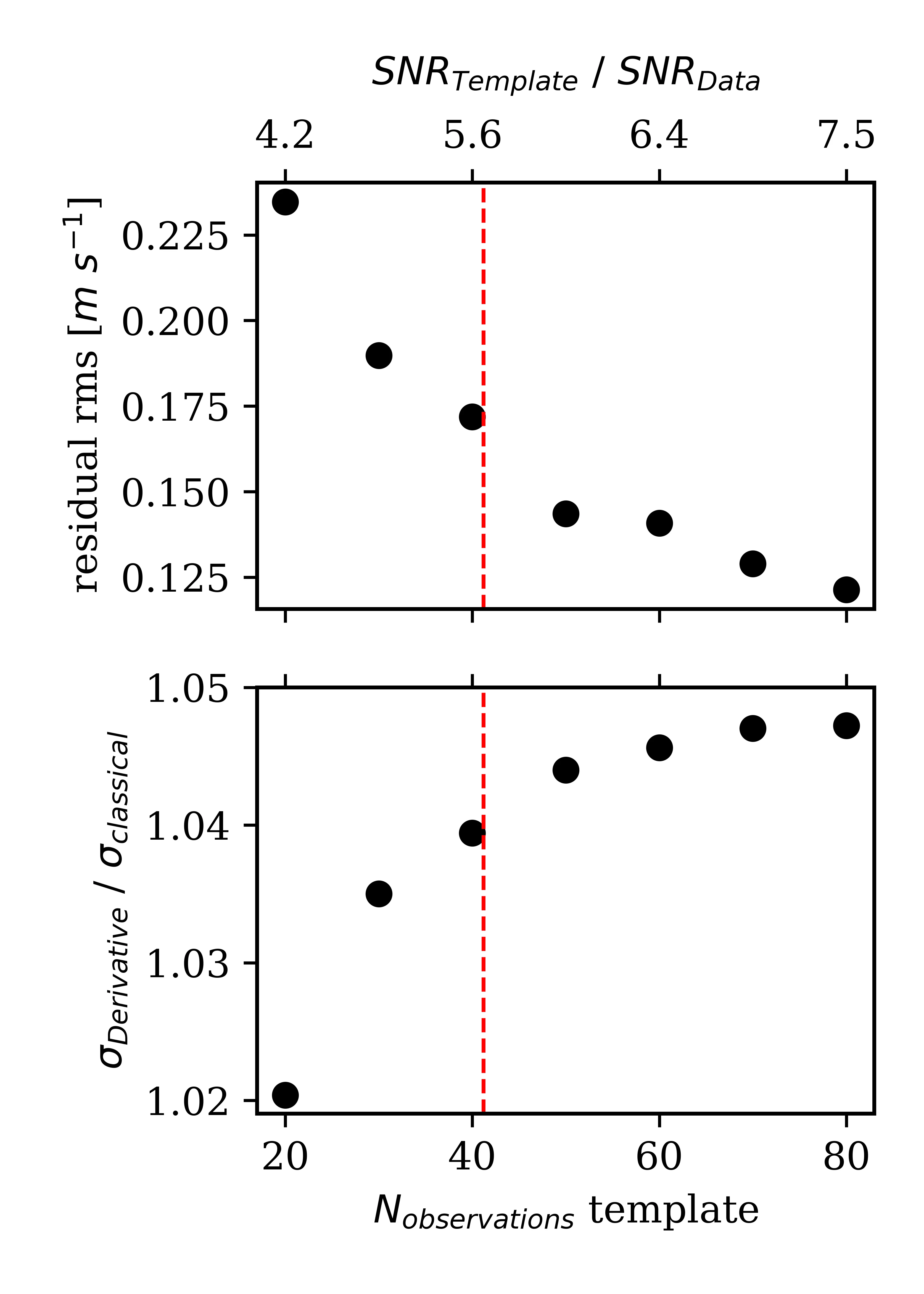
One comparison method is the derivative method. It looks at how quickly the brightness changes along the spectrum and uses that slope to compute the shift. But if the reference portrait is built from faint frames (with a low signal-to-noise ratio), the slope becomes inaccurate. A translator is distracted by every rustle in the hall, and a one-hour meeting stretches into two. The authors tested this on artificial lines and real data.
When the signal becomes brighter (signal-to-noise above 1000), the error drops below the sensitivity threshold of the best modern spectrographs. And if you average many lines, the uncertainty shrinks at any quality. On real observations, the difference between methods was only 12.5 centimeters per second for a template made from 78 frames — less than the growth rate of bamboo.
This work is a reminder: in the hunt for Earth-sized planets, even a microscopic glitch in calculations can mislead. A quiet error in the method, almost imperceptible, can mask a real signal. And then the spectrograph in the quiet observatory will keep catching light, unaware of the hidden planet.
The radial velocity method first helped find an exoplanet around the star 51 Pegasi in 1995. Since then, precision has improved so much that we can detect a star's wobble of centimeters per second — slower than a snail's pace.